For the last 250 years, eighth-generation farmer Quint Pottinger’s family, no-tilling since 1968, has continuously found new ways to keep their farm economically sustainable in New Haven, Ky.
The latest chapter has Pottinger forging his own path on the bleeding edge of conservation ag, starting with a complete equipment overhaul.
“We had cut costs everywhere we could and still raised a good crop, but the fixed equipment costs were just eating us alive,” Pottinger recalls. “So, I did something incredibly stupid. I pushed all my chips in and said, ‘We’re going to sell both of our 40-foot planters.’”
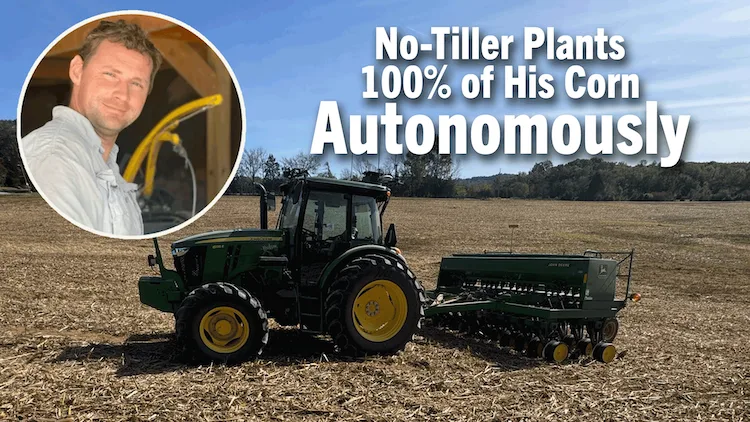
Looking to slash equipment costs, Pottinger sold his two big-frame 8000-series John Deere tractors and two 40-foot 16-row planters and replaced them with a small 135-horsepower John Deere tractor and a 20-foot 8-row planter.
But the big kicker? He was going to start planting all his crops autonomously.
“Everybody seems to be saying autonomous planting is 5-10 years way,” Pottinger says. “We looked at it and said, ‘All the pieces are there. Let’s put it together and do it now to save some money.’”
Pieces of Autonomy
Pottinger bought a Sabanto autonomy kit, which retrofits to the 135-horsepower tractor. It includes antennas, a dual GNSS receiver, obstacle-detection sensors and video cameras.
“It has an operating system that you can literally run from your phone,” Pottinger says. “With the cameras, I can view everything and see the surroundings to make sure it’s safe. I can press play on a mission that I’ve laid out the passes for, and it will run on its own without me there.”
Starlink and Precision Planting’s Panorama are the other key pieces to the autonomous puzzle for Pottinger.
With Panorama, he can monitor what’s happening on the planter remotely and make key adjustments.
“It allows us to see if our planting depth is good and whether we’re getting good seed-to-soil contact,” Pottinger says, “and if we’re getting good seed singulation for corn specifically, which is important from a population standpoint.”
Precision Planting’s 20|20 monitor needs uninterrupted internet connectivity for remote access, Pottinger says, and that’s where Starlink comes in. It provides Wi-Fi connectivity and serves as a backup for the Sabanto system, which relies heavily on cellular connectivity to maintain accuracy within 1 centimeter on each pass.
Fall Autonomy
Equipped with Sabanto, Panorama and Starlink, Pottinger became the first farmer in the Bluegrass State to plant his entire crop with a driverless tractor, joining fewer than 50 farms nationwide, according to the Kentucky Department of Agriculture.
“We’re the first farm globally to do it at the farm level without being a research or company project,” Pottinger says. “We received no assistance and paid full retail price for our new equipment without having to go in debt.”
Pottinger spent about $200,000 total on the small tractor, no-till planter and autonomy kit, significantly less than his old equipment setup, which came with an estimated price tag of $750,000.
Last fall, Pottinger autonomously seeded his winter crops — wheat, rye and barley — for the first time.
“I think a lot of people saw us do it in the fall and said, ‘Great, it works in grains but doing it in a row crop is different.’”
Spring Autonomy
Pottinger proved skeptics wrong this spring, autonomously planting corn across 850 acres, many of which were no-tilled green into thick cereal rye.
“We had trouble getting seed depth at 3.5 mph, changed the gear and stuck it at 2.8,” Pottinger says. “It took an hour and a half longer to do the field, but it didn’t matter because it planted all night and got the job done. We had great seed depth and now we have a great no-till corn stand.”
At first, he felt the need to check in on the planter every 5 minutes, just to make sure everything was running OK. “But the more you trust it and trust the text alerts it gives you, the more you’re able to just let it do its thing,” Pottinger says.
“Sabanto recommends checking on the tractor every 4 hours and just line it up with a fuel refill, seed refill or a maintenance checkup.”
Smaller & Slower
While many manufacturers and farmers seem to be going bigger and faster with equipment, Pottinger is going in the opposite direction with autonomy — smaller and slower. And so far, it’s working, he says.
“Spend the money so you can plant faster, till faster and get the crop in quickly — that’s the message coming from equipment manufacturers,” Pottinger says. “Their point is, don’t have two 40-foot planters, have one 40-foot planter that you can run 10 mph. We took a different approach. Instead of planting at 5 mph, we’re planting at 3.5 mph and that sucker is running up to 20 hours a day. We’re getting good seed placement and better crop stands than we could’ve hoped for, especially in no-till.”
By not having to operate the planter anymore, Pottinger has more hours on the clock to focus on other tasks. The autonomous planter also got the job done significantly quicker than his old 16-row planters that only covered about 70 acres per day. The autonomous planter averaged about 100 acres per day.
Bigger Picture
Pottinger says if autonomy can work on his irregular fields, shaped by creeks, rivers and hillsides, it can work anywhere.
“And with the ag economy the way it is, farmers are looking for new ways to cut costs and that’s important to keep these mid-south farms alive,” Pottinger says. “When you go smaller and you slow down, you start to look at other things you can change on your farm.
“Look in your community. What is the market asking you as a farmer to do and can autonomy return dollars back to your operation to serve those needs in your community? Can it help you diversify?
“My family’s seen many changes over the years. We were farming grain and livestock in the late 1700s just to feed a community and establish a town. We farmed post-Civil War and pre-World War to build out an entire mechanized industrial revolution. And we’ve been farming post-World War II to feed the world.
“We’ve adapted and if farmers are honest with themselves, they’ll look deeper in their history and say, ‘We can adapt and there are things we can do better that will serve the people around us.’”