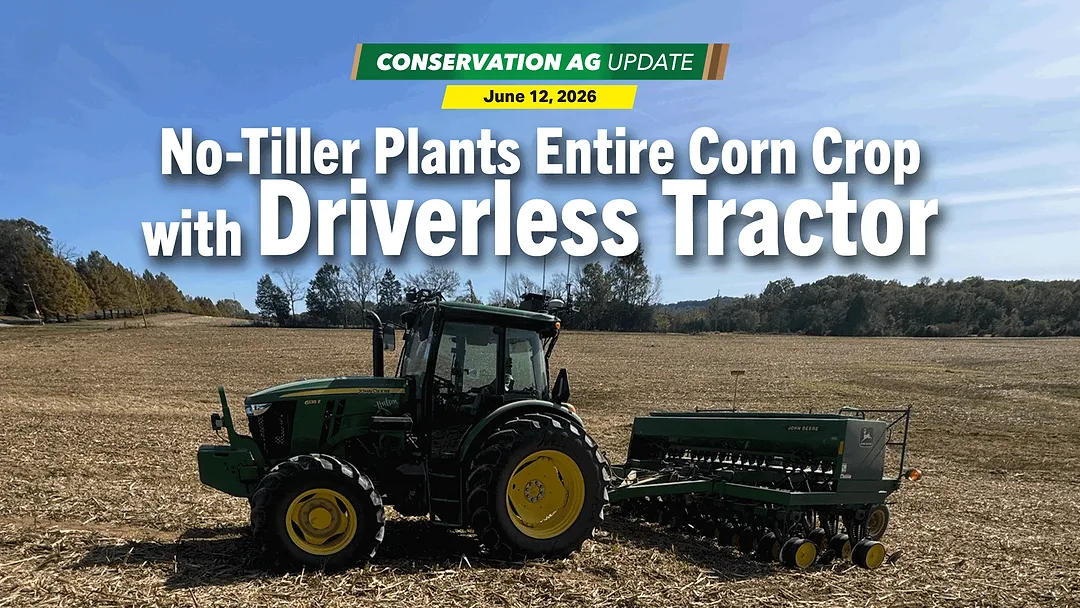
On this episode of Conservation Ag Update, brought to you by Titan International, we catch up with young Kentucky no-tiller Quint Pottinger to see how he autonomously planted his entire crop in 2026.
Senior editor John Dobberstein checks in from the CTIC Conservation in Action Tour in Scotland Neck, N.C., where no-tiller Zeb Winslow III talks about his multi-species cover crop program.
For the Cover Crop Connection, managing editor Mackane Vogel catches up with No-Till Legend Steve Groff in Holtwood, Pa.
Later in the episode, Conservation Ag Operator Fellow Tony Peirick runs down the key features on his no-till planter in Watertown, Wis.
In the Video of the Week, No-Till Innovator Ray Archuleta shows the differences between conventional and no-till/cover crop practices in a “tale of two fields.”

This episode of Conservation Ag Update is brought to you by Titan International.
Titan International is a global leader in off-the- road wheels and tires, and is the maker of Titan Wheels, Titan Tires and Goodyear Farm Tires. Super Single Goodyear Farm Tires, featuring Titan LSW®️ technology help growers unlock greater performance.
Featuring a larger rim and smaller sidewall, LSW technology minimizes soil compaction and creates a smoother ride in and out of the field. Titan has you covered with a full lineup of tires to fit every application on your farm. Contact your local Titan and Goodyear Farm Tire dealer today and learn more about LSW Tire Technology.
TRANSCRIPT
Jump to a section or scroll for the full episode...
- No-Tiller Plants 100% of His Corn Autonomously
- Cover Crop Benefits on Display During CTIC Tour
- Steve Groff Bringing Cover Crop Knowledge to No-Till Conference
- Longtime No-Tiller Details Key Features on Planter
- Video of the Week: Ray Archuleta’s Tale of Two Fields
No-Tiller Plants 100% of His Corn Autonomously
A young no-tiller just made history in New Haven, Ky., becoming the first in the state to plant his entire corn crop with a driverless tractor. Looking to slash equipment costs, Quint Pottinger went all in on autonomy, replacing his two big tractors and planters with a small tractor, an 8-row planter and a Sabanto autonomy kit.
The 8th-generation farmer autonomously no-tilled corn green into cereal rye. And as you can see in this video, it went even smoother than he expected across 850 acres. While many in the equipment world are pushing bigger and faster, Quint says he’s going smaller and slower, and it’s paying off.
“That’s the messaging that’s coming from the equipment manufacturers, spend the money so you can plant faster, you can till faster and you can get the crop in quickly. And their point is don’t have two 40-foot planters, have one 40-foot planter that you can run at 10 mph. We took a different approach. We said, you know what, we’re going to get rid of two 40-foot planters and we’re going to go with a 20-footer and we’re going to slow down because we have time and that’s what we’ve seen. So instead of planting 4.5-5 mph, we’re planting at 3.5 mph and that sucker is running 16, 20 hours a day and we’re getting better seed placement, we’re getting better crop stands than we could have ever hoped for, especially in no-till. Slow down. Let the equipment do the work.”
Pottinger notes he’s the first in the world to do this without it being a company or research project receiving financial assistance. All in all, this setup cost him $200,000, compared to his old equipment setup that cost $750,000.
Cover Crop Benefits on Display During CTIC Tour
Let’s get back to the CTIC Tour now, where no-tiller Zeb Winslow III talked to attendees above the cover crop program on his 4,000-acre farm and the difference it’s making for his soil health.
“Moisture retention and weed suppression, that’s the low hanging fruit that you’re going to get to really quickly. Then you start seeing the amount of life come back into your soil. When I was a kid, if we needed worms to go fishing, we went to the woods. You can go into my fields now and if you pull up one of my corn plants or take a shovel full of soil out of the ground, you’re probably going to find 1-2 earthworms in there. If you get down and look underneath that residue, you’re going to see all kinds of ground beetles and other decomposers and shredders that are there doing their work. I’m not sure how much we can stack on top of that as we go further down the rabbit hole, but I think there’s a lot of possibilities that we can do with this that we don’t even know yet.”
Winslow III covers 100% of his corn, soybeans and cotton acres.
Steve Groff Bringing Cover Crop Knowledge to No-Till Conference
Mackane Vogel here with this week's cover crop connection. As you can see, we are at the birthplace of the tillage radish. Yes, I'm on Steve Groff's farm in Holtwood, Pennsylvania. And speaking of which, we're going to toss it off to Steve right now for some cover crop action.
“Hey everybody. Steve Groff here. It's been a while since I've been at the National No-Till Conference, but I'm coming back this year and I'm really excited about it. But why would I come back? I don't even grow any corn. I don't grow any soybeans. No wheat. None of the stuff that almost all you guys grow. But I'm really, really committed yet to no-till. Been no-tilling since 1982 and we're big into cover crops. As you can see right here, this is a freshly rolled down cover crop field that we're going to plant pumpkins into next week. So big into cover crops, big into no-till, but I'm more into specialty stuff. I'm going to show you here in a second some really cool things, but I grow a lot of pumpkins and squash and even no-till tomatoes. Things that most people don't even know they could be no-tilled.”
“So I remember, and you would have to ask Frank about this, because this is before summer you were born. I spoke at the National No-Till Conference in I think 1996 here and there and I talked about my no-till tomatoes back then. So it's really interesting to fast forward 30 years now. I'm still doing the same principles, same thing, but I have moved on to more specialty type crops.”
There we have it from Cedar Meadow Farm in Holtwood, Pennsylvania. That's all for this week's cover crop connection.
Longtime No-Tiller Details Key Features on Planter
Time now for another visit to Conservation Ag Operator Fellow Tony Peirick’s farm in Watertown, Wis. Today, Peirick gives us an up-close look at his John Deere 1775 Exact Emerge planter, which he uses to plant green into cereal rye.
“We don’t run any fertilizer openers. We just have the air adjust row cleaners. We’re running PTT blades on it. On this one, we’ve got the belt delivery system, air pressure down close for closing wheels and we use the Martin-Till closing system. On this row, we’re kind of experimenting running the different closing wheel vs. the regular disc they have on here. The fertilizer, we made the tubes and we put the 2-by-2 out the back. We do 5 gallons of QLF starter with 15 gallons of 32 with ammonia Thio-Sul. That goes at planting, and the rest we’ll sidedress (the rest of the nitrogen) later on.”
Video of the Week: Ray Archuleta’s Tale of Two Fields
Let’s wrap things up with our Video of the Week. This one comes to us form South Carolina, where No-Till Innovator Ray Archuleta shares a tale of two fields.
“Here are two soils — no-till with covers, look how dark it is. And I want to show you heavy, conventional tillage with high inputs. What are the three things that make this soil distinct? This farmer has a different mindset; he knows the soil is alive. This farmer treats the soil as a growing medium. The soil diversity is very diverse here. I think we forget that the plant is the mouth of the soil. These soils are continually fed liquid sun, taking light energy and converting it into liquid sun. Way diverse. This one has no diversity, and this soil is starving. It only has corn and soybean, and it has no cover crops at the end of the year. So, what’s the answer about compaction? Let’s be very clear. What fixes compaction is living plants and living roots leaking all these acids and creating these aggregates. You see these little bee bees? Those are called aggregates. I want that.”
What do you think? Send me your thoughts and story ideas to Nnewman@Lessiter Media.com. Thanks for watching. Until next time, for more stories visit no-tillfarmer.com, striptillfarmer.com and covercropstrategies.com.