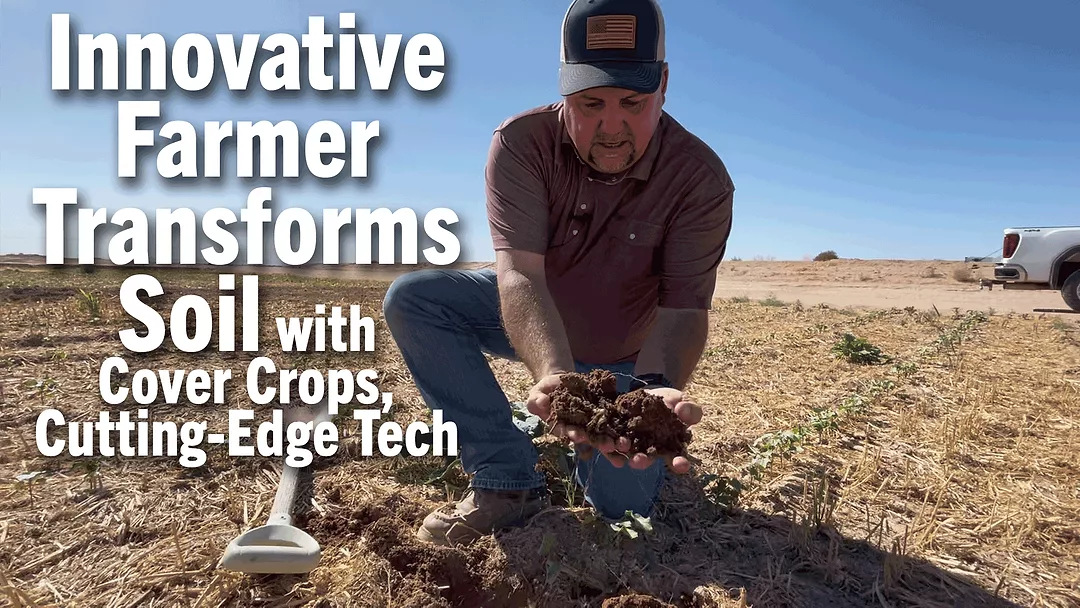
I just got back from Coolidge, Ariz., where Strip-Till Innovator Robert Boyle is proving cover crops can work anywhere…even in the desert with less than 7 inches of rain.
The proof is in the soil. Check this out. An earthworm in the first dig. Robert says 15 years ago, there never would’ve been a worm in this place. He planted cover crops on this field, then strip-tilled it and planted cotton dry. Robert says his soil health journey is an ongoing 10-year process. Anytime he makes a change, he gives it at least 3 years to come around.
Driving around Robert’s farm, I was amazed by how he’s able to manage so many different fields, with each one having completely different rotations and cropping practices. For example, on another field we stopped by, Robert strip-tilled twin-row corn into a terminated mix of triticale, oats, peas, vetch, clover and kale.
As you can imagine, he uses a lot of equipment and tools to get the job done, including some cutting-edge precision technology.
Noah Newman: " Robert, we have a big piece of technology behind us here. The 360 rain. Tell us a little bit about it when you get out of this."
Robert Boyle: "So this is our autonomous sprinkler. We're using it to irrigate this crop of corn. It's our second crop with it. We've had an oak crop before that. We're using 225 gallons a minute. We're irrigating a hundred acres. Right now we're getting around on it. It takes us about seven days to get around on that corn and then be back on it. Puts on six tenths of an inch is what we're putting on right now. And then I'm putting all my fertilizer on with it. We're getting way better utilization through the banding of the fertilizer through the wide drop of the rain unit than we are with our flood irrigation. Probably going to be able to use half the liquid fertilizer we've been using."
Newman: "And out here where you get only about seven inches of rain per year, that water conservation's really important to you and the efficiency. So how much does this help with that?"
Boyle: "Oh, it's cut our water usage on our corn in half."
Newman: "Wow."
Boyle: "And then when we can cut the water usage on our corn in half, that's to let us expand our acres on our other crops that we're growing. And then with this thing being completely mobile, this machine will follow our crop rotation around the farm. We're not dedicated to just one section of the farm that we can run it on."
Newman: "And as we were driving around, you controlled from your phone, right? I saw."
Boyle: "Yeah. All the adjustments, faults, anything like that, everything runs off your phone. There's one keypad on the back that you can adjust things back there, but other than that, everything is all through the app."
Newman: "Very cool. Now, what are some other big pieces of technology that you're using in your operation here that's giving you a lot of bang for your buck?"
Boyle: "So I have telemetry on everything. All my tractors, I run ops center or razor tracking, which are compatible and so I can figure out where all my equipment's sitting at any point of the day or night. We run Crohn hay balers. I have the Chrome Smart Connect and on that every morning I can see how many bales I've made, what the weights are, moisture, how many tons per field. And so I can even see where the bales are dropped through the field."
Newman: "And it's interesting how much of a mixed fleet you have out here on your farm. I mean, every different color you could think of you have out here, but you're able to manage it all with the John Deere Operations Center, right?"
Boyle: "So I have their tracker on all the machines and then also Razor, which is a compatible company with them. So we run a complete mixed fleet of brands and manufacturers on equipment between Cases, McCormicks, Fords. So we use OpsCenter and Razor tracking in combination to where we can put trackers on all the equipment. I can see where every baler gets parked at night. Every swather gets started in the morning, but it's really key when you're dispatching your help in the morning that I can know, "Hey, I have 300 bales here, 600 bales over there, so I know where I need to send the guys and in what order."
Newman: "Awesome. Well, Robert, thanks for giving us a tour of your farm out here. Completely different ball game out here in Arizona than our neck of the woods back in Brookfield, Wisconsin. So it's been a very interesting tour."
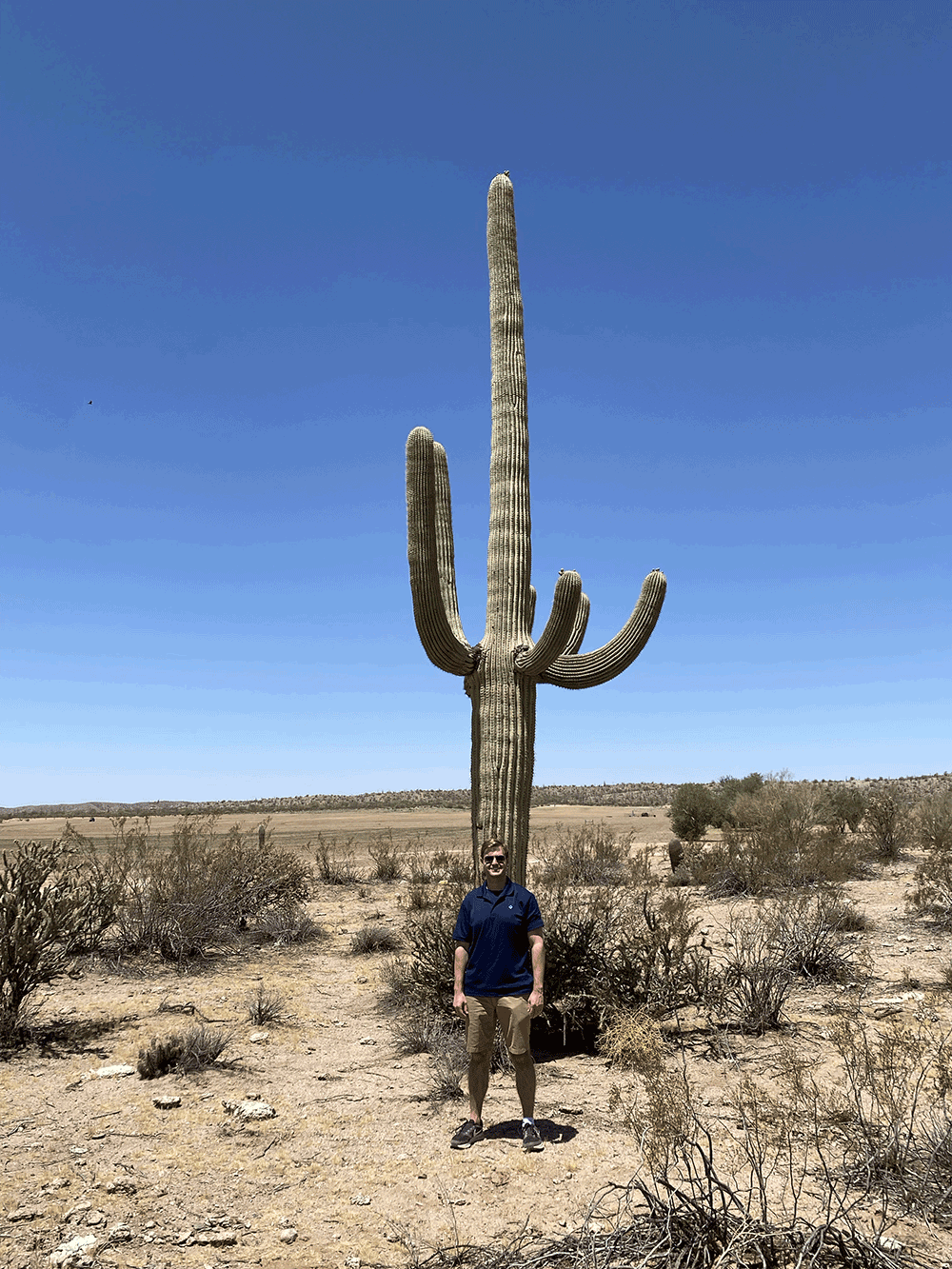
To further illustrate the environment Robert’s farming in…here’s a photo of me next to a giant saguaro next to one of his fields. Fun fact, those can live up to 200 years.
Watch the full Video of this episode of Conservation Ag Update.