TAKEAWAYS
- Always think about breakdowns, and how you’ll deal with them, when stocking machinery for your farm.
- Think about your soil types, climates and crops before deciding on drill models and openers.
- When taking on new farms, make sure to do soil tests to establish a baseline for nutrient management.
Raising crops in Alaska has been compared by some to farming on the moon: There is a very short growing season, spotty labor help, supply chain hurdles and harsh and unpredictable winters.
But the owners and operators of one of Alaska’s biggest farms are switching to no-till practices this year to reduce field work, preserve soil moisture and get small grains crops planted earlier.
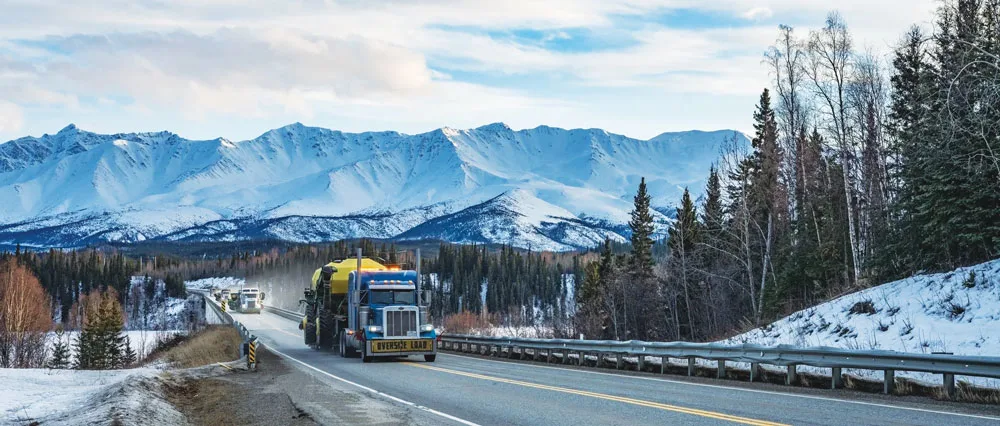
To make this work, Wichita, Kan.-based Quality Drills hauled two John Deere air seeders more than 6,000 combined miles from the southern Plains to AlaskaAgro, a 5,600-acre farm just south of Delta Junction.
AlaskaAgro is one of the largest producers of agricultural commodities in the state, raising barley, oats, hay and grass seed and putting up around 20,000 straw bales annually that are distributed across the Alaska as crucial feed for livestock during the winter.
The firm’s marathon trip in April wrapped up with a no-till field day at the farm, where growers from across the region learned more about no-till practices and equipment. Prescription Tillage Technology, Schaffert, SeedForce Ag and Dakota Ag Innovations were among those to participate in the field day.
Finding the Right Tool
Stefan Alderson founded Quality Drills in 2016 after working for an agricultural service company that serviced John Deere single-disc drills, which he grew to know intimately. After developing a passion for learning about no-till practices, Alderson started the company, believing his knowledge of Deere drills would provide value in the regenerative space.
Quality Drills rebuilds John Deere drills, air seeders and air carts, provides equipment and parts sales, offers on-site dealer assembly for new equipment and provides field service and pre-season prep for farms.
“When I was visiting farms I would notice a common stumbling point when it came to no-till, minimum-till or anything other than conventional agriculture. It was always the equipment that was the stumbling point for growers,” Alderson says. “Because a no-till drill is doing a high-demand job planting into undisturbed or minimally disturbed soil, you need a much more robust opener.”
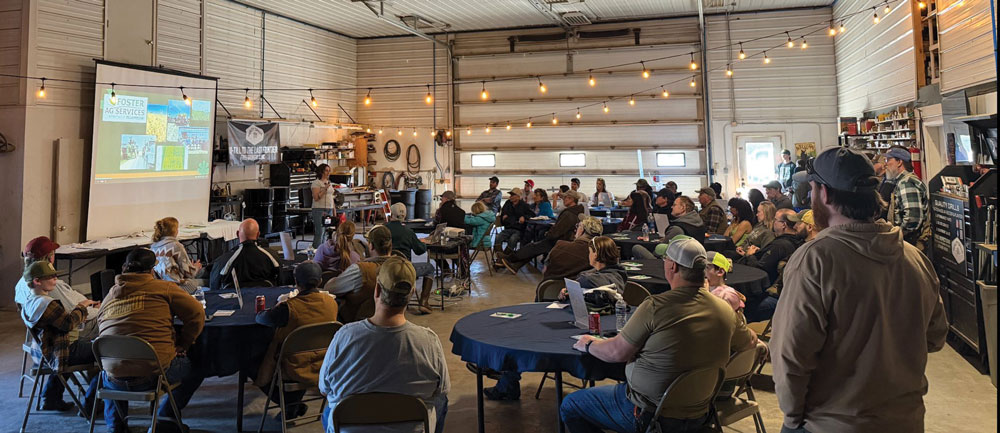
LEARNING LAB. AlaskaAgro and Quality Drills sponsored a clinic in April to give Alaska farmers better access to the tools, knowledge and resources needed to succeed in the state’s challenging agricultural conditions. Prescription Tillage Technology, Northern Rooted Agronomy, Univ. of Alaska-Fairbanks Extension and the NRCS were among the guest speakers. Quality Drills
Alderson and his business partner and operations manager, Devin Marcin, spent the first few years, “going out looking at machines that people already owned and telling them what was wrong with that machinery. We were always the bearer of bad news, telling them they had to spend way more money than they wanted to,” Alderson said.
“So we decided to start getting in on the right side of the deal and selling the equipment to the grower so we could be transparent in the buying process and make them fully aware of what they were buying before they bought it.”
A Labor of Love
Alderson’s firm got a call in March from AlaskaAgro’s owners about buying equipment so they could no-till small grains. After a weekend of discussion they ended up buying two machines to fit with their expansion plans.
“Farming in Alaska is like farming on the moon,” Alderson was told. “You have what you brought with you, so bring two. If you have one, you have none.”
One of the drills came from a large farm in North Dakota that grows potatoes for McDonald’s, although that specific drill wasn’t used for planting potatoes. The other drill came from Howard Turner Farms in Wagoner, Okla. The owner had Quality Drills rebuild the drill for him, but he unfortunately passed away before he could use it.
Alderson said the two machines are the first John Deere single-disc drills put to use in the state, and possibly the largest pieces of farm equipment in the state. Despite the logistical challenges and expense of moving the machinery that far, Alderson said he did not up-charge their services.
“We just extended the growing season by more than two weeks just by changing some equipment…”
“It's really a labor of love. We’re doing something that’s very important,” he says. “Alaskans pay the price of their remote living and their solidarity at the grocery store. They pay a premium for milk and bread and all the things you and I take for granted every day because they’re dependent on logistics to get those things there.
“So growing food in Alaska is not only a profitable business venture for growers if they’re willing to put in the work and make it happen, but it’s also a philanthropic mission to do something to reduce dependency for Alaska.”
The Alaska move was a culmination of efforts from over a dozen different people from his team. Walt Pene Trucking out of Plainview, Texas had an established relationship with Quality Drills and provided 3 semi-trucks for the haul from Oklahoma. They met up in Minot, N.D. to join another convoy with a self-propelled sprayer AlaskaAgro purchased.
Three mechanics and field technicians from Quality Drills flew to Anchorage, then took a rental car and drove 6 hours to Delta Junction to rebuild the machinery at the farm.
No-Till Brings Options
AlaskaAgro is managed by Clayton Griffith and owned by Alan Boyce, whose purchased the operation last year in what’s billed as the largest farm sale in the state’s history.
In the late 1980s, brothers Mike and Scott Schultz bought the property, cleared a boreal forest and began farm production with conventional tillage methods. But AlaskaAgro’s managers will start no-tilling crops this year to get into fields earlier due to the short growing season. Tilling the fields and spraying would eat up another 3-4 weeks of time.
“You can’t have an actual target date for planting. So it's very important that you get the seed in the ground as soon and as efficiently as possible,” says Griffith. “With that we can do some variable rate seeding, apply fertilizer right with the seed, and have better control of our crop and growing conditions that way.”
The farm researched no-till seeding equipment that would fit their soil conditions, which are primarily dry due to being on the north slope of the Alaska range. They see about 12 inches of precipitation a year. Soils are light and tend to have very high soil carbon, and tillage operations and high winds would dry fields out and put it at risk of blowing away.
They felt a single-disc opener and air cart fit the bill to plant through straw, so they opted for the two 42-foot John Deere 1890 air seeders set on 7.5-inch spacings and two 350-bushel Deere 1910 commodity carts, along with 2 toolbars. The farm also purchased a Hagie STS-10 self-propelled sprayer that joined the convoy to Alaska from Minot, N.D.
Typically in Alaska the fertilizer of choice is straight urea and phosphorus, which is about the only thing available. Farm managers took 500 soil samples last year and mapped all the fields so they can do variable-rate application.
Getting help during breakdowns isn’t likely, so Quality Drills spent many hours educating AlaskaAgro’s managers on repairing the equipment and knowing what parts tend to wear out. Another challenge is labor availability, as the oil-and-gas pipelines, gold mines and military bases tend to dominate. They don’t see the situation improving.
“We can’t call a mechanic. We can’t call the parts dealer. There is a John Deere dealer here, but they sell lawnmowers and lawn tractors and heavy construction equipment for the mining and oil-and-gas business,” Griffith says. “There are no resources for any agriculture equipment, so we are the resource.”
From a business standpoint, AlaskaAgro’s goal is to, “have the best quality barley in Alaska” for customers and maintain that standard for all its products. But building up long-term fertility in the soil is another major goal to log yields that are more consistent.
No-till practices in southern Alaska have generally gained acceptance, Griffith says, although much of the farmland was built up during the 1980s by farmers who are getting older and don’t easily adapt to change. “To build a more sustainable local food system,” Griffith asserts, “you need change, and efficiency is a big thing as well.”
“To preserve our soil and our soil moisture, no-till is a key. I really don't want our topsoil to blow away, and we want to preserve that soil moisture,” Boyce says. “It's hard enough with the shorter growing season and anything that you can do to make yourself more efficient and get seed in the ground earlier makes sense.”
The growing season is typically only 140 to 150 days. From mid-May through mid-August it doesn’t get dark, “so if you've got good soil moisture, the growth rate of the plants is spectacular,” Boyce says. It took the previous owners 3 weeks to get everything planted, but Boyce thinks they can do it in a week or less with 2 no-till drills running.
Winter might arrive in mid-September, but last year it was mid-October, which adds to the urgency to speed up the planting process. “If your crop is still out there trying to mature and dry out and a big snowstorm comes, you might not get to that crop until the snow goes away the following spring and then it's garbage,” Boyce says.
“If you do get those optimal conditions, we just extended the growing season by more than two weeks just by changing some equipment. So I think that's a huge advantage.”