
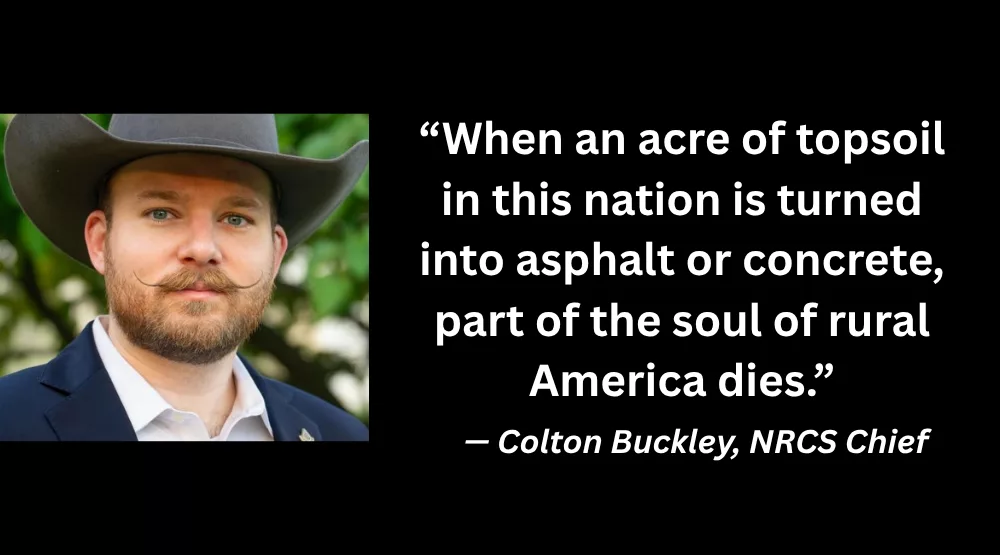
WASHINGTON — Colton Buckley, recently appointed as NRCS chief, is taking the reins at a time of rapidly changing farm technology, cost pressures for farmers and a highly partisan atmosphere Washington.
Last month, more than 500 producers sent a letter to lawmakers urging them to prioritize staffing for conservation programs. The USDA Office of Inspector General said 20,306 USDA employees left last year, including a 22% reduction at the NRCS.
Many farmers are concerned this will result in longer wait times at local offices, delayed payments and less help to work through complex programs and decisions.
But Buckley told No-Till Farmer Tuesday he will continue pushing to modernize the tools farmers have available through the NRCS and ensure the agency “gets back to basics” helping them succeed with their conservation goals.
Buckley insisted technical assistance will not dwindle under his watch. When the Soil Conservation Service was founded more than 90 years ago it was a “technical assistance agency” and that needs to be a priority, he says — from local county offices to the national headquarters.
“My focus as chief for the duration of my time here at NRCS is to make sure our field staff have the tools that they need with (the One Farmer, One File program), and with the upcoming integrated field tool to allow them to be more expeditious in the work they do,” Buckley explained.
At Commodity Classic, USDA Secretary Brooke Rollins said the USDA was overhauling its much-maligned computer network to make it easier for farmers to apply for grants and disaster funding, update acreage and participate in other farm-related programs.
The USDA’s massive upgrade project is the first part step being its “One Farmer, One File” initiative announced at the show to create a single, streamlined record that follows farmers during their movement through the USDA’s internal system.
The FSA, NRCS and RMA work with agricultural producers on a wide range of programs and services, from establishing a farm number to reporting acres planted, and from getting capital to recovering from disasters.
As associate chief, Buckley oversaw the agency’s financial and technical assistance programs, management and strategy, science and technology, soil science and resource assessment deputy areas, and partnerships division. Previously, he served as chief of staff for NRCS and as CEO of the National Association of Resource Conservation and Development Councils. He was raised on his grandparents’ cattle ranch outside Gatesville, Texas.
Buckley says he and his predecessor, Audrey Bettencourt, worked together to develop the NRCS’ priorities, and the most significant one now is to, “preserve and protect agricultural land.” He said the U.S. loses about 5,000 acres a day in productive farm ground to development pressure, at least 50% of that is considered prime farmland.
“When an acre of topsoil in this nation is turned into asphalt or concrete, part of the soul of rural America dies,” he says.
Improving the agency’s focus and measuring progress is also crucial, Buckley said.
“We’re shifting to outcomes-based conservation and farmer empowerment. We're strengthening partnerships by streamlining processes for the money our agency gives out, instead of having one-off, non-competitive agreements that sometimes have no benefit to the producer or our field staff,” he said. “That is going to be key as we move forward.”
Another issue the NRCS is tackling is an update to the agency’s 168 different conservation practice standards. At least 91 of them are statutorily out of date and a dozen of them are more than a decade old, a situation that is “leaving producers at the train station,” he says.
The NRCS has been working with farmers, state technical committees and career staff in farm states to amend the standards, Buckley said, “to make sure that producers have the right tools that are for the 21st century in the toolbox to drive better outcomes in conservation and agricultural production.”