 Premium content is for our Digital-only and Premium subscribers. A Print-only subscription doesn't qualify. Please
No-Till Farmer
Get full access NOW to the most comprehensive, powerful and easy-to-use online resource for no-tillage practices. Just one good idea will pay for your subscription hundreds of times over.
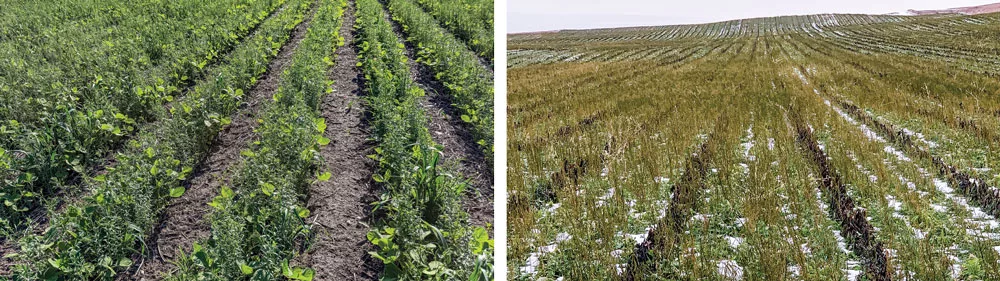
WORKING TOGETHER. Seeding flax and oats in the row in soybeans following soybeans has proven to help manage water and excess nitrogen that can contribute to increased impact of iron deficiency chlorosis. Soybeans perform well as long as the interseeded crop is terminated prior to soybeans flowering. Joe Breker
Havana, N.D., no-tiller and No-Till Innovator Joe Breker told No-Till Farmer recently that he’s experimenting with intercropping in soybeans with the additional goal of helping manage Iron Deficiency Chlorosis (IDC).
Soybeans need iron to make chlorophyll for photosynthesis. In soils high in calcium carbonate and pH, many soybean varieties struggle to take up iron. This problem, known as iron deficiency chlorosis (IDC), shows up as interveinal yellowing of young leaves.
“Variety selection has typically been the primary way to manage IDC,” says Mary Love Tagert, associate professor for the Mississippi State University Extension Service, in an article in the Soybean Research & Information Network.
“Research and observation has noted other management factors that have helped alleviate IDC symptoms, but they haven’t been evaluated together.”
The Mississippi Soybean Promotion Board checkoff funded a research study led by Tagert to do just that.
“Some research has found that growing oats as a companion crop with soybeans can reduce IDC symptoms,” she says. “The thought is that their use of nitrogen in the soil helps soybeans better access iron. However, a companion crop isn’t practical to manage in our cropping systems.”
Additionally, research at North Dakota State Univ. has shown that IDC increases in soils with high salts and excess N. Planting a cover…

Get full access NOW to the most comprehensive, powerful and easy-to-use online resource for no-tillage practices. Just one good idea will pay for your subscription hundreds of times over.
Download these helpful knowledge building tools

We have engineered and developed the most advanced concave system that threshes all crops, eliminates rotor loss, improves grain quality, gives you a cleaner sample – all with one set of XPR concaves.

At Titan International, our product portfolio reflects our commitment to innovation and high-quality products. Titan International offers a full line of solution-focused wheel, tire, and undercarriage products for a wide variety of off-the-road equipment in agriculture, construction, forestry, mining, power sports, high-speed trailers, and outdoor power equipment segments. As one of the largest North American manufacturers, with a network of dealers all over the world, Titan is an industry leader that original equipment manufacturers and operators can count on for durable products and quality service.

Provide expert analysis and decision support to increase productivity and profitability.