

WASHINGTON — The U.S. EPA announced it has finalized the Renewable Fuel Standard (RFS) “Set 2” final rule that will realign the program to increase the use of American biofuels, a move expected to “put American farmers first” and help promote American energy independence.
The RFS program, “Set 2” establishes the renewable fuel volume requirements for 2026 and 2027 at the highest levels in program history. EPA Administrator Lee Zeldin said the Set 2 rules will create a “larger, more stable and more reliable” domestic market for U.S. crops.
The high volumes are expected to create a $3- to $4-billion dollar increase in net farm income and a $31 billion dollar value for American corn and soybean oil for biofuel production in 2026 — which is $2 billion more than in 2025, said USA Secretary Brooke Rollins.
To meet the 2026 and 2027 volume levels, EPA estimates that biodiesel and renewable diesel production and use will need to increase by over 60% compared to 2025 volumes, which was the last year of the Biden-Harris administration’s “Set 1.”
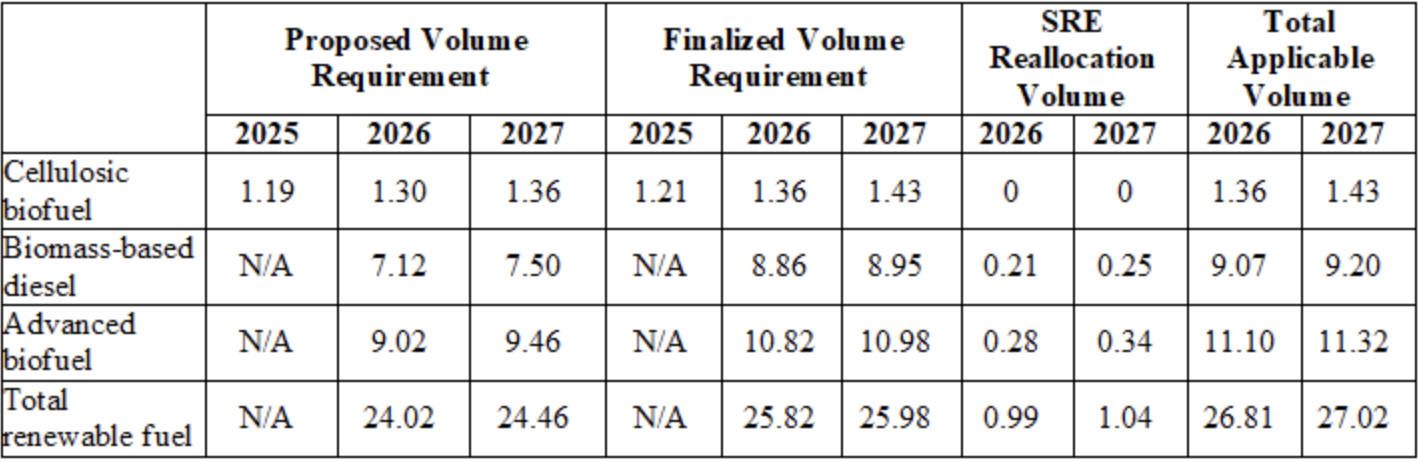 2026 and 2027 Renewable Fuel Volume Requirements, SRE Reallocation Volumes, and Total Applicable Volumes (billion RINs). (EPA)
EPA estimates the Set 2 rules will generate over $10 billion for rural economies and create over 100,000 new jobs in the agricultural and manufacturing sectors. To provide continued certainty for American corn growers and ethanol producers, EPA will maintain the 15 billion conventional biofuel level for 2026 and 2027.
High Soybean Demand
The priority “Set 2” places on expanding the use of American-made ethanol, biodiesel and renewable diesel will also reduce the nation’s dependence on foreign oil by roughly 300,000 barrels of oil per day over 2026 and 2027, officials said.
The EPA expects this will drive renewed demand for American soybean producers. U.S. soybean acreage for 2026 is projected to rise significantly, with estimates ranging from 85 to 86 million acres, representing a roughly 4.7% to 6% increase from 2025. Farmers are shifting toward soybeans due to improved price ratios compared to corn. The USDA will release official planting intentions on March 31.
Additionally, the EPA is restoring the RFS program to align with the plain language of the Clean Air Act (CAA) by removing “renewable electricity” from the RFS program to end what the agency said was effort’s by the previous administration to, “push EVs onto the American people.”
After reviewing comments, data, and analyses, the EPA said it’s also finalizing a 70% partial reallocation of the 2023–2025 exempted Renewable Volume Obligations for the 2026 and 2027 compliance years to, “balance a number of factors that come into play when considering volume requirements and the impacts of SREs, including protecting biofuel demand while maintaining a stable and functioning credit market.”
Starting in 2028, foreign fuels and feedstocks will receive half the RFS compliance value compared to American-made products, providing American biofuel producers with time to prepare for the change while ensuring that American farmers benefit from the RFS program and American energy independence.
ASA Pleased with Rules
The American Soybean Assn. praised the decision, expecting it will bolster U.S. soybean farmers and boost soy-based domestic biofuel production.
“ASA is grateful for the tireless efforts of EPA and USDA to ensure the soy biofuel value chain could benefit from the strongest RVOs ever finalized,” said Scott Metzger, ASA President and farmer from Ohio. “The 2026-2027 RVOs will increase soybean oil use, boost U.S. soybean processing and grow domestic biofuel markets for our crop.”
Domestic biofuel production accounts for over half of all domestic soybean oil consumption and serves as a critical U.S. market for soybean farmers.
ASA said the updated Renewable Volume Obligation rule will increase biomass-based diesel blending to approximately 5.4 to -5.5 billion gallons, a 60% increase from 2025 volumes.
Further, the rule reallocates 70% of retroactive 2023-2025 small refinery exemption volumes that EPA took action on last year in addition to the 2026-2027 compliance years.
“ASA appreciated EPA clearing a significant backlog of legacy SREs dating back to 2016, which were remanded to the agency, and is glad to see a significant reallocation of volumes back into the blending pool to support additional biofuel production and increase soybean demand,” Metzger said.
While the rule doesn’t make immediate changes to prioritize domestically sourced biofuel feedstocks, ASA said it celebrated the EPA’s announcement on reducing credit generation for imported biofuels and biofuel feedstocks because it could, “serve as a significant economic driver for the entire domestic biomass-based diesel value chain and will catalyze domestic demand for U.S. soy."
The Renewable Fuels Assn. also welcomed the EPA’s move, “at a time when American consumers are looking for relief at the pump and hard-hit farmers are looking for new demand opportunities,” said RFA President and CEO Geoff Cooper. “The final rule locks in the highest-ever renewable fuel volume obligations and provides clarity for farmers, ethanol producers, oil refiners, and fuel distributors alike.”
EPA’s final rule requires 15 billion gallons of conventional renewable fuels like corn ethanol in both 2026 and 2027. In addition, 10.82 advanced biofuels RINs are required in 2026, increasing to 10.98 billion RINs in 2027.
EPA will also reallocate 70% of the renewable fuel volumes lost to small refinery exemptions (SREs) for 2023-2025, effectively restoring 2.03 billion gallons of previously lost demand.
RFA noted in its statement Friday that by not fully reallocating the renewable fuel volumes lost to SREs issued for 2023-2025, “today’s rule stops just short of providing farmers and ethanol producers the market expansion opportunity Congress envisioned in establishing the RFS program.”
Cooper noted that while RFA advocated for full reallocation of the 2023-2025 SREs, the 70% reallocation included in the new rule is, “better than other options that were under consideration.
'Failing Consumers and Taxpayers'
The EPA’s updated projections for advanced cellulosic biofuels production, “underscore how the Renewable Fuel Standard has failed both consumers and taxpayers,” he added.
“In 2007, Congress envisioned 16 billion gallons of non-food-based cellulosic biofuels produced by 2022. Actual production has fallen woefully short of this mandate — 2026 volumes represent just 8.5% of that target. Instead, conventional, first-generation biofuels like corn ethanol and soy-based biodiesel continue to dominate compliance.
“By continuing to pick winners and losers through mandated markets, federal policy drives demand for biofuels while increasing reliance on costly tax subsidies. The 45Z clean fuel production credit, expanded in 2025, is projected to cost taxpayers $53.1 billion over the next decade.”
Learn more information on the "Set 2" Final Rule.