 Premium content is for our Digital-only and Premium subscribers. A Print-only subscription doesn't qualify. Please
No-Till Farmer
Get full access NOW to the most comprehensive, powerful and easy-to-use online resource for no-tillage practices. Just one good idea will pay for your subscription hundreds of times over.
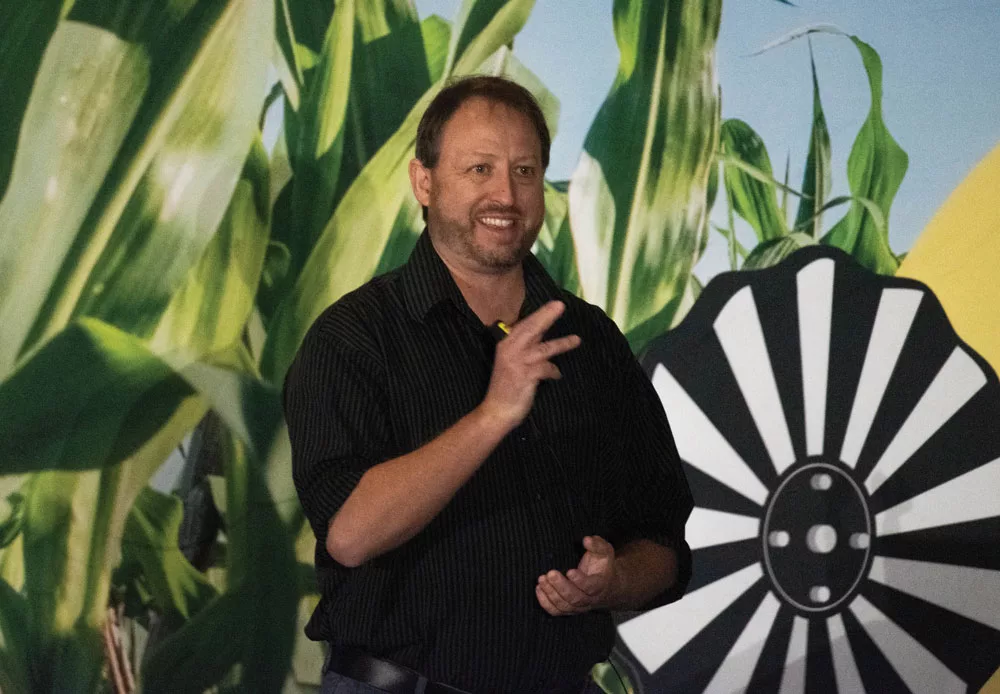
A BETTER WAY. Regenerative practices, including no-till systems, provide growers a chance to tamp down input costs, improve the health of their families and consumers and boost profitability, said Jonathan Lundgren, executive director of the Ecdysis Foundation, at the National No-Tillage Conference. Jeff Lazewski
One of the criticisms often levied against regenerative agriculture is that it won’t be consistently profitable or productive enough compared to traditional farming systems.
But the Ecdysis Foundation believes an exhaustive analysis of on-farm results over the last few years provides solid answers to those questions. In 2022, the organization embarked on a multi-year project collecting and analyzing data on soil, water, plant and animal communities, yields, nutrient density and profitability to show the regenerative outcomes on individual farms.
With the help of numerous partners, the foundation has also been developing new technologies, procedures and partnerships that generate, analyze, interpret and share farm- and landscape-level data. The goal of the 1,000 Farms Initiative is to determine how to transform food systems so they benefit farmers, ecosystems, communities and human health.
Their measurements quantify chemical and physical properties of soil — including soil carbon, microbiology and organic matter — water dynamics, diversity and biomass of plant communities, insect diversity and distribution, wildlife diversity and habitat use, plant pathogens and insect pests, crop nutrient analysis, economics and profitability.
Jonathan Lundgren, founder and executive director of the Ecdysis Foundation, says the idea for this program started several years ago as farmers started showing in…

Get full access NOW to the most comprehensive, powerful and easy-to-use online resource for no-tillage practices. Just one good idea will pay for your subscription hundreds of times over.
Download these helpful knowledge building tools

We have engineered and developed the most advanced concave system that threshes all crops, eliminates rotor loss, improves grain quality, gives you a cleaner sample – all with one set of XPR concaves.

At Titan International, our product portfolio reflects our commitment to innovation and high-quality products. Titan International offers a full line of solution-focused wheel, tire, and undercarriage products for a wide variety of off-the-road equipment in agriculture, construction, forestry, mining, power sports, high-speed trailers, and outdoor power equipment segments. As one of the largest North American manufacturers, with a network of dealers all over the world, Titan is an industry leader that original equipment manufacturers and operators can count on for durable products and quality service.

Provide expert analysis and decision support to increase productivity and profitability.