Cereal Grains
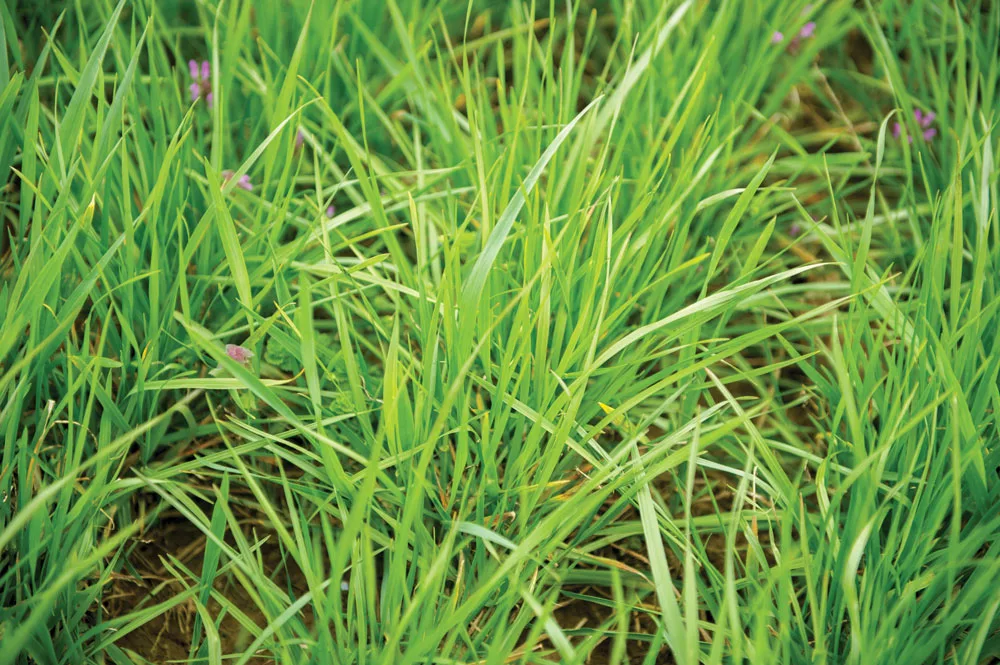
Difficulty Terminating: Easy.
Most Effective Herbicide: Gramoxone or glyphosate
Application Tips: Cereal rye is one of the easiest cover crops to control using herbicide. Before boot stage, cereal rye can be effectively terminated with glyphosate.
After boot stage, gramoxone, or a mixuture of gramoxone and glyphosate, is more effective.
Winter wheat can be somewhat more challenging and may require the addition of atrazine or metribuzin to effectively control.
Annual ryegrass
Difficulty Terminating: Somewhat difficult.
Most Effective Herbicide: Glyphosate
Application Tips: Annual ryegrass has a reputation for resisting termination. Always apply glyphosate during warm, sunny conditions in the morning or early afternoon.
Under cool conditions, it may take 2-3 weeks to kill the ryegrass and a second application of herbicide may be necessary.
If cold, wet and cloudy weather conditions persist, farmers can burn the field down with Gramoxone to achieve about 70% control. Then apply the standard rate of glyphosate or another application of Gramoxone to fully terminate.

No-Till Farmer's "Getting Started With No-Till Farming" is brought to you courtesy of Calmer Corn Heads.
Farmer Invented. Farmer Tested. Farmer Proven.® Calmer boasts this motto proudly as it references our farmer-first mentality and state-of-the art technology.
Calmer offers a custom experience, suited to your farm’s needs. Whether its talking with our experienced sales team or directly with the folks who designed and built your corn head, we are committed to providing you top-notch service without the red tape of a big corporation. Calmer specializes in products suited to benefit your no-till operation including the patented BT Chopper® Stalk Rolls, versatile Corn Head Upgrade Kit for harvest efficiency and residue management, and the High-Performance Concave Upgrade Kit.
We know Calmer products work because we run them on our own farms; that’s why we offer a 100% Satisfaction or Your Money Back Guarantee!
Vetches
Difficulty Terminating: Somewhat
Most Effective Herbicide: 2,4-D, dicamba, clopyralid or mixes
Application Tips: For control of most clovers or other legume cover crops, glyphosate alone is generally not effective, but is useful in a mixture with other herbicides.
A 2,4-D ester or dicamba formulation will effectively control hairy vetch and field peas.
Expert Tip...Avoid using vetch in rotations with small grains
Vetches have a high proportion of hard seed. Even when effectively terminated with herbicide in the spring, dormant seeds will continue to germinate in fields for years. This can be extremely problematic for small grain production.
Clovers
Difficulty Terminating: Somewhat difficult. Depends on species and varieties. Red clover is harder to terminate than crimson, balansa or alsike varieties.
Most Effective Herbicide: Dicamba
Application Tips: Only crimson clover can be effectively controlled with glyphosate or Gramoxone alone. For other clover varities, dicamba, atrazine or metribuzin should be added to increase performance.
Expert Tip... beware of red clover
Red clover can take up to 3 weeks to die compared to crimson clover which will normally be dead in 5 days.
Brassicas
Difficulty Terminating: Somewhat difficult. Depends on species and varieties.
Most Effective Herbicide: 2,4-D
Application Tips: Some brassicas, like rapeseed, are especially difficult to kill with glyphosate, requiring a higher than normal rate of application and possibly multiple applications.
Radish, mustard and turnip can be killed using a full rate of Gramoxone, multiple applications of glyphosate or glyphosate plus 2, 4-D.
General Tips
Always check rotation restrictions
Some crops cannot be planted a certain number of days before or after herbicide application. Be aware of any restriction when developing a termination plan.
Apply herbicides to actively growing cover crops
Most herbicides will be substantially more effective when applied during warm, sunny conditions. As the plant actively undergoes photosynthesis, the herbicide is transported through the plant, maximizing impact.
Terminate cover crops prior to flowering when possible
Plants that have reached their reproductive phase are more difficult to control with herbicides.
Adapted from “Important reminders for chemically terminating cover crops” by Erin Hill, Michigan State University Extension, Department of Plants, Soil and Microbial Sciences (2017)