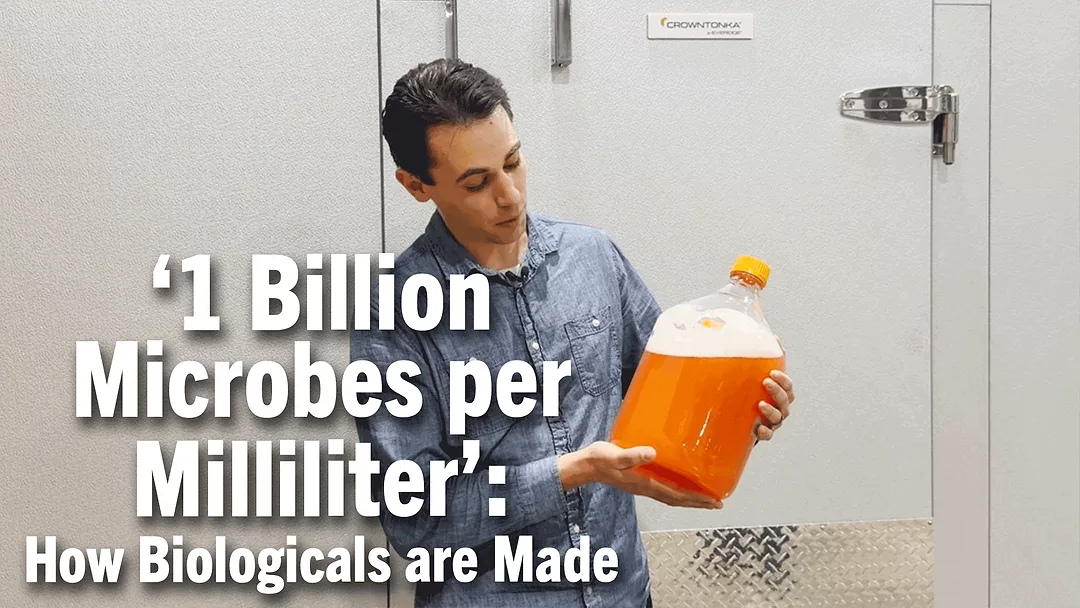
Our team got an up-close look at how biological products are made during an exclusive tour of the TerraMax facility in Eagan, Minn. From R&D to quality control and manufacturing, Brian Kibble Kisely takes us behind the curtain.
“Everything starts with the single isolated microbial species. So if you are a farmer, depending on what you're growing, we have a exact microbe to grow your crop. It all starts with the incredible work by our R&D team with a single isolated microbial species. Everything starts with this isolated culture right here, and then it's brought through our fermentation system where we do large batch fermentation to get you guys the microbial species that you need for your crop.”
“Each one of those isolated microbes in the culture tubes I showed you before is then grown on a large scale fermentation system called the bioreactor. Each one of the vessels you see over here on either side of the room is a different microbial species. Each microbial species is grown for a specific crop. Here we have Azospirillum brasilense. This is a nitrogen fixture for the corn crop. And inside here, it looks like a bunch of pink liquid, but the fascinating part about this is the high number of bacteria in this liquid. Inside this liquid, you have one billion microbes per milliliter. And that volume of microbes increases your crop potential and boosts your yield.”
“Now, something at TerraMax we take very seriously is quality control. We want to make sure the microbes that are stated on the label have the highest counts for the farmer and the optimal yield potential is secure. So, the microbes are growing on a large scale fermentation and we want to do that quality check like I talked about. So in order to do that, our R&D scientists are plating them out on these media plates, you can see here. And depending on what crop you're growing, whether it's a corn or whether it's a soybean, we are making sure that the microbes that are stated on the label come in your final products and those alone.”
Catch the full tour onNo-TillFarmer.com.“Now that we've gone through the laboratory, we're moving on to manufacturing. And here we have our dry manufacturing process where we take our liquid ferment, we stabilize it to make sure it lasts on your shelf for up to two years.”
Watch the full version of this episode of Conservation Ag Update.