 Premium content is for our Digital-only and Premium subscribers. A Print-only subscription doesn't qualify. Please
No-Till Farmer
Get full access NOW to the most comprehensive, powerful and easy-to-use online resource for no-tillage practices. Just one good idea will pay for your subscription hundreds of times over.

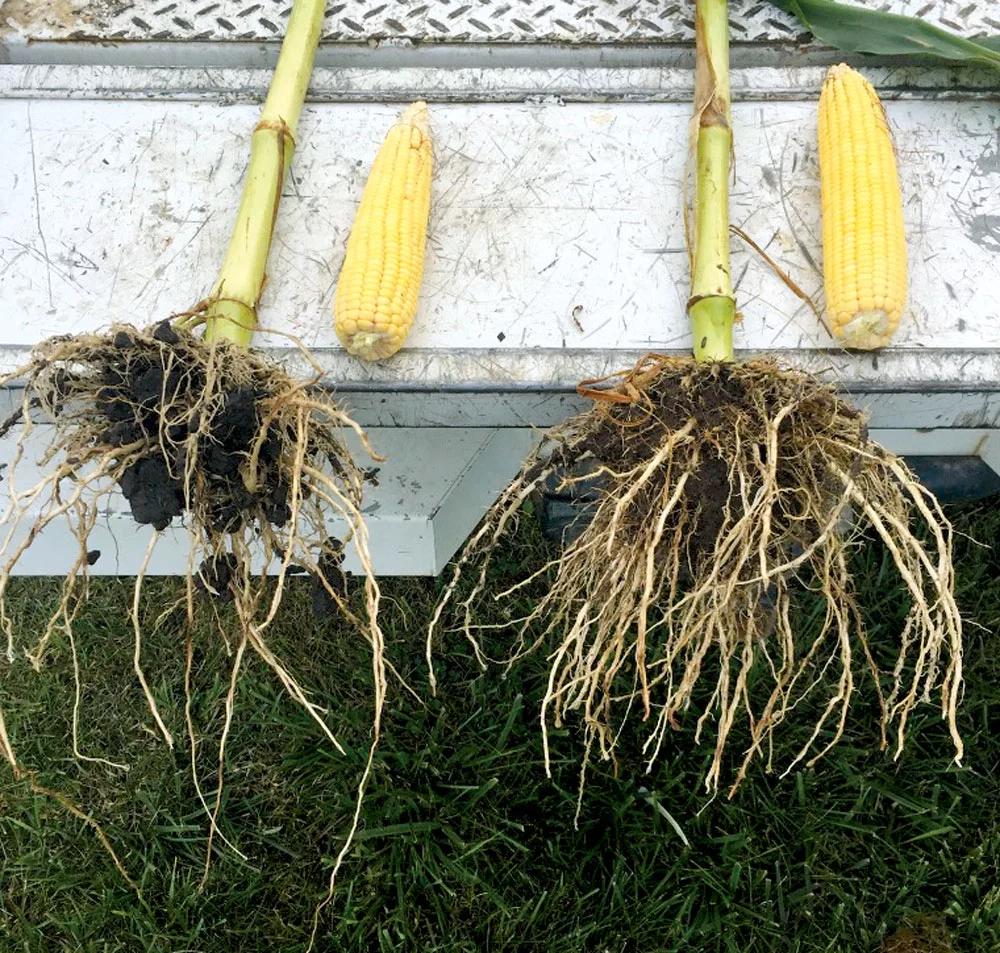
ROOTS. The roots on the right were treated with Holganix. Using biologicals to grow a greater root biomass can help with crop fertility because roots only explore about 1% of the soil. The more roots, the more soil that the crop can explore, and the better it’s able to find more nutrients. Holganix
The soil microbiome is an incredible asset to farmers. A healthy, diverse one will improve soil structure, increase water retention, help fend off pathogens and parasites, and buffer against abiotic stress. It also aids in nutrient uptake and cycling, which can have a significant impact on a no-tiller’s operation, given that generally less than half of fertilizer applied makes it into the crop.
David Stark, molecular biologist and president of agriculture at Holganix, says the nutrient use efficiency of nitrogen (N) ranges from 40-65%, phosphorus (P) 15-25% and potassium (K) 30-50%.
“The USDA in 2021 said 36% of the operating cost of growing a corn crop is fertilizer,” Stark says. “And to think that over half of our money is going to waste. How do we make these things more efficient?”
One way many growers are trying to do that is with biologicals. Stark reviewed some of the options growers have in using these products to get more nutrients into their crops, from tapping into what’s available in the atmosphere and the soil, to capturing and recycling applied fertilizer.
One option growers have is applying biologicals that contain certain bacteria capable of converting N in the atmosphere into ammonia. While that may sound like an easy process, gaseous N is made of two N atoms that are triple bonded, while most chemical bonds — like ammonia — contain a single N atom bonded with three hydrogen atoms. It takes a lot of energy to break that N molecule…

Get full access NOW to the most comprehensive, powerful and easy-to-use online resource for no-tillage practices. Just one good idea will pay for your subscription hundreds of times over.
Download these helpful knowledge building tools

We have engineered and developed the most advanced concave system that threshes all crops, eliminates rotor loss, improves grain quality, gives you a cleaner sample – all with one set of XPR concaves.

At Titan International, our product portfolio reflects our commitment to innovation and high-quality products. Titan International offers a full line of solution-focused wheel, tire, and undercarriage products for a wide variety of off-the-road equipment in agriculture, construction, forestry, mining, power sports, high-speed trailers, and outdoor power equipment segments. As one of the largest North American manufacturers, with a network of dealers all over the world, Titan is an industry leader that original equipment manufacturers and operators can count on for durable products and quality service.

Provide expert analysis and decision support to increase productivity and profitability.