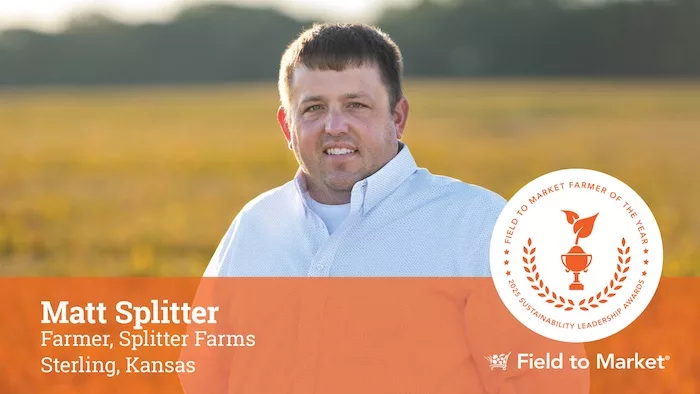
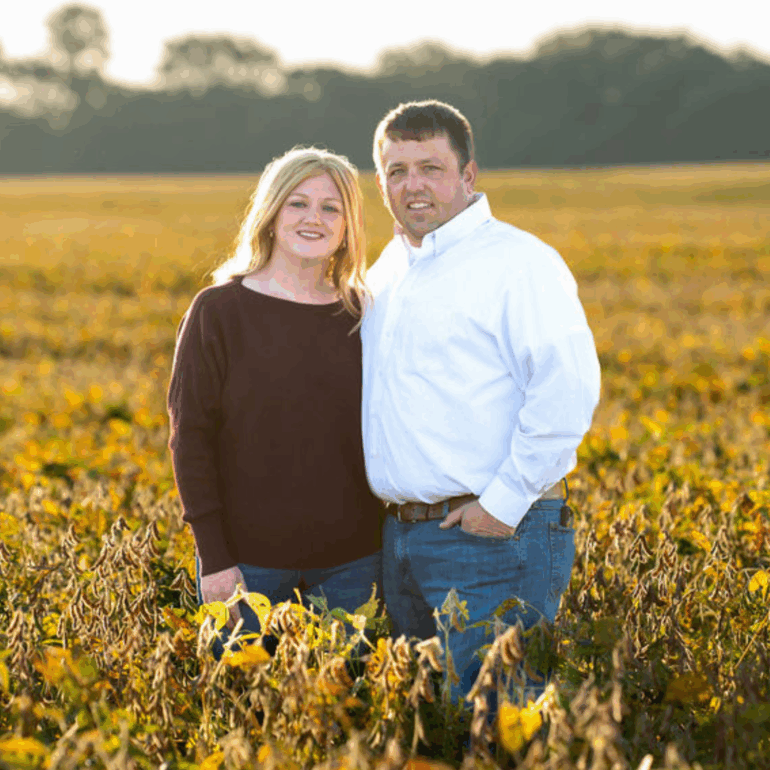
In Sterling, Kansas, Matt Splitter and his wife, Janna, manage 13,000 acres of farmland growing corn, soybean, wheat, and sorghum with a simple but steadfast idea: care for the land that cares for you.
Recognized for outstanding conservation efforts on his farm and leadership in advancing sustainable agriculture, Matt was honored as Field to Market’s 2025 Farmer of the Year.
Where Stewardship Begins
For Matt, a 5th generation farmer, and Janna, a 2nd generation farmer, agriculture roots run deep. Married high school sweethearts, the couple started farming together following the unexpected passing of Matt’s father. This fall now marks their 15th harvest.
Source: Field to Market
When the couple took over the farm, they quickly realized that conventional tillage wasn’t economically or environmentally sustainable in their semi-arid Kansas climate. They quickly moved to operate their farm with a “never-till” mindset, striving to leave as much residue on the surface and only opening the soil to place a seed.
“We wanted to do more with less,” Matt recalls. “It was the economics that really caused our first jump into no-till – it allowed us to cover more acres with less people and less equipment.”
In addition to no-till, their suite of sustainability practices now includes cover crops, grass waterways, and terraces. The benefits for these practices, they say, came back tenfold, including improved moisture and soil retention, weed control, an improved soil microbiome, and more.
“The whole goal is to do everything that we can to help our soil,” says Matt. “To be sustainable, we think the soil needs to be active all the time. So, with no-till and our other mechanical and biological practices, we feel we’re giving the soil the best chance to survive, and, more importantly, to thrive.”
“Moisture retention is key here where we get such variable weather,” adds Janna. “[Our practices] help hold water and reduce erosion, including wind when it blows.”
That same mindset of stewardship — of tending and supporting, not taking — also shapes how they approach relationships beyond the field.
Mentorship has been a cornerstone of their story. When veteran farmers Lee and Margaret Scheufler met Matt at a county extension meeting nearly a decade ago, they were searching for a successor — and Matt was searching for a mentor.
“He asked me a simple question about soybean spacing,” Scheufler recalls with a laugh. “But behind that question was someone who wanted to learn.”
Over time, that curiosity grew into a partnership. The Scheuflers eventually transitioned their own operation to the Splitters, not because of family ties, but because of shared philosophy. “Matt wasn’t looking to take over anything,” Scheufler says. “He just wanted to do things right. For us, it was about finding someone who would care for the land as we had — maybe even better.”
That mutual respect and humility became the foundation for what Splitter Farms is today: an operation grounded in family, driven by data, and guided by an unshakable sense of stewardship.
Data that Drives Decisions
Step into the Splitters’ operation and you’ll find soil tests, yield data, and analytics throughout — a clear sign that this is a modern farm built on both science and stewardship.
“Our operation is always researching and analyzing results from previous years and the impact our changes have made - for better or worse,” says Matt. “Using multiple tools to measure, we can make informed decisions to help the bottom line and remain true to our goal of making the soil a sustainable environment for years to come.”
Keith Koch, ADM Western Region Climate Smart Origination Manager, who works closely with the Splitters through ADM’s re:generations™ program, describes them as among the most forward-looking farmers he’s met. “They are very high-tech, forward-thinking, and futuristic,” says Koch. “One of the most numbers-driven operations I’ve seen.”
A key part of that numbers-driven approach, tied to their ADM re:generations involvement, is Gradable – a tool integrated with Field to Market’s Fieldprint Platform® to help them track and benchmark their sustainability progress. The Platform allows them to evaluate and compare sustainability indicators like soil carbon, irrigation water use efficiency, and energy use across multiple growing seasons.
"What they—Gradable and the Fieldprint Platform—have done is help us verify that we’re doing things right, as well as think about if there’s something better to try or do the next year."
Through that data, Splitter Farms has refined crop rotations, strengthened nutrient management, and built a clearer understanding of how their conservation practices pay off over time.
“What they—Gradable and the Fieldprint Platform—have done is help us verify that we’re doing things right, as well as think about if there’s something better to try or do the next year,” Matt explains. “We’re able to layer all of this data that we have and inform our decisions for the next season.”
Technology as a Tool for Stewardship
In addition to data tracking, the Splitters are heavily involved in other forms of technology and advanced equipment. Over the past several years, the couple has enhanced their full suite of precision ag tools to include variable-rate fertilizer and seed prescriptions and applicators, yield mapping, and GPS guidance, all designed to further maximize efficiency while minimizing input use.
“Where our farm has really excelled,” Matt says, “is the technology and data-tracking side of sustainability. We’re doing all those other things — cover crops, waterways — but what people don’t see is the technology inside our equipment: the sprayers, how we’re placing seed and fertilizer, and the other efficiencies on that side of doing more with less and not wasting chemical, seed, or water.”
The evolution of this side of their operation has been a journey, with support from Scheufler and others in their circle. “We helped Matt get into precision ag tools years ago,” Scheufler recalls. “Now he has exceeded me in adopting new technology and keeping up with that.”
The Splitters also work closely with Prairieland Partners, their John Deere dealership, to test and refine new technology that helps them reach their goals.
“Matt is a quick thinker and had a lot of ideas – he’s not afraid to try anything, and he definitely keeps me on my toes” says Cory Leonhardt, Large Ag Salesman at Prairieland Partners, with a laugh. “They use so much innovative technology across the farm – touching everything from day one, all the way through harvest – and all of those things help them take even better care of their land.”
Technology as a Tool for Stewardship
For Matt and Janna Splitter, the measure of success goes far beyond yields or efficiency. Their focus is on what they’ll leave behind — not only for their children but for the wider farming community that has shaped them. This focus is tied to Matt’s unique theory about legacy versus heritage, and it guides the Splitter Family’s work.
“Heritage is the hard assets that you’ll leave for another generation — the ground you can give to your kids, the farm equipment, the cash,” Matt explains. “Legacy is what you did with those assets, what you did with that resource pool. Our goal is to leave a legacy for the next generation in agriculture that questions and finds answers through critical thinking and the power of deduction.”

Source: Field to Market
This is evident in their work with the community. From peer-to-peer support, public speaking and teaching events, serving on various boards and committees, and more, Matt and Janna work diligently to share their knowledge and support others on their sustainability journeys.
“If we need something, they’re there – they always have been,” remarks Koch. “They are very, very invested in making sure that farming, and the whole farming community, thrives.”
“Rick Schlender, who supports the Splitters’ agronomic and precision work has seen their generosity extend well beyond education. “We watch their operation center, and he’s got neighbors that he custom farms for,” he says. “Ninety-nine percent of farmers would do their own land first, but I saw them pull over and harvest for a neighbor when it was ready. That kind of care for others really impressed me.”
Over the past decade, Splitter Farms has hosted more than 30 international trade teams from 15 countries, opening their doors to downstream customers and trade teams from around the world to show what regenerative agriculture looks like in practice.
“Being able to show, teach, and express what we’re doing on our farm is critical,” says Matt. “At the end of the day, there are things that [downstream customers] see or use that I don’t, and the same can be said for us. So, when we come together in the fields and talk about things like data tracking and technology, it’s eye opening for all of us.”
For the Splitters, that exchange of ideas — between farmers, partners, and consumers — fuels their drive to keep getting better. Each conversation and each shared lesson reinforces their belief that transparency and progress go hand in hand and impact their legacy.
“Everybody should have a goal,” Matt says. “Ours is we want to continue to improve our practices to leave our greatest assets in a better position for the next generation, and that’s happening by farming sustainably.”