 Premium content is for our Digital-only and Premium subscribers. A Print-only subscription doesn't qualify. Please
No-Till Farmer
Get full access NOW to the most comprehensive, powerful and easy-to-use online resource for no-tillage practices. Just one good idea will pay for your subscription hundreds of times over.

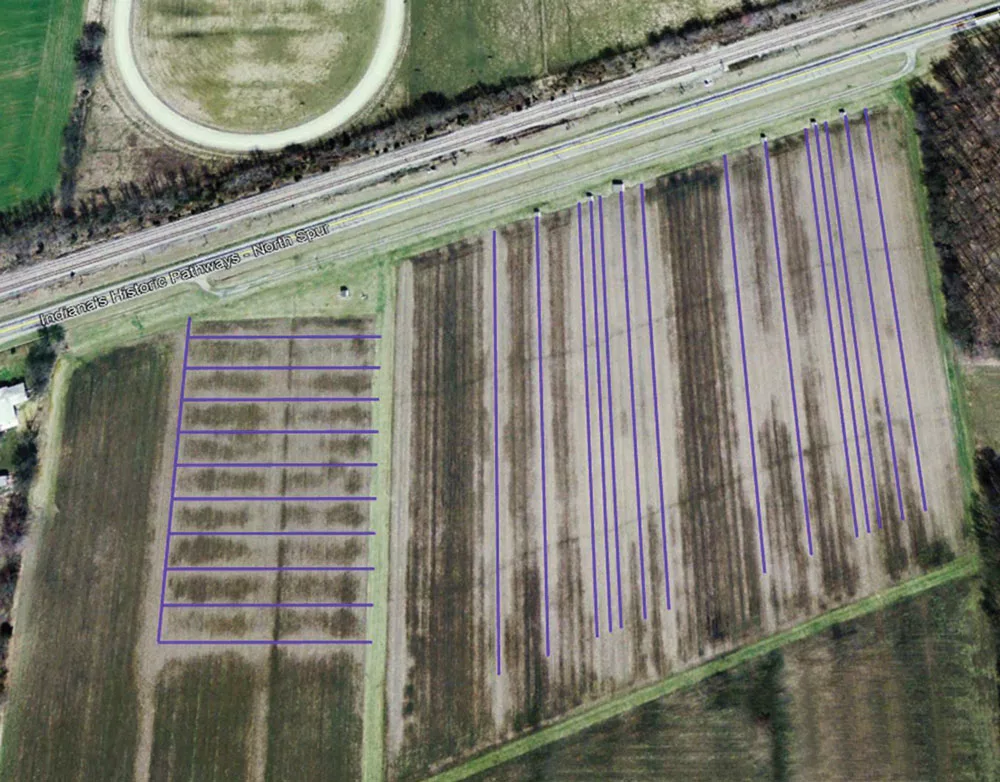
DRAINAGE OVERVIEW. This aerial photo overlain by drainage tile treatments in blue illustrates SEPAC’s 35-year proving ground for various tile spacing in poorly-drained Clermont soils of southeastern Indiana. Note the lighter (drier) soils under narrow drain fields. Purdue Univ.
More than 35 years of research shows growers with “high water-table” soils can reap corn yield benefits from subsurface tiling and, at the same time, improve the effectiveness of their conservation practices.
Purdue University agronomist Eileen Kladivko has spent much of her nearly 44-year career involved in field drainage studies at the university’s Southeast Purdue Ag Center (SEPAC) near Butlerville, Ind., seeking to improve the structure and productivity of the area’s Clermont silt loam soils. Looking back, she’s convinced addressing drainage issues — even with soils that are naturally resistant to optimum waterflow — is the first effective step to improving farm productivity.
“There are soils with fragipan or claypan, or glacial till at 2 or 3 feet deep. The water gets to that level and then builds up and ponds to form a high water table at certain times of the year,” she explains.
It’s under those conditions properly placed drainage tiles can provide both short- and long-term benefits such as:
Kladivko’s research began in the early 1980s when the university began studying perforated plastic pipe as a drainage medium and its…

Get full access NOW to the most comprehensive, powerful and easy-to-use online resource for no-tillage practices. Just one good idea will pay for your subscription hundreds of times over.
Download these helpful knowledge building tools

We have engineered and developed the most advanced concave system that threshes all crops, eliminates rotor loss, improves grain quality, gives you a cleaner sample – all with one set of XPR concaves.

At Titan International, our product portfolio reflects our commitment to innovation and high-quality products. Titan International offers a full line of solution-focused wheel, tire, and undercarriage products for a wide variety of off-the-road equipment in agriculture, construction, forestry, mining, power sports, high-speed trailers, and outdoor power equipment segments. As one of the largest North American manufacturers, with a network of dealers all over the world, Titan is an industry leader that original equipment manufacturers and operators can count on for durable products and quality service.

Provide expert analysis and decision support to increase productivity and profitability.