
Editor’s note: In an interview with No-Till Farmer Senior Editor John Dobberstein, Pioneer agronomist Matthew Vandehaar discusses why late-season nitrogen (N) still has a place in this year’s corn crop, in spite of high input prices.
From drought-stressed fields at the start of the growing season to record-setting July rains in some areas, 2025 has kept growers guessing, especially when it comes to nitrogen (N) availability for corn.
Modern hybrids continue nitrogen uptake into grain fill and delay moving stored nitrogen into kernels. With a wider window of N use, many growers consider making later N applications.
Kansas State University Extension researchers tested how different N programs affected several Pioneer brand hybrids under both irrigated and dryland conditions. The goal was to see how late-season nitrogen changes kernel numbers, kernel weight, grain fill timing and overall yield.
Research found that late-season N applications extended the grain fill period and increased the rate of dry matter accumulation compared to no late-applied N.
Q: Input prices are taking a bite of our growers’ wallets right now. Why should growers still consider a late-season nitrogen application for corn?
A: The anhydrous prices we paid last fall came down from the previous year’s highs. It's still a high price that we don’t want to pay, but it’s not where many will just skip a fall application.
Many growers have investigated in-season N applications to increase efficiency and timeliness for the plant, and use less overall N. We've also seen a stretch of dry years and then last year we would've had a little more rain, at least in central Iowa, May to June. This year (in central Iowa) we had a lot more rain through the main part of the growing season.
You should feed that crop when it truly needs it, in the vegetative stages. At the stages where we’re building protein and starch in that kernel, the plant is trying to mine out its leaves and stalks, and that's when we see some deficiencies occur during grain fill. If we can get that N closer to that period — which is more important than ever as we modernize our hybrids and bring out high-yield hybrids — they can really excel in the grain-fill period.
Q: Checking the crop to determine if a late-season application is needed would make sense. What tools can growers use to look at the crop and at data to decide if it’s a good investment or not?
A: There’s lots of different options for looking at field imagery at different resolutions through your seed company or whoever you use for technology. You can look at a lot of imagery without spending the time to find somebody with a drone or airplane.
Drones used by crop advisors or people providing inputs can provide a quick glance above the field to see how yellow yields are because you can’t always see it from the road. Then you can scout and see how ugly the spots are and assess what we have for N in there. You can certainly go through a lot of tissue testing, but your eyes are going to ground truth it first.
Q: We have a lot of people that no-till and strip-till in our readership. Do tillage practices make any difference in terms of deciding on late-season N requirements?
A: With no-till or anything minimal tillage, like strip-till, you’ve got a lot of the residue sitting at the surface. Sometimes we see early-season tie-up, which is why some growers have moved to more in-season applications — even doing them around planting — to ensure the N plants need is out there. As you get that residue breakdown throughout the season, it can still have a little more of a lag than the conventional tillage. We see that with corn-on-corn as well. You’ll get the N release eventually, but it may still be delayed. Sometimes with no-till we can see those patterns drag out a little bit further in season as that residue breakdown still is occurring at the surface rather than being incorporated with the soil.
Q: As far as mode of application and the type of product, have you seen any late-season setup works better than another?
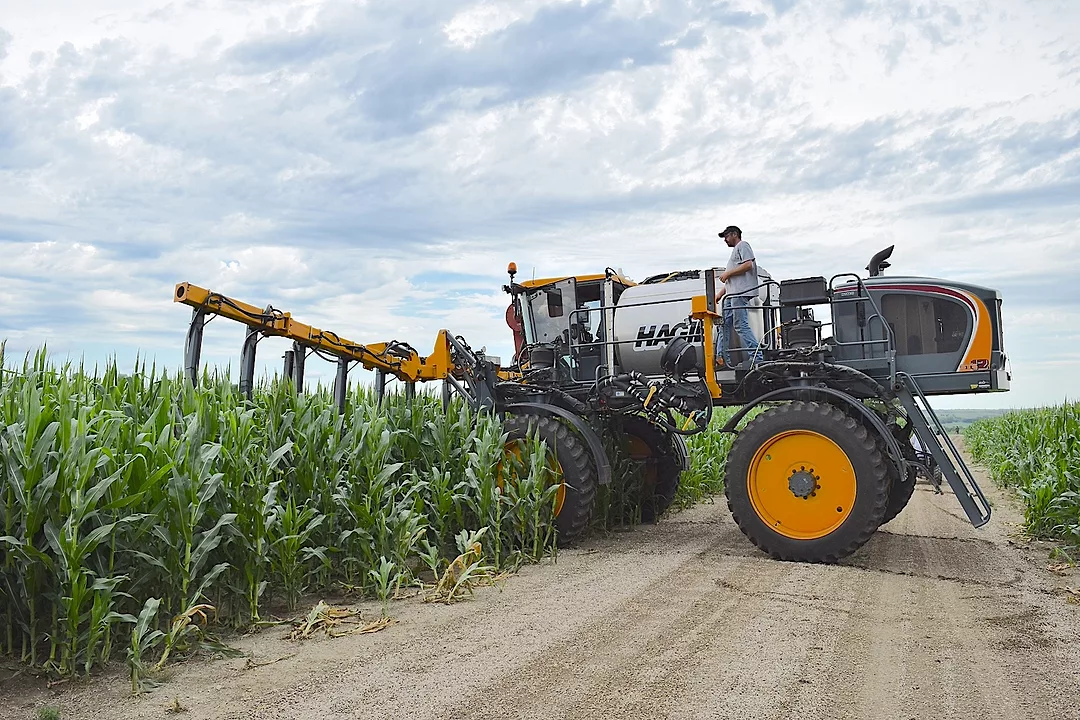
A: At least in central Iowa, the Y-drop is being used at a good rate, and then topdressing with a highboy spreader. Then you have aerial applications, which are less frequent because a lot of the planes are switching over to fungicides and may not go out there as frequently with late-season N. And certainly there’s a few more in there like a coulter-based application.
I’m not sure one method is significantly better than the other. They all do a good job. There’s differences in placements and products. I tend to make sure people are applying some sulfur with the N, because if we’re having some N concerns — especially with no-till — you also may need sulfur.
Some products need a little more moisture and the application must be closely planned unless you’ve got a product that’s stable and doesn’t need it. It's more about the feasibility: do you have access to a high-clearance spreader or are you OK taking the time with the extra volume that occurs when you’ve got Y-drop liquid applications?
Q: If you’re looking at a late-season N application and rain is moving in, is it better just to wait?
It’s a different perspective this year after a lot of in-season rainfall vs. the last couple years. You could have got yourself in trouble the last couple years, not having a timely rain on certain products used, especially dry-based products.
This year it might've been more the opposite where if I had a window, I'm hitting that window no matter what and I'm going to go get it while I can get that field done. Because there were some applications that just didn’t get done in time and it was because we could not get to the field because it was wet. I can’t predict what the weather's going to be in 7 to 14 days when I may need the product rained in. But I want to make sure I get that N budgeted in there.
Q: You hit on the kernel weight issue earlier. Why is that so important?
What we've just been studying is this new wave of advancements. Some of our best-yielding hybrids truly are 70,000 kernels per bushel when you average them across a lot of environments. And we're not dividing by 90,000 kernels per bushel anymore. So some of these more modern hybrids may not necessarily put on a big kernel count because they are really, really invested in putting on a big kernel and that's worked well for them.
But at the same time, we can’t run out of groceries for those certain hybrids. So if you’ve got a big-kernel-weight hybrid, we want to ensure the plant and hybrid, and that environment, isn’t running out during those critical stages late in season. So not that I’m saying that all these new hybrids need more N in season, but we’ve certainly seen the kernel weight being increased on a lot of them.