 Premium content is for our Digital-only and Premium subscribers. A Print-only subscription doesn't qualify. Please
No-Till Farmer
Get full access NOW to the most comprehensive, powerful and easy-to-use online resource for no-tillage practices. Just one good idea will pay for your subscription hundreds of times over.

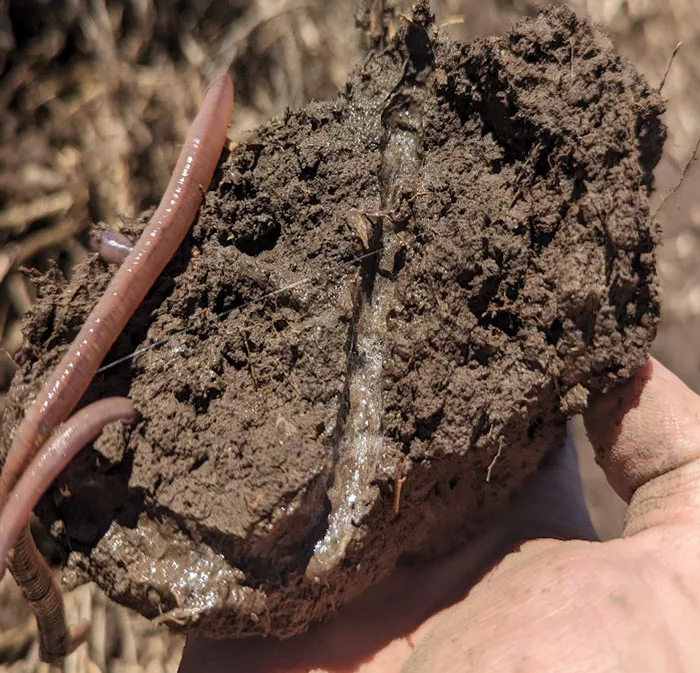
NATURAL TILLAGE TOOL. Earthworm galleries can provide up to 70% of a field’s infiltration rate and are lined with 5-10 times the available nutrients of adjacent soils. Also, worm channels are rich in calcium. Brian Dougherty
Brian Dougherty says growers combatting compaction in their fields should realize they have bigger problems than merely compressed soil, and compaction is a symptom of poor soil function.
“Compaction is not natural or inevitable in modern cropping systems and, to be blunt, it usually can be traced back to three factors: too much equipment, not enough biology and excessive nutrient application,” he says. “To deal with compaction in the long run, we need to address what is not allowing the soil to function properly.”
Dougherty is a field consultant for Understanding Ag, a firm dedicated to helping growers implement soil health improvement practices. He preaches the importance of well-aggregated soils which contain roughly equal volumes of minerals, water and empty pore space. Since minerals (soil particles) and water are non-compressible, when heavy equipment travels over a field, the only thing to yield in the soil is the pore space — which produces compaction.
“For proper plant growth, roots need a gaseous exchange and pore space is where that occurs,” Dougherty says. “If the soil is compressed and pore space is compromised, there’s little room for water and oxygen/carbon dioxide exchange. When those components are shorted, soil microbiology suffers and in the long run so does crop performance.”
The interconnected pore spaces so important for water infiltration and nutrient exchange with crop roots are protected by soil aggregates held together by a natural glue — glomalin — produced symbiotically by mycorrhizal fungi from carbon-rich exudates shed by adjacent living roots.
“Those…

Get full access NOW to the most comprehensive, powerful and easy-to-use online resource for no-tillage practices. Just one good idea will pay for your subscription hundreds of times over.
Download these helpful knowledge building tools

We have engineered and developed the most advanced concave system that threshes all crops, eliminates rotor loss, improves grain quality, gives you a cleaner sample – all with one set of XPR concaves.

At Titan International, our product portfolio reflects our commitment to innovation and high-quality products. Titan International offers a full line of solution-focused wheel, tire, and undercarriage products for a wide variety of off-the-road equipment in agriculture, construction, forestry, mining, power sports, high-speed trailers, and outdoor power equipment segments. As one of the largest North American manufacturers, with a network of dealers all over the world, Titan is an industry leader that original equipment manufacturers and operators can count on for durable products and quality service.

Provide expert analysis and decision support to increase productivity and profitability.