TRANSCRIPT
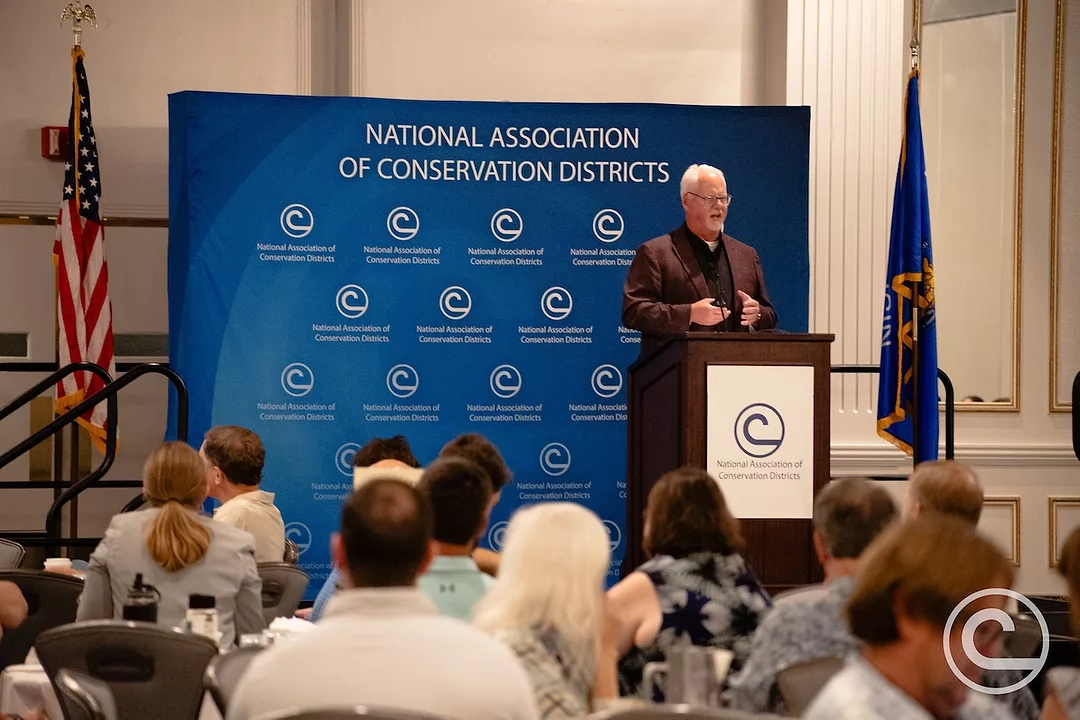
Gary Blair: Enjoy your lunch as we welcome him to the stage. I actually met our speaker about a little over two months ago. We were in South Dakota together at a CTIC tour. And we were sharing notes and sharing upcoming meetings and locations. And I told him that we were coming to Milwaukee. And he said, "Well, I'd love to just attend." And I went back and shared with our team about meeting Mike. And next thing you know, he's our keynote speaker today. So thank you, Mike. We're glad you're here. Mike Lessiter is the president of Lessiter Media joining us today. Lessiter Media is an ag media company whose brands are recognized and trusted as a source of information by conservation districts and the producers they serve. For years, Lessiter Media has been offering a myriad of brands to the ag community, including No-Till Farmer, Cover Crop Strategies, and more.
They also offer grassroots and farmer-to-farmer annual conferences, like the National No-Till Conference. The company also produces two video broadcast shows, On the Record and Conservation Ag Update. Mike is a second generation agricultural journalist. His parents started the family publishing company in Brookfield, Wisconsin. His father, Frank, produced the first edition of No-Till Farmer in 1972. And since then, the Lessiter family has brought knowledge of conservation and practices to the producers across the country.
Mike joined his father in 2023 and oversaw expansion of the company's agricultural division. He was named president of Lessiter... Was it 2023 or...
Mike Lessiter: 2003.
Gary: 2003, okay, I'm sorry. That's a misprint. I was going to say you joined him, but you were president in 2007. In 2024, Mike was named the president of the Conservation Ag Foundation and newly formed non-profit created to advance farmer-to-farmers sharing and education of the transitions and conservation ag practices. Today, Mike will share with us key elements of no-till history, plus a blueprint for the future, in critical success factors to sustain and grow conservation practices and the role of conservation districts in making successful conservation transitions and adoptation a reality. Please join me in welcoming my friend, Mike Lessiter.
Mike: Thank you, Gary.
Gary: Thank you.
Mike: And I commend you for your bravery here. It takes guts to give a journalist a microphone, because you may never get it back again. But I did promise Gary, Candice, and Jeremy that I would help manage the clock, so I better get started here. Like Gary said, we're from Brookfield, Wisconsin, about 15 miles west of here. We serve a national audience of farmers, but right here in southeastern Wisconsin. Pleasure having the mayor here. We are very proud of Milwaukee. Think it's one of the best kept secrets in all of the United States. And great to have you here. And I hope the meeting is going wonderful for you. I know we have a lot of No-Till Farmer subscribers out here today, and I met several of them this morning. But the foundation may be new to you.
It was set up last year. We were encouraged by farmers. The no-till community is not satisfied with where we are today on adoption and suggested that we get more involved and move our circles out of just speaking with farmers to try to grow the whole pie here. So we established a foundation. Howard G. Buffett Foundation was one of the first in. He was a no-tiller in the early days by design, and he is paying things forward to encourage no-till worldwide. We also have an Operator Fellowship. Our role with the foundation is farmer-to-farmer sharing. And that's what we do in our publications, at our events, and so forth. So we're excited about that. Wanted real briefly, if I could introduce, I have two staff here with me today, Patrick Sharpe. If you could stand up, Patrick. Patrick is the executive director of the new foundation we have here. And Mackane Vogel in the front row. He's one of our up-and-coming editors who's reporting on no-till and cover crops. You'll get to know him a lot more. Thank you, gentlemen.
As I put together these slides, it occurred to me how many others before me got heckled when presenting on a no-till audience, including my own dad. And there were some manufacturers and dealers out there who claimed we were trying to put them out of business with this little thing called no-till. So I'm standing on their shoulders today, but I do appreciate the friendlier crowd and the allies we have with you. So we are going to get going here. See if I got this work. I love this quote from Saidi, who is a major champion across the African continent on no-till. "Knowledge not shared is knowledge wasted." And that's what you're here to do this week. Surely, you had other places you could be than in the heat and the humidity of Milwaukee. But by showing up, you're in the top echelon of those committed to bringing the very best back to your home district. So kudos to you for rolling up your sleeves to learn, strategize, and plan with like-minded pros here this week. What I hope to do today is make you think about what could be the greatest difference you could make in your districts back home, why no-till and cover crops are worthy of a number one priority and how the ROI could be very, very significant. As I go backward, you're also going to learn how tough it was to make no-till work, since this radical idea was introduced a half century ago. But those days of shock and awe and excuse-making are long behind us. There are no limitations today on planting equipments or drills, the crop protection products, the information and network to help, but does take smarts, management skills, and strategies for what mother nature hands you. And unfortunately, that means it's not for everyone quite yet.
This is my dad, Frank. And I was speaking with Phil Campbell earlier, executive board from South Central. I am a very, very proud son of my father. He is 86 years old this year. Still comes in a couple days a week to write the stories for No-Till Farmer and Cover Crop Strategies. He is at our old centennial farm in Michigan with my sister right now. Otherwise, he would've loved to have been with you here today. He moved our family to Wisconsin in 1972 to produce that first edition of No-Till Farmer, which is up there in the upper left-hand corner. I was three years old when that happened, when we made the move, and he came up here and edited that first piece. So No-Till Farmer was like the fifth child in our family and probably the best behaved, if I'm honest, but my parents nurtured it and cared for it just like the rest of us.
And so, growing up with it, I knew acronyms like NACD, SCS, NRCS, SWCD, CTIC at a very young age. At right, here, our dad's two books that we recently put out on no-till history. Frankly Speaking is the newest of the ones here. Page 2 of No-Till Farmer for the past fifty-some years has always had a column. And dad pulled no punches. He called it like he saw it. And this book is a compendium of 50 years of rants and raves about what was happening in real time out there. And it was great fun to help him put that one together. When I graduated college, virtually no one was recommending careers in ag. There wasn't room for me in the family business. The dad was rebuilding after just barely surviving the 1980s. And so, like many of you, I had to "move to town" to find work.
And in my case, I moved to Illinois to run manufacturing magazines for 12 years before coming back to join dad and my late mother 22 years ago. Since then, we've added 31 people, acquired five publications, and expanded our conservation and machinery niches. But I very much know where we came from and how it was no-tillers sending in their subscription checks that kept us afloat, kept our business afloat and our family afloat, when the odds were stacked against us.
So no-till's story is very personal to me, and that's much of what I'll be covering today. And again, Frank stood in the gap, and many of you did it right along with them. And forever grateful for that. We're going to go back, as you said, some history here. The notion of no-till was totally unconventional just a generation ago, radical, wasn't how dad or granddad did it. Only the crazy folks were endorsing it. This quote here was when things started to turn in the early '80s. This was from Dick Foell, who I've gotten to know and was one of the founders of CTIC, who was quoted by saying, "Farmers can save soil, toil, and oil. Farmers are scraping, ripping, tearing, and raping the bosom of mother Earth." No-till could save the family farm at a time it was needed by being able to farm more acres with no additional labor and less equipment and fuel. And people, even the New York Times, were starting to pay attention.
Just sort of real briefly, basic definition of no-till here. It's keeping the soil covered by residue, using as little disturbance as possible to get that seed in the ground. We are only 63 seasons removed from the first no-till corn being commercially harvested, so we're still a pretty young pup in the world of agriculture. Bill Richards here, who was, like Chief Bettencourt, was running NRCS, he described this and how he got through those early times by saying, "No-till taught us to manage more acres with the same labor and machines and farm more profitably.
We have countless stories about how no-till saved farms and changed lives. And there's an entire chapter in Dad's From Maverick to Mainstream book that was devoted to the topic of how no-till changed my life with personal submissions from all over the US and the globe.
Just a brief look here, back down there in the left-hand corner, that's 1972 when dad put out the first issue. At that time, all the no-till acres in the country could have fit within the border of Connecticut. Up here at the right is where we are today, 110 million acres. A nice line of growth, but still frustratingly slow.
In 1975, the USDA projected that 50% of the crop land would be in no-till by 2004 and would be approaching 60% by 2010. Where we are today, we're in the 40s for soybeans and wheat, in the mid-30s on corn. So we still haven't hit that halfway mark yet projected by the USDA, so we're running about two decades behind schedule.
Even the Equipment Manufacturers Association in their a hundred-year anniversary had to admit that no-till planning is the single most innovative cultural practice to be widely adopted in ag since the mid-1960s. But the movement to no-till wasn't easy, nor was it an assured foregone conclusion. It brought different sets of problems and variables to manage things like soil temperature, germination processes, new diseases and pests, more complicated planting, and how to control that residue, or what the farmers unknowingly referred to as trash. But even in those early years, it was possible to net out a savings of $135 an acre in fuel, labor, and machinery costs by farming with the brain instead of the brawn.
Dr. David Savage, who's an agronomist turn writer for Forbes Magazine, had insisted in a podcast to us that the no-till story and its historical paradigm shift was one that had to be told. It shows how significant change is still possible. It shows how to survive and quiet the naysayers and the objectors, how numerous stars had to align in sequence and compound itself for what became eventual success. In his words, "It's necessary for all to believe the significant change that is still possible in a well-entrenched tradition-rich world in what needs to happen or not to happen for lasting change to take root." We learned earlier this morning about how NACD turns 90, the Leopold award turns 60, congratulate you for this key role in this story to date, the story's not done yet.
Got a few slides just on no-till benefits. Rolf Derpsch, who was responsible for a lot of no-till growth in South America and worldwide has said, "No technique yet devised by mankind, has been anywhere as effective as halting soil erosion and making food production sustainable as has the no-till practice." That image at right was one of the very first pieces ever produced about no-till. It was distributed by Allis-Chalmers who would become the first to make no-till equipment.
At the time, there was very little data to work with, we didn't have research data, it was a brand new practice, and its opening sentence appealed to farmers with the story of the Garden of Eden. He said, "When God was planting the whole world by himself, everything was planted without tillage and he grew a very respectable crop." The words here get to the root of the benefits for mankind and the farmer environment, wildlife, soil sustainability, reduced greenhouse gases, dealing with floods and droughts, the reduced soil compaction, soil temperatures, higher yields, more land with less and profitability.
I'll whip through some of these fairly quickly. Erosion was the primary reason in how it was promoted to farmers back then. There were certain parts of the country on sloping lands where erosion was just killing the ag property at epidemic proportions, most so in the hilly areas of Tennessee and Kentucky where invention would be born out of necessity.
Water management, this is a real-world picture of conventional and no-till ground following the same rain event on adjacent farmland. Everyone who's running side-by-side plots can show this very story by turning on the pivots and watching what happens. We've got detailed summaries of farmland following tremendous storm events, and conventional farmers can lose five tons of acre virtually overnight. Meanwhile, a neighboring farmer with no-till and cover crops might lose just 200 pounds in the same rainfall. Very significant.
I imagine most of you have seen a no-till water demonstration here that clearly depicts what water looks like coming off conventionally-tilled grounds versus no-till versus no-till with cover crops. A great story on water.
The soils, the organic matter, the soil structure, the benefits of earthworms, no-till fields will have 10 times the earthworms as conventionally tilled soils greatly improving soil structure, moving and depositing nutrients and all the biological activity. And a shovel to a no-till field will be full of earthworms doing all kinds of underground work for the farmer, and the earthworms are the sign of life.
Just productivity gains are no surprise. As no-till took off, the productivity went at a very steep rate.
Yields, there's always talk about yields and contests are contests, but the highest yields still come from the no-till categories. And while most of the no-tillers that we deal with at our conferences or in our interviews, they're less likely to talk about yield and more likely to talk about profit and net margin rather than getting caught up in bragging rights on yields. But the 2025 No-Till Farmer Operational Benchmark study shows no-till corn and no-till soybeans both out yield the national averages.
So we're going to talk about what set the table here for this change. And some of the names you'll see were mentioned earlier today. John Deere's plow that came back out in 1837 would indeed eventually break the plains and it also broke a lot of dreams of rural America. These are pictures from what the 1930s looked like. And while most of us would say that Benjamin Franklin was a very wise man, I'm sure he never anticipated how misguided his words, meant to define work ethic, were still hanging around as a folk saying in rural America hundreds of years later, "Plough deep and you shall have corn to sell and keep."
So we're going to talk about two people that were very responsible for the movement that happened. And I love this quote, this proverb, "A society grows great when old men plant trees who shade they know they shall never sit in." And this proverb defines what each of you are doing here today and what you're working on to make this land better for future generations. These two prophets here, H.H. Bennett, which Chief Bettencourt mentioned earlier, and Edward Faulkner, they never got to sit in the shade of the work that they started. Both died before seeing the dreams for no-till become reality, Bennett in 1960 and Faulkner in 1964.
Bennett, as you know, was the father of the conservation movement. He was named the chief of the new Soil Conservation Service and he attacked quote that we have here that was coming out of the federal government that had this view of soils, that it was indestructible, it could never be used up and early in his career, he made it his business to fight that notion.
Got a following few quotes from Bennett. I won't go through all of them, but I'll highlight a couple of them. This one's very powerful, "What would be the feeling of this nation should a foreign entity suddenly enter the US and destroy 90,000 acres of land as erosion has been allowed to do in one single county?" Or this one, "The Soil Conservation District's movement is one of the most important developments in the entire history of agriculture."
Before we move on, everyone knows about how Bennett did not waste the crisis of the Dust Bowl storms that clouded our nation's capital and how he got unanimous support for the SCS in Washington DC. So I want to show you this one. This photo was from two years ago in a dust storm that stemmed from an Illinois farmer working the land near the interstate. It had eight people killed in that one event. And how well have we responded to this tragedy? Eight lives lost in one event and another two dozen per year. Have we, like Chief Bettencourt mentioned, acted with absolute urgency like Bennett did back in the day? I think we know there's more work to be done. Randall Reeder of Ohio State was on our podcast recently and said these words that, "None of these dust storms are necessary if no-till and cover crops were used."
Go to the second no-till Prophet I wanted to mention Edward Faulkner. Faulkner came with a new philosophy about soil principles and dropped a bombshell on contemporary farm theory when he blamed what was then the universally used moldboard plow for the disastrous pillage of the land. And he assaulted the entire practice of cultivation in the US and reported that no one has ever advanced the scientific reason for plowing. This caused great debate between adversaries and opponents, and he opened up a whole lot of eyes.
So that brings us to the 1960s, and this is when the research movement started for no-till, still not all that long ago. Who I have pictured here is George McKibben. He started the first no-till plots at the University of Illinois Dixon Springs in 1961. That picture at the lower right is the planter that they used to get it in the ground, trial and error. That's Donnie Morris who built that planter and is still with us. Ohio State started one year later and they've kept those no-till plots going. They're the longest, continuously run no-till plots on the planet.
I mentioned Kentucky and Tennessee where this was born. Farmers were losing as much topsoil in four years that had taken 1,000 years to create. And in parts of Tennessee, there's white beach sand directly underneath the topsoil. And if you've drilled for a well down there you can see it. Professors like Blake Brown said that that part of Tennessee would be an inland beach had they continue to be farmed with tillage.
So bring you up to the first commercial crop ever. A farmer in Kentucky by the name of Harry Young Jr. had been out to see McKibben in Dixon Springs, Illinois, and decided he didn't need to wait for the research. He put the first commercial plot of no-till corn in in the spring of 1962. He had pulled a mule-drawn tobacco planter out of the fence row and hooked it up, as you see here. He was not a fanatic of the practice but wanted to see if it worked. And he put this so-called trashy looking field along a Kentucky highway for everyone to see whether it worked or not, but it did.
And he worked with the University of Kentucky, Cheryl Phillips, to continually refine that system and he never hid his success under a bushel basket. Over the next 20 years, there would be more than 11,000 farmers who converged on this tiny town of Herndon, Kentucky, to see for themselves. And if you find yourself over in that part of the country, I would encourage you to stop by for a visit. His son, John and grandson Alexander still work the land and visitors come all over the world to see this hallowed ground. And John has told me that he's seen Buddhists pray by that sign there, thanking them for the no-till gift that was started there.
Dad spent a lot of time with the Youngs in Kentucky learning about no-till. And remember, there was virtually nothing written about this in written form in 1972. In '73, he asked to speak before Congress about no-till and they accepted his invitation and it was the first testimony on record on the subject. Gary and I were just talking about this very thing because he testified just the week after we were together in South Dakota.
I've warned you before, I'm proud of my dad. One of my favorite descriptions about Dad's work came from the late No-Till Farmer Hall of Famer, Walt Buscher. "When No-Till Farmer came off the press in 1972, it was a voice crying in the wilderness. It filled the need for insightful information and data when most of the other farm publications were hoping no-till was just a fad and that the idea would go away."
So here's what had to be overcome back in those days. There was no equipment. Farmers had to torch and weld up their own tools all through trial and error. There was outright resistance by the major equipment manufacturers. They viewed it as a threat to their higher-horsepower tractor and heavy tillage sales. We had professors who couldn't admit to decades of outdated or flawed research where they pushed terracing, stripped cropping or other expensive practices instead. They were set up for failure. The plots that were begrudgingly started were often arranged on the worst possible ground. And some, including academics, suppliers, and other farm journalists were all too happy to report the failures and the black eyes. And finally, it was the social factor, which the Chief also talked about today. The coffee house ridicule over the lazy, ugly farming that was going on. And the no-tillers stopped going to town and sitting and dealing with the abuse. So how did they do it? How did they make this? How did they overcome these incredible obstacles? There was ingenuity and commitment to work the problems to death. A burn the boats mentality. The true story, we had farmers who told us they got rid of all their tillage equipment so they wouldn't be tempted to go back to it when things got rough. A passionate few who took on the naysayers, researchers who insisted on setting things up for success, making sure that the crop wasn't planted too early, or making that adjustment that was needed to give it a fair shake.
Industry cooperation with universities. I was told that this was pretty much a foreign concept at the time when researchers shut their gates off. The people who did the Milan No-Till Field Day in Tennessee went a different route and they opened it open participation from farmers, from manufacturers, from everybody. And their work was responsible for an awful lot of innovation. Extension agents and advisors who studied the science got out in the field together and ran the equipment, and maybe most importantly didn't give up either for themselves or the farmers they were working with.
We have a machinery business magazine that we run as well, and I'm very keyed in to the short- line equipment advancements. We had farmers who became short-line equipment manufacturers and bet their futures and their farms to develop and build the tools that were needed for no-till. High risk. The CSP, the EQUIP programs, the conservation districts like we're talking about here with the technical assistance, the education, the incentives, and a dedicated publication in No-Till Farmer to transfer those best practices, the innovations and the problem solving, including the landmines that were out there.
So we have online and in our publications a 200-item milestone of what took place in no-till. And obviously I'm not going to delay your afternoon by going through that here, but I've pulled out a few. The first one here, the first no-till equipment came out of Alice Chalmers in '66. And the historian Norm Swinford covered how wheel track planting had confirmed earlier that only a small area of fine firm soil was needed for planting. And finally, planter experts finally asked the million-dollar question: why do we need to turn up 1,000 tons per acre with a moldboard plow when we only need 8% of the ground for a seed-bed? They got it started, 1966.
1973, Sheryl Phillips and Harry Young who we've talked about, published a book on no-rill, which was the first real literary piece out there on it published by No-Till Farmer. '76 Roundup comes in, changes the world on weed control. Just mentioned the No-Till Field Day in Tennessee. Unique collaboration, and lots and lots of innovation. And a lot of things didn't work, but they got the chance to test them out and refine them and adjust and keep going.
'85 conservation put into the Farm Bill for the first time. Also in 1985, John Deere comes with the 750 no-till drill. And they were late in the game and were far from all in, but they gave a great tool out here that legitimized the practice out in the field. They were still calling tillage the responsible way to farm as late as 1999, and were still making the moldboard plows until 2023. But this was a significant moment.
I have a picture here of Bill Richards, who was the chief of what became renamed NRCS. He was a no-tiller from Ohio who was put into this role. He was the second no-tiller to be put in that role behind Pete Meyers and his passion and diligence changed the score, and he had a major promoter on a national platform with Bill Richards, who just recently died at the age of '92. A great friend of no-till. Also have to mention the conference in what happened here. Dad was one of the very first newsletter publishers to get into the conference business. He had done surveys of his subscribers in the summer in 1992 and it brought a resounding yes to the idea that he put forward. So he took on a risk and it was a risk that had to work for our company at that time. He had hotel space in Indianapolis for a crowd of 150, but was overwhelmed with registrations and had to expand three times before selling out at a max of 800. We got farmers from 21 states and three nations. Meals had to be served on three different levels because the hotel couldn't accommodate this crowd we had.
And the magic that was seen there was remarkable. Farmers weren't known to share a whole lot locally at the time, but something magical happened when we got them together around a shared common interest of no-till. And the conference is general sessions and classrooms and everything. We had these farmer-to-farmer roundtables. There was no speaker, we'd listed common problems and farmers would pick which one to go to. And then when they got into that small room, they traded notes and workshopped problems and encouraged each other.
One of the smartest no-tillers I know on the planet has called this event his support team, his therapy group. And after he missed the first one in 1993, he's made 32 straight conferences. It wasn't us, but it was the farmers who showed up and shared that made this unique concept work. And I've worked in other industries and our company does five other in-person events and still have not seen anything like this. Remarkable.
One more thing I wanted to talk about with the history and the dichotomy of response between the U.S. and the other areas to a practice that was invented here. Mentioned earlier that adoption rates are stagnant in the U.S. when there's so much more opportunity for growth. And though it was born here, it wasn't raced to like it was in places like South America and Australia. And wanted you to see here, if you can see these percentages of total crop land under no-till, you can see where South American and Australia look like versus where we are today. I asked Rolf Derpsch to detail what went right down there. And he gave these seven reasons here, but essentially it was an all-in approach and that's what yielded the change. And their farmers were on such thin margins they had to embrace anything they could to survive, and they did, and they thrived. Young and Phillips shared with them what farmers weren't listening to in the U.S. and then these farmers were off and running with a new ag system that allowed them to compete internationally.
And no-till is more a story of people than it is about equipment, crop attraction, or any significant scientific or machinery development. I don't have time to do this justice, but wanted to mention that the no-till story is one of those who wouldn't give up and diligently shared everything they knew, including the landmines. Guys like the late David Brandt, Bill Richards, and Grover Triplett, to today's national champions like Ray McCormick and Jimmy Emmons. All are featured on our website and our pages and are worthy of you knowing their story. The passionate farmers, researchers, educators, and advisors who stood in the gap and wouldn't let it fail.
As we talked about the stagnation here, here's what our acreage looks like today. About 45% for soybeans and wheat, 36% for corn, and 19% for cotton. The recreational tillage habits still die hard. There's some farmers who are still comfortable and didn't have to change like some of their others did in other parts of the country.
I've heard this recently about some iron obsessions that are coming out of a new generation who perhaps weren't reared and taught about the struggles of the 1980s. And John Bradley, who was a very significant person in no-till, he still consults with generational farms. And he said, he boiled this down to me, which I thought was interesting, the younger generation wants control and no-till requires you to work with and respond to Mother Nature, not control her, but he sees youngsters excited about the machinery and how they think they can beat her. They pull out a huge disc, tear up the soil, and feel in control. Feel in control.
Last one here, the passionate people who are winding away. This is the one that's most concerning, I think, at every level. You have university people who are unwilling to make those adjustments, to give no-till its best in comparative studies. We have retirements, deaths, farm sales, job cuts, a whole generation of people who mentored and encouraged.
And John Bradley and Randall Reeder, and we've talked a lot about this, said, where no-till grew the most there's always a direct correlation to a mentor, a champion there who gave it their all. And on the same hand, where no-till is retreating or stagnating, there's a direct correlation to the loss of those same champions. They're going away. What we can do is tell our story and support the supporters. We had a farmer sponsor a session at our conference later this week in Iowa City, solely to encourage and support an up-and-coming PhD who's being tasked with replacing a 40-year professor. He wanted to keep him encouraged and fighting the good fight with the university administrators.
A couple more positive points here. Cover crops. We've been reporting on it almost since the beginning, but we have a new frontier for cover crops that's encouraging. No-tillers are the biggest cover crop users by far. 80% use them in some form, and six times more likely than the average farmer. Survey indicated 70% say cover crops assist in the switch to no-tillage. So, as cover crop increases, so should no-till.
And like we've done before with no-till and strip-till, we're also investing in resources for farmers to learn from one another. We published a ... I thought I had one here. Oh, here it is. We published the new book, the No-Till Cover Crop Handbook, already in its second printing, and have dedicated newsletters, website, videos, virtual conference and information under the brand of Cover Crop Strategies, which Mackane here is working on. Wide away of free information.
Economics, politics, and PR. This chart here shows the public benefits of no-till, $112 an acre. Also, there's a stat that's 10 years old already about greenhouse gases and how it's been the equivalent of taking 50 million cars off the road.
The rest of this slide is a bit of a rant. Jim Moseley, former US deputy, had an idea for five years farmers doing continuous no-till with covers, could receive 100 bucks an acre, and after five years of success, you'd have to break their arm to go back to tillage again. Understand it was a very good plan and had a lot of support from farmers, but on the national level, the commodity groups did not want to give up their tillage tools.
A couple other things. We see no-tillers who are in great competition for land leases. One of these days I hope that land owners start valuing what's going on in their soils and make a change in how the leases are working for what's happening there.
Food companies and ESG statements. If these commodity buyers truly believed in sustainable and regen practices like no-till, there's a lot more work to be done than just crafting fluffy PR statements. Putting equipment in farmers' hands, supporting clinics, scholarships to conferences, transition the management, education always provides an ROI.
And with a few exceptions, I've been told or challenged, I should say, by an ag engineer who said, "With few exceptions is no-till not viable." And he tasked me with an assignment of finding conditions south of Fairbanks, Alaska, where no-till cannot be made to work. Not sure I'm going to do this project, but he put it out there for me.
And then last slide. Like many of you, we've been pinched for financial support, and like you, it hurts, but it's not going to stop us from doing what needs to be done because it's the right thing to do. And if I haven't convinced you yet that no-till and cover crops are worthy of more focus back home, I hope you'll come and see for yourself at our national no-tillage conference in St. Louis in January. I will personally offer 100% refund if it fails to open your eyes to what is still possible in the greatest revolution in ag since the tractor.
Thank you for listening. Wish you a great event here in Wisconsin. I hope our city gives you our very best. And cheer for the Brewers tonight, the True Blue Brew Crew. We need this game and you're seeing one of the hottest pitchers in all of baseball. Thank you.
Related Content
Conservation Ag Operator Fellowship
Photo Gallery: Mike Lessiter Presents Luncheon Keynote at 2025 NACD Summer Meeting
NACD CEO: ‘It’s Never too Late to Start Conservation Journey’