 Premium content is for our Digital-only and Premium subscribers. A Print-only subscription doesn't qualify. Please
No-Till Farmer
Get full access NOW to the most comprehensive, powerful and easy-to-use online resource for no-tillage practices. Just one good idea will pay for your subscription hundreds of times over.
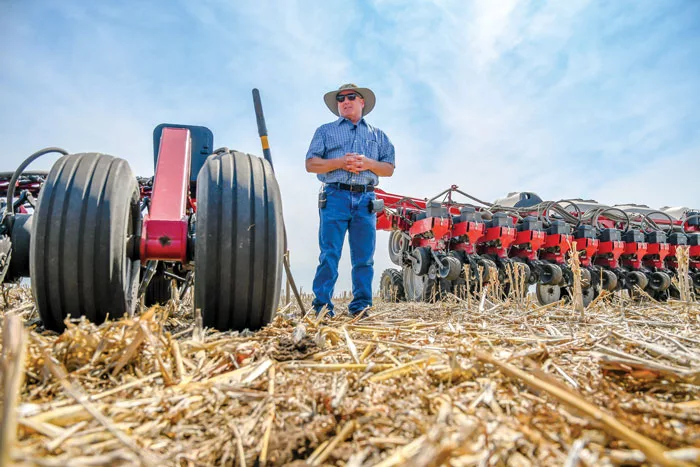
LESSON IN PERSEVERANCE. Kurt Stiefvater went through a rough transition period going to no-till, but parking the plow, adding livestock and cover crops and improving soil health helped him reduce fertilizer inputs by 50% and hay use by 40%. John Dobberstein
During a recent stop on the Conservation in Action tour, Kurt Stiefvater was handed the microphone to talk about the no-till operation he and his family have built over the last quarter century.
More than a few people probably didn’t know how close that moment was to not happening. The fourth-generation farmer gave credit to several mentors in the audience for helping him through the difficult transition from tilled soils to no-till.
Persistence has paid off. This year, Kurt and his family were awarded with the Conservation Legacy Award by the American Soybean Assn. for the Upper Midwest Region of the U.S., and they were also named the South Dakota FFA Foundation Family of the Year in 2024.
The family utilizes a diverse crop rotation, integrated livestock and cover crops to boost soil health and resiliency for the 1,800-acre operation near Salem, S.D.
“I didn’t have a lot of failures doing this — I had a lot of learning experiences,” Stiefvater told attendees in May. “When I started no tilling I didn’t understand the soil, so didn’t know what I was doing the first 10 years. I understand now how soil…

Get full access NOW to the most comprehensive, powerful and easy-to-use online resource for no-tillage practices. Just one good idea will pay for your subscription hundreds of times over.
Download these helpful knowledge building tools

We have engineered and developed the most advanced concave system that threshes all crops, eliminates rotor loss, improves grain quality, gives you a cleaner sample – all with one set of XPR concaves.

At Titan International, our product portfolio reflects our commitment to innovation and high-quality products. Titan International offers a full line of solution-focused wheel, tire, and undercarriage products for a wide variety of off-the-road equipment in agriculture, construction, forestry, mining, power sports, high-speed trailers, and outdoor power equipment segments. As one of the largest North American manufacturers, with a network of dealers all over the world, Titan is an industry leader that original equipment manufacturers and operators can count on for durable products and quality service.

Provide expert analysis and decision support to increase productivity and profitability.