 Premium content is for our Digital-only and Premium subscribers. A Print-only subscription doesn't qualify. Please
No-Till Farmer
Get full access NOW to the most comprehensive, powerful and easy-to-use online resource for no-tillage practices. Just one good idea will pay for your subscription hundreds of times over.
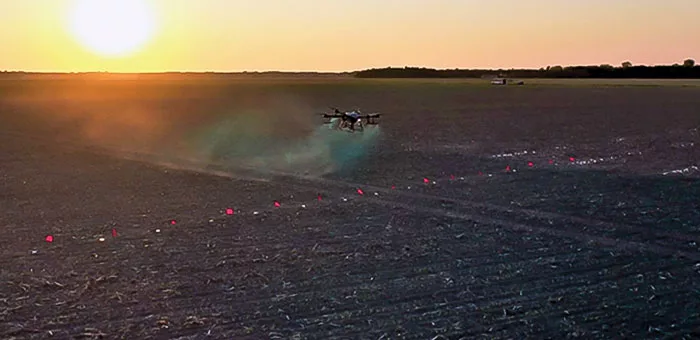
CHANGING REGS? Current EPA oversight on UAV-applied crop chemicals will likely get more focused, and crop protection companies are in the forefront with studies to enable more efficient labeling procedures. USPASTF
While regulations, or lack thereof, governing the use of crop protection chemicals applied by unmanned aerial vehicles (UAVs) vary widely across the globe, U.S. growers and applicators are currently operating under a grace period of oversight. That isn’t likely to last long.
Neill Newton, Syngenta’s Global Drone Applications Manager, says major chemical companies are funding studies to better standardize the labeling of products that can be applied to crops by drones in hopes of reducing future red tape in product labeling for UAV use.
“The EPA has essentially told us that currently, as long as a product has an aerial label, it can be applied from a drone as long as various state regulations apply,” Newton says. “That assumes the operator has the proper licensing and certifications.
“EPA also told us that’s not going to be the case forever. They will want to assess the risks from these applications in the future, just as they assess risks from ground rigs or piloted aircraft.”
To address future regulations from EPA, and similar organizations around the world, Newton says 9 major crop protection chemical companies pooled money initially in 2021 to fund research and generate data under the Unmanned Aerial Pesticide Applications System Task Force (UAPASTF). The thrust of the project is to study drift data, human operator exposure data, and other research that agencies such as EPA, Canada’s Pest Management Regulatory Agency (PMRA) and regulators in Europe and Australia will be requesting.
Current membership in the organization includes BASF Corp., Bayer…

Get full access NOW to the most comprehensive, powerful and easy-to-use online resource for no-tillage practices. Just one good idea will pay for your subscription hundreds of times over.
Download these helpful knowledge building tools


We have engineered and developed the most advanced concave system that threshes all crops, eliminates rotor loss, improves grain quality, gives you a cleaner sample – all with one set of XPR concaves.

At Titan International, our product portfolio reflects our commitment to innovation and high-quality products. Titan International offers a full line of solution-focused wheel, tire, and undercarriage products for a wide variety of off-the-road equipment in agriculture, construction, forestry, mining, power sports, high-speed trailers, and outdoor power equipment segments. As one of the largest North American manufacturers, with a network of dealers all over the world, Titan is an industry leader that original equipment manufacturers and operators can count on for durable products and quality service.

Provide expert analysis and decision support to increase productivity and profitability.