 Premium content is for our Digital-only and Premium subscribers. A Print-only subscription doesn't qualify. Please
No-Till Farmer
Get full access NOW to the most comprehensive, powerful and easy-to-use online resource for no-tillage practices. Just one good idea will pay for your subscription hundreds of times over.
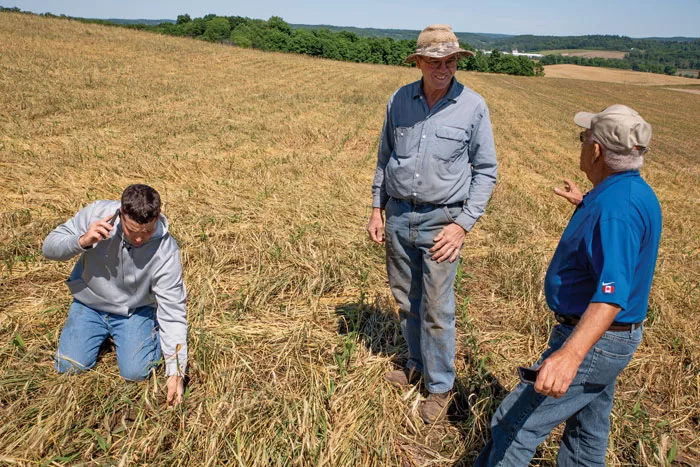
CRIMPED CEREAL RYE. Crop consultant Jon Spreng (left), dairy owner Steve Ayers (center) and retired ag chemical rep Bill Haddad (right) check a cereal rye cover crop that was crimped with a manure dragline in a no-tilled corn field.
A lot can change in 30 years. In the early 1990s, Perrysville, Ohio, brothers Steve and Carl Ayers were adopting no-till and cover crops on 700 acres of continuous corn on their 650-cow dairy operation, creating a standard for other growers in the area to emulate.
Today’s operation includes Steve’ wife, Deb, his son Jesse, Carl’s wife, Janet, and his daughter Kathy Davis. They farm is on the western edge of the Appalachian area of Ohio, where the farmland is terminal moraine, littered with hills and valleys of all shapes and sizes, various light, non-organic, mineral-based soils.
The Ayers’ interest in no-till dates back to 1969, thanks to a neighbor who bought a no-till planter. He planted a large, hilly field for the brothers. Ten inches of rain fell overnight on July 4 that year, causing flooding which tore out fences and resulted in livestock getting out.
“When we went past our bowl-shaped no-till field that funneled into a drainage area, water running off that field was clear, but everywhere else, there was just mud,” says Carl. “That convinced us to try no-till, since a lot of our ground is hilly.”
NAME: Steve Ayers
LOCATION: Perrysville, Ohio
ACRES: 700
YEARS NO-TILLING: 28
CROPS: Corn, soybeans, wheat, cover crops
ANNUAL PRECIPITATION: 40 inches
IRRIGATION: No
LIVESTOCK: Dairy cows
The Ayers bought a no-till planter later that summer and converted to 100% no-till within 3 years.
The Ayers began using cover crops on 100%…

Get full access NOW to the most comprehensive, powerful and easy-to-use online resource for no-tillage practices. Just one good idea will pay for your subscription hundreds of times over.
Download these helpful knowledge building tools

We have engineered and developed the most advanced concave system that threshes all crops, eliminates rotor loss, improves grain quality, gives you a cleaner sample – all with one set of XPR concaves.

At Titan International, our product portfolio reflects our commitment to innovation and high-quality products. Titan International offers a full line of solution-focused wheel, tire, and undercarriage products for a wide variety of off-the-road equipment in agriculture, construction, forestry, mining, power sports, high-speed trailers, and outdoor power equipment segments. As one of the largest North American manufacturers, with a network of dealers all over the world, Titan is an industry leader that original equipment manufacturers and operators can count on for durable products and quality service.

Provide expert analysis and decision support to increase productivity and profitability.