In the late 1950s, Harry Young had been thinking about reducing tillage on his family’s farm at Herndon, Ky. Conventional tillage had been practiced on the family farm since the 1830s.
In the summer of 1961, Harry joined a group of southwestern Kentucky farmers traveling to view the trail-blazing no-till plots at the Dixon Springs Agricultural Center in southern Illinois and share ideas with University of Illinois agronomist George McKibben.
After visiting McKibben’s plots, Harry felt he could save considerable amounts of labor, fuel, machinery and soil with no-till. As a result, he started the no-till revolution by no-tilling 7/10ths of an acre of corn in 1962 in a field I’ve visited several times over the years.
That first no-till year was successful enough that the family no-tilled 94 acres of corn the following year.
“Back in 1962 when my dad planted that first no-till field, he was exemplifying the two traits Thomas Edison said are necessary to be an inventor,” says his son, John, who operates today’s 4,500-acre operation with his son Alex, the sixth generation to work the family farm. “That is to have a good imagination and a pile of junk.”
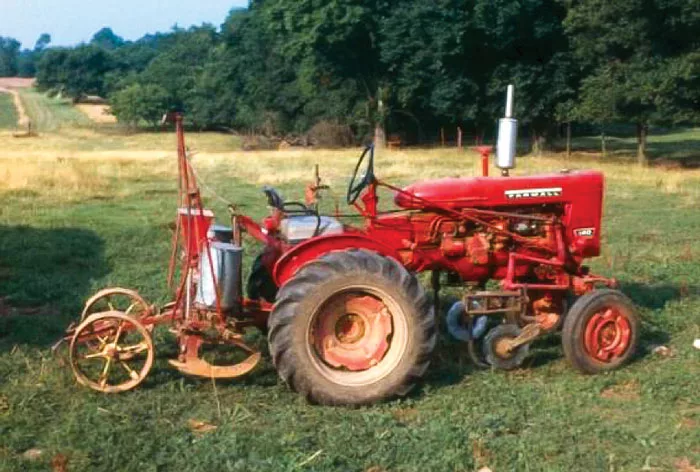
The “junk” trait was represented by Harry’s original no-till planter, an old two-row mule-pulled planter pulled out of a fence row that was modified for no-till and mounted on a small tobacco tractor. A few years later, he bought one of the first Allis-Chalmers planters designed for no-till.
60-Year Rotation
For 60 years, the Young’s have followed the same no-till rotation. This includes no-till corn followed by no-till wheat, which is harvested in late June or early July followed by double-crop soybeans. This allows them to harvest 6,700 acres of no-tilled crops each year from 4,500 acres of ground.
Under today’s no-till conditions, Roundup Ready corn yields 150-180 bushels, with some yields as high as 240 bushels per acre. Roundup Ready double-cropped soybeans yield up to 70 bushels and no-till wheat averages 75 bushels, with some yields running over the 100-bushel-per-acre mark.
That first year, they used 2,4-D and as much as 5 pounds of atrazine per acre for weed control. Paraquat came along several years later as a no-till burndown herbicide.
Herbicides in those early days were applied with a modified self-propelled Hahn hi-boy sprayer with a 30-foot boom. “One thing Dad was adamant about was having the proper spray boom height and not overlapping spray materials,” says John. “With today’s effective sprayer swath control, we probably save 10% on our yearly pesticide and liquid fertilizer bills.”
Today, a John Deere self-propelled and a Case IH self-propelled sprayer make multiple trips that cover 19,000-20,000 acres per year to apply fertilizer and pesticides on the farm’s 4,500 acres.
While every year is different, John says there have not been any major problems in this no-tilled field over the years.
“We have earthworms in our no-till fields that you wouldn’t believe compared to 60 years ago,” he says. “You get at least one or two worms anytime you dig down into the soil, which shows how healthy the soil organisms are in this no-tilled field.”
After 6 decades of no-tilling, John has seen an increased concentration of soil organic matter. Years ago, the organic matter was only 1.5-1.7%, but has increased to around 4% today.
Research conducted in this field in the 1970s helped University of Kentucky soil scientists recommend that no-till soil tests be taken at a 4-inch depth rather than a 6-8-inch depth since phosphorus and potassium tend to accumulate near the soil surface.
Tremendous Impact
Looking back over the farm’s 60 years of no-till history, John says no-till has had a huge influence on the farm’s profitability and growth:
- There is much less erosion, which is a critical concern.
- With no-till, they farm more acres with fewer people.
- While chemical usage has gone up over the past 6 decades, there are fewer fertilizer and pesticide carryover concerns with no-till.
- Weeds that show up in continuously no-tilled fields are now the same weeds that are showing up with conventional tillage.
Even after 60 years of continuous no-till, the Youngs pick up numerous ideas from other successful no-tillers every year.
“There are always new products, practices, hybrids and technologies out there,” says John. “No one has the corner on the whole no-till package. Sharing information is essential to succeeding with no-till.”
The 2024 No-Till History Series is supported by Calmer Corn Heads. For more historical content, including video and multimedia, visit No-TillFarmer.com/HistorySeries.