TAKEAWAYS
- Read the label!
- Don’t be afraid to try again with biologicals. Formulations have significantly improved even in the last 5 years.
- Look for products with thorough testing done on a larger scale.
Surveys from the past several years show that about 50% of farmers have not tried using biologicals because they feel uneducated about them, according to Dr. Pam Marrone. A renowned innovator and co-founder of Invasive Species Corp., Marrone has successfully launched four ag biologicals companies and holds over 400 patents, one of which is a biological that replaces the need for neoinsecticide treatments in corn.
Marrone breaks down biologicals into 6 categories: biopesticides, biocontrols, bioprotectants, biostimulants, biofertilizers and bionutrients. Biostimulants, Marrone says, support a plant’s natural nutrition process and are not yet regulated by the EPA. The EPA also does not regulate biofertilizers or bionutrients.
Not to be confused with micronutrients, which are directly a nutrient the plant needs, biologicals benefit plants in other ways, Marrone says.
“Your micronutrient mix package is really designed to enhance something that you need, whereas the biologicals are reducing crop and water stress and helping the nutrients you deliver be more efficiently taken up.”
Rapid Evolution
If a no-tiller used biologicals in the past and didn't see a benefit, Marrone encourages them to try again. Advancements in the formulations have overcome hurdles that previously blocked particular microbes from being effective. For example, biologicals companies now better understand the adverse effects that certain adjuvants may have on their products.
“The change happens in this industry so fast,” Marrone says. “If you tried something 5 years ago, it's totally different than it is today. It would be worth trying it again, provided the company can tell you what they did to it, why it's different and have data to back that up.”
Understanding the Data
Marrone admits that sometimes the data surrounding biologicals can be confusing. Since biostimulants are not regulated by the EPA, the specificity of labels may vary state to state. The more specific a label is, the better a farmer can use the biological where it’s most well suited to succeed. To maximize product effectiveness, no-tillers need to understand the product’s mode of action and apply accordingly.
Factors to consider include water pH and hardness, water volume and dilution, spray droplet size, adjuvant effect, tank-mix partners, temperature effects, rainfastness, impacts on beneficial insects, application timings and intervals. Marrone says these factors should all be on the label, but that is not always the case.
In those situations, it’s best to contact the manufacturer to ask for clarification. Chlorine can kill the biologicals and having too high of a water volume for foliar biologicals renders them useless as the biological will roll off of the leaf. In both cases, the time and money spent on the biological was wasted, simply because the application method did not complement the biological’s mode of action — a completely avoidable issue, Marrone says.
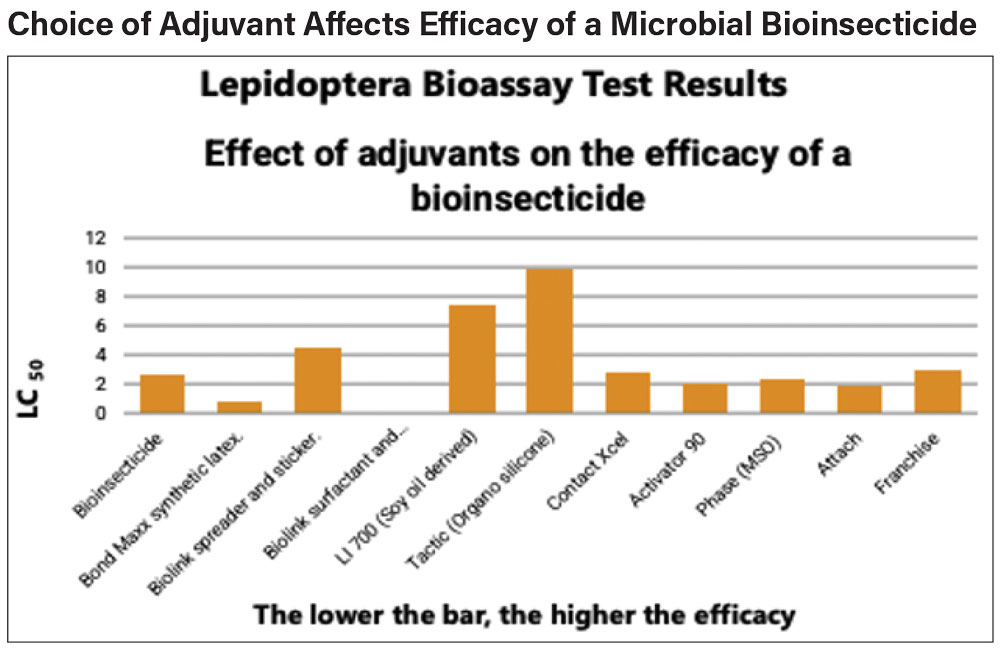
ADJUVANT EFFECTS. Continued testing has shown that many variables affect how well a plant can utilize biologicals, Pam Marrone says. Pam Marrone
Considering the scope of testing a product went through can also give no-tillers an indication of a product’s efficacy and reliability.
Marrone pushes for more than just small university trials, saying that in crops like corn and soybeans, trials need to be large enough and have enough repetitions to be able to see statistical differences.
“There's a debate about how many field trials you need, and how many locations to show that the product is working,” Marrone says. “I really think the minimum is going to be 25 to 50 trials. The companies don't like me to say that because it's expensive to generate that many trials.”
When reading about the product’s field trials consider their size, location and consistency of results. Ideally, Marrone likes to see at least an 80% success rate in the trials, but prefers to show statistical significance based on 0.1% rather than standard p-value of 0.05.
“I've done many, tens of thousands of field trials in my day, and many of those reports show the chemical doesn't separate, statistically, from the untreated,” Marrone says. “In large crops like corn and soybeans, you need a big enough demo and enough reps to be able to see the statistical effect regardless of whether it's a chemical or biological.”
Marrone references a study published by several land grant universities that concluded biological nitrogen-fixation products didn't work. When she looked into the data, Marrone was astonished to find that the trials only had one or two locations in each of the handful of states in the study. Each location only had four small plots.
“If you tried something 5 years ago, it's totally different than it is today…”
"That’s not how you do field trials, and not how you should publish or conclude, because those trials were extremely limited,” Marrone says. “You cannot make a conclusion from one location in one state."
At the end of the day, Marrone believes trials should be designed to show farmers which biologicals will provide them with the best ROI through marketable yield. Marrone would like to see test plots of at least 5 acres in corn and soybean trials with at least four to six replications. Marrone says the trials should be integrated with the programs that farmers already use to provide a more realistic environment in which to test the biologicals’ efficacy.
“I wouldn’t design the trial just for the number of bugs on the plant or the number of leaf spots,” Marrone says. “That's not going to tell you the whole story. It's got to be the end product that you care about, marketable yield.”
Do Your Homework
Marrone also encourages no-tillers to do their homework when larger numbers of microorganisms are included. She claims the quality control may vary and questions if all microorganisms in the mix have a purpose. This is not to say that all large mixes are ineffective, but some may be unnecessary.
“Some people say that single microbes are not as good as multiple microbes in a product, and that's not necessarily the case,” Marrone says. “The data doesn't show that a single microbe is worse than the mixture of microbes. It just depends on what the microbes are doing. Single microbes can be very effective.”
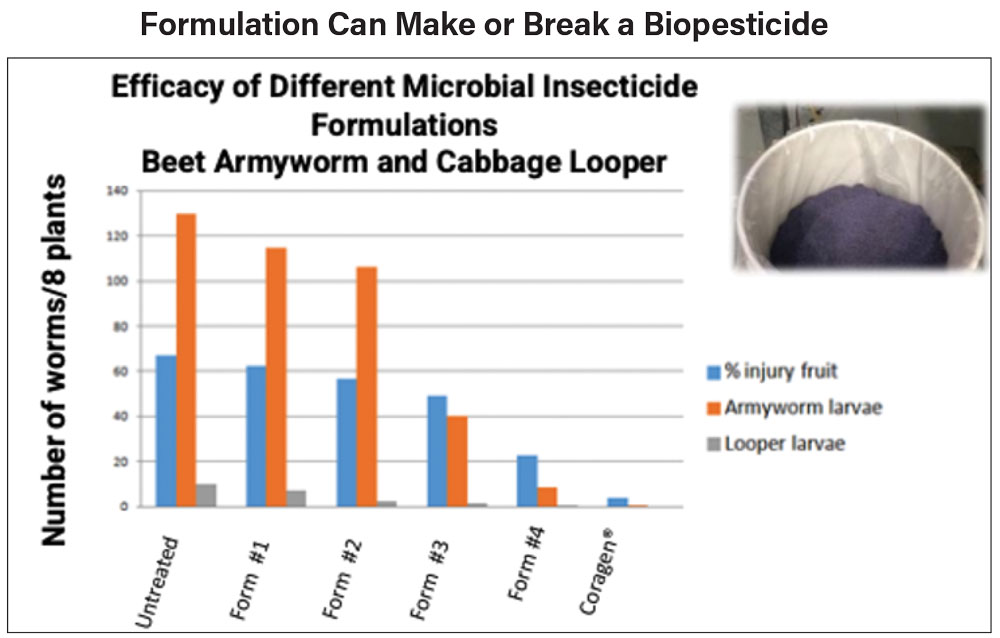
THE RIGHT FORMULATION. Marrone says formulation is critical to biology as demonstrated by the repeated tests used to develop Coragen. Experimenting with different formulations allowed for a significant increase in effectiveness. Pam Marrone
Marrone says sometimes a single nitrogen fixing microbe may fill the need a no-tiller has, while in other situations, a variety of microbes with varying capabilities may bring about the desired outcome more fully.
It’s important to make sure those microbes are still alive by the time they get to the farm though. Marrone recommends purchasing biological products with high colony forming unit counts (CFU) and low application rates.
“If the microbe dies over time, and it doesn't have resting spores, it's better to have a higher CFU count,” Marrone says. “Then by the time you get it, they'll probably still have some microbes that are doing the activity. Some companies deliver the microbial products directly to farmers to help improve reliability for some living microbial products.”
Other companies, such as Pivot Bio, freeze dry the short lived gram-negative bacteria to boost shelf life stability.
Building Confidence
Buying biologicals with certifications from The Fertilizer Institute and the USDA can give no-tillers reassurance the product they’re buying has a verified process, satisfies its claims and has been proven safe, Marrone says. The more rigorous USDA certification confirms the identity and quantity of the bacteria claimed on the label in addition to verifying that levels of contaminant bacteria, heavy metals and total aromatic hydrocarbons are equal to or below the stated limits. So far, not many companies have gotten these optional certifications, likely due to cost. Marrone says the USDA certification cost Corteva $20,000, while The Fertilizer Institute certification is significantly cheaper.
“What's the science behind it? And where's the data to prove that…”
No-tillers can also use AgList to endorse biologicals they’ve found effective. Biologicals companies can pay to list their products on the AgList website, and farmers can leave comments about their personal experience with the product. Marrone is excited to see how this platform plays out and believes that it may offer some more confidence in biologicals.
When considering what biologicals to add to their farm, Marrone encourages no-tillerss to do their research, keep asking questions and remember that biologicals are rapidly evolving.
“You have to go one step deeper and say, ‘Okay, what's in it? What's it doing? What's the science behind it? And where's the data to prove that?’"