On this episode of Conservation Ag Update, brought to you by Titan International, a big piece of equipment is unveiled at the Kinze Product Innovation Day in Williamsburg, Iowa. Plus, we pay another visit to Robert Boyle’s farm in Coolidge, Ariz., for a look at a unique rotation that includes a 5-way cover crop mix.
In the Cover Crop Connection, Mackane Vogel catches up with no-till soybean champ Chris Weaver in Finksburg, Md.
Later in the episode, we check in with Landon Frye from Compeer Financial, for details on the company’s initiative with PepsiCo to fund conservation practices.
In the Video of the Week, Robert Saik, founder T1 Technology Corp., shares what excites him most about the latest developments with AI in agriculture.

This episode of Conservation Ag Update is brought to you by Titan International.
Titan International is a global leader in off-the- road wheels and tires, and is the maker of Titan Wheels, Titan Tires and Goodyear Farm Tires. Super Single Goodyear Farm Tires, featuring Titan LSW®️ technology help growers unlock greater performance.
Featuring a larger rim and smaller sidewall, LSW technology minimizes soil compaction and creates a smoother ride in and out of the field. Titan has you covered with a full lineup of tires to fit every application on your farm. Contact your local Titan and Goodyear Farm Tire dealer today and learn more about LSW Tire Technology.
TRANSCRIPT
Jump to a section or scroll for the full episode...
- Kinze Yetter Falcon SF700 Unveiled at Kinze Innovation Day
- Arizona Farmer Uses 5-Way Cover Crop Mix Ahead of Corn
- Soybean Yield Champ Previews Upcoming National No-Tillage Conference Presentation
- Compeer Financial Teams Up with PepsiCo on Strip-Till Financing
- Video of the Week: ‘What Excites Me About AI in Ag’
Kinze Yetter Falcon SF700 Unveiled at Kinze Innovation Day
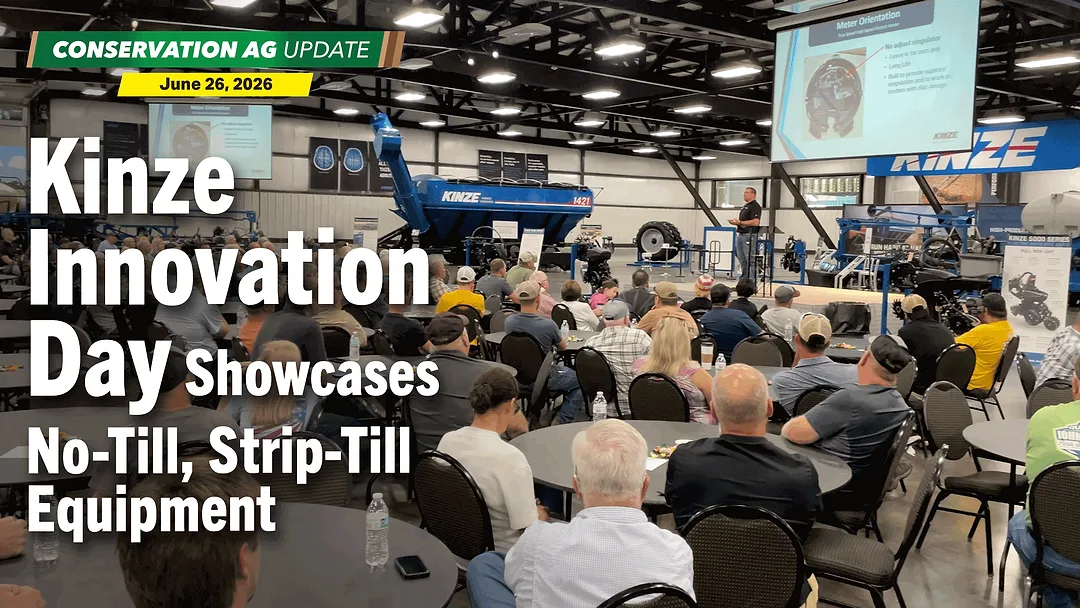
Welcome to a special road edition of Conservation Ag Update here from the Kinze Innovation Day, where inside the building behind me, over 100 farmers are here to check out some of the latest offerings from Kinze and farm technology geared towards farmers that include no-tillers and strip-tillers.
We were surprised when we walked in for a big reveal. Check this out. The Yetter Kinze Falcon SF700 on display for the first time here. This a partnership that’s a few months in the making. We got the inside scoop from Andy Thompson.
“We're excited about this collaboration between Kinze and Yetter. Introducing this new machine, not only to our familiar strip till market, but also to maybe people that showed up here not expecting to be looking at strip till equipment. As we always talk about, strip till is everywhere. It's growing and now we're bringing it to markets outside of the traditional strip till market.”
“This partnership really came together very well. We have a Kinze planter toolbar — their 5,700 frame. It's already designed to run it at a 24-inch toolbar height, perfect for the Yetter strip-till units. It has hydraulic wing downforce. It has the capacity to be able to put the liquid fertilizer on that. Just so many things make a lot of sense. It's also available in not only 30-inch rows, but also 20-inch and 22-inch rows. So just makes a lot of sense. It fills some voids out there for anybody that's wanting to strip till in 20- or 22-inch rows aside from the 30-inch rows. And of course the Yetter row units, we've had a ton of success with those. The Strip Freshener CC units that we see on the unit behind me here. Those have been in operation for 8ight years. So, we took two existing units and put them together. And not only that, but also two great family-owned companies in Kinze and Yetter.”
Arizona Farmer Uses 5-Way Cover Crop Mix Ahead of Corn
Strip-till is a conservation practice we talk a lot about on this program. But a lot of farmers here today aren’t very familiar with strip-till, so they’ve been getting schooled by Andy on some of the concepts of strip-till.
From innovative equipment to an innovative farmer. Let’s head out to Coolidge, Ariz., now to check out one of Robert Boyle’s more action-packed fields.
“This is one of the first fields we have on our 2026 corn. This was planted into triticale cover crops with oats, peas, vetch, clover, and kale. We harvested that for silage mid-February and then we planted the corn into it. It's got a Rain 360 running on it. We're side dressing all our fertilizer with the Rain unit, and this field will be chopped July 10th through the 15th. Then go back into sorghum. That'll come off in November and then we'll go right back into a cover crop, Triticale cover crop again with the peas, vetch, clover and kale to help build the ground up.”
“I have an 8-row 30 twin-row planter and with the twin row that makes it to where the tram lines or the wheel paths are only about 22 and a half inches wide. So, we block off a plate on each side of the wheel traffic and then double the population in the next plate. So, as you can see, there's tram lines out here, but they blend right in because you can't see them with that double population. We're running about 72,000 seeds per acre on that single row and we run 40,000 on the double row.”
You can read much more about Robert’s operation in the upcoming Conservation Tillage Guide or No-TillFarmer.com.
Soybean Yield Champ Previews Upcoming National No-Tillage Conference Presentation
A few weeks ago I visited my home state of Maryland and had the chance to chat with Finksburg, Md., no-tiller and soybean yield champ Chris Weaver. Check out this clip as he introduces himself and his farm while giving you a sneak peak of his upcoming presentation at the 35th annual National No-Tillage Conference in Indianapolis this coming winter.
“I'm Chris Weaver. I'm a six generation farmer from Finksburg, Maryland. Been no-tilling my whole farming career. Dad started in 1986. We're here at our cattle feed lot where we feed cattle out for our freezer business where we actually sell fresh meat right from the farm as well as other beef that we raise for local butcher shops. I'm very big and everything has to be farm to table and knowing where everything's grown. With that being said, in 2025, we set another world record in soybean production of over 155 bushel beans. We're coming this year to the no-till conference to talk to other no-till farmers and everything that we're doing to try to get ahead from our corn planter and the maintenance that we're doing and how we have our planters set up. How we're doing infer applications on beans, what is right and what's wrong, how to reduce salt from fertility.”
“What plant population's right for your soil types? As well as how many times are we going across the field? Does it really matter? We'll get into that hard discussion as well as herbicide passes have be herbicide and foliar passes should be foliar passes. That is one of the big things we're going to talk about. When's the right time to apply a fungicide? We're going to get down into the depths of how have we been successful no-till farming for not just 10 years but for a couple generations now and what else are we looking at to get us further ahead in the future? My goal is to be the first guy to 200 bushel no-till non-irrigated soybeans. I think we're on the way to success and we hope to get there in the next few years. So please come out to the no-till conference, be more than glad to sit down and chat with you, bring your soil samples, bring any information you want. We'll sit down and we'll look at it. We'll come up with an on- farm approach like we've done here on this operation.”
Be sure to head to no-tillfarmer.com/nntc and register for the National No-Tillage Conference so you can hear Chris Weaver’s presentation as well as dozens of other great speakers sharing their knowledge of no-till, cover crops and much more.
Compeer Financial Teams Up with PepsiCo on Strip-Till Financing
More strip-till news now. Compeer Financial and PepsiCo partnered on a pilot leasing program to help farmers interested in strip-till offset the costs of new equipment. We caught up with Landon Frye from Compeer Financial for more on this new initiative.
“Yeah, over the past 10 months, PepsiCo and Compeer Financial have worked on a pilot program to deploy their regenerative capital and they make all kinds of investments across US agriculture, but to deploy a specific test where the incentive was tied to the financing of the equipment and we really honed them in on strip tillage specifically. One, it allows for their environmental practices to be measured and managed and meets those standards that they have. But two, and in our research and probably reading some of the things that you guys put out, there was a lot of demand for it organically for farmers via lower inputs, via fewer passes over the field. And that pairing of a technology farmers are chomping at the bid at, so to speak, with something that aligns with what food companies want to achieve, felt like the right place to deploy a million dollars.”
Video of the Week: ‘What Excites Me About AI in Ag’
We wrap up this special road edition of Conservation Ag Update with the Video of the Week. We’re at the Innovation Day and when you think about innovation in ag, AI comes to mind. Robert Saik, founder of T1 Technology Corp., knows a thing or two about AI. I caught up with him at the visorPRO AI workshop in Rosemont, Ill., the other day and asked him about some of the latest AI trends and how they’ll affect no-tillers.
“If you could harness all the uses of data coming off a farming operation, so think weather stations, soil moisture probes, remote sensing, telematics, and bring that all together to make better information available to a farmer, that would make the prediction better. Decision has two sides. It has prediction and judgement. How can we leverage AI to make better decisions? Give me more information into a centralized base. Let me extract those data points more rapidly and more accurately, therefore I will make a better decision as a farmer as to what to do. I get excited about this because when you think about all the legacy information that’s available agronomically for farmers from years and years of soil test data, years and years of agronomic recommendations, years and years of yield data, the zone data, the weather data, can you imagine pulling all that together to do regression analysis so that in this year when these conditions are going on and say ‘well yeah that’s happened 3 times historically in the period of our farm and this is what happened and this is what we should do.’ That’s what I get excited about with AI in farming.”
That’ll conclude this road edition of Conservation Ag Update from the Kinze Innovation Center. We’ll have much more from this event in the coming days on No-TillFarmer.com.
What do you think? Send me your thoughts and story ideas to Nnewman@Lessiter Media.com. Thanks for watching. Until next time, for more stories visit no-tillfarmer.com, striptillfarmer.com and covercropstrategies.com.