 Premium content is for our Digital-only and Premium subscribers. A Print-only subscription doesn't qualify. Please
No-Till Farmer
Get full access NOW to the most comprehensive, powerful and easy-to-use online resource for no-tillage practices. Just one good idea will pay for your subscription hundreds of times over.
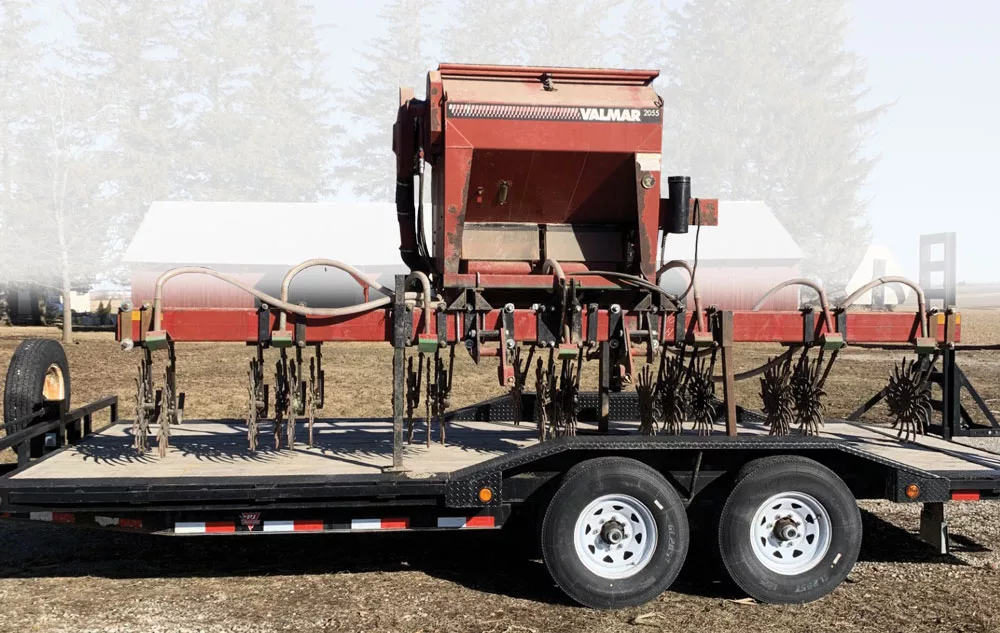
REPURPOSED ROTARY HOE. Ryan Gibbs bought this used Hiniker rotary hoe and seeder to convert it to a twin-row interseeder to plant cover crop mixes between 30-inch corn rows. Drill units from a Great Plains planter spaced 7.5 inches apart will seed covers between corn rows at V2 and V3 stages to improve soil health and provide fall and winter livestock grazing. Ryan Gibbs
Ryan Gibbs is making a conscious effort to cut input costs, boost his soil’s health and diversify the family businesses of GibbsField Farms and a farm supply retail outlet. His latest project involves building a 6-row interseeder to establish cover crops between his 30-inch corn rows.
A 7-year no-tiller, Gibbs and his wife, Kristy, farm 500 acres of corn, soybeans and small grains near Hopkinton, Iowa, about 40 miles southwest of Dubuque and the Mississippi River.
The couple also runs a 2,400-head hog operation and a cow/calf/finishing herd, as well as Gibbsfield Ag, which includes custom drilling and aerial seeding services as well as inputs of micronutrients and soil amendments.
“I have three goals for the interseeder project,” Gibbs explains. “I want to increase the amount of forage I have for my cattle, I want to eliminate one herbicide pass on my corn in the spring, and I want to build the soil health of my crop ground.”
The “new” interseeder he refabricated over the winter is based on a Hiniker 5700 Rotary Hoe which came with a Valmar seeder box.
“The rotary hoe units mix up the dirt and bring weed seeds to the top, so I’m replacing them completely with sets of long and short Great Plains drill row units spaced…

Get full access NOW to the most comprehensive, powerful and easy-to-use online resource for no-tillage practices. Just one good idea will pay for your subscription hundreds of times over.
Download these helpful knowledge building tools

We have engineered and developed the most advanced concave system that threshes all crops, eliminates rotor loss, improves grain quality, gives you a cleaner sample – all with one set of XPR concaves.

At Titan International, our product portfolio reflects our commitment to innovation and high-quality products. Titan International offers a full line of solution-focused wheel, tire, and undercarriage products for a wide variety of off-the-road equipment in agriculture, construction, forestry, mining, power sports, high-speed trailers, and outdoor power equipment segments. As one of the largest North American manufacturers, with a network of dealers all over the world, Titan is an industry leader that original equipment manufacturers and operators can count on for durable products and quality service.

Provide expert analysis and decision support to increase productivity and profitability.