TAKEAWAYS
- Fields during wet springs might look like a mess, but cover crops can soften the blow.
- Conservation practices may earn bonus income with the 45Z Clean Fuel Production tax credit.
- Compare the price and performance of biologicals to traditional fertilizers to explore potential savings.
LORD WILLING, I want to farm until I’m 80 or 85. Believe it or not, no-till is part of my strategy for achieving that goal.
My brother, Jeff, and I both worked full-time jobs until retirement in our early 60s. He was a postal worker. I worked for a youth organization. Reducing labor when we were still working was one of the drivers in our first adventures into no-till. We started no-tilling soybeans in 1995, but it wasn’t until 2019 that we converted all our acres to no-till.
Despite being retired at that point, labor was still a factor. In 2019 I did some math — figuring if I was going to keep farming until I no longer can climb into a tractor — I’d have to change something.
Check The Specs...
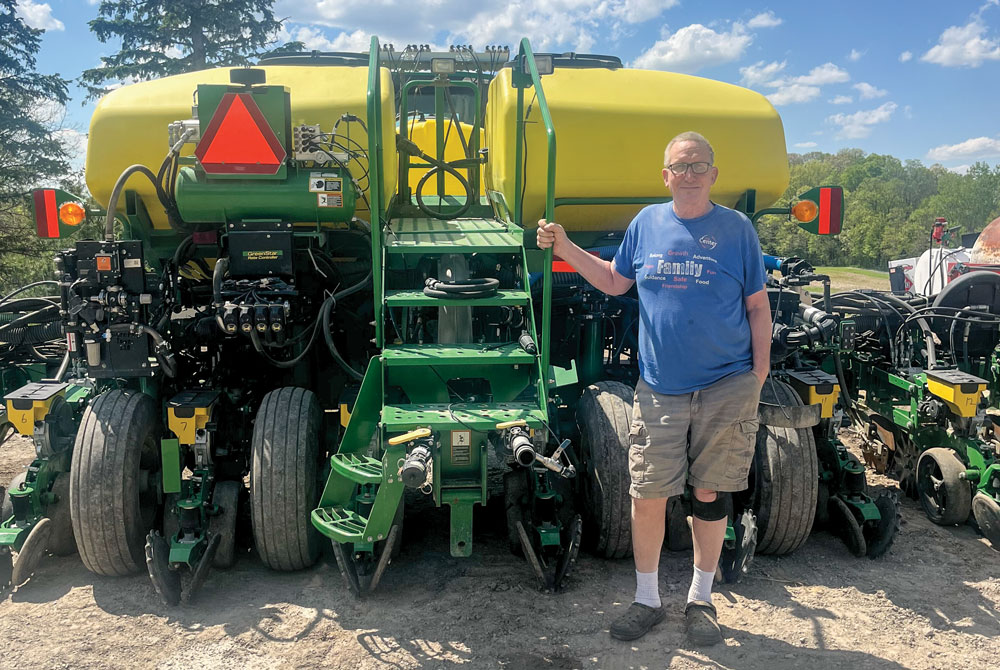
NAME: Greg Woll
LOCATION: Columbia City, Ind.
ACRES: 2,100
YEARS NO-TILLING: 31
CROPS: Corn, soybeans, hard red winter wheat
PRIMARY SOIL TYPE: Sandy loam to clay
ANNUAL PRECIPITATION: 36-50 inches
We didn’t have the desire or manpower to work ground ahead of the corn planter anymore. With no-till we would need less equipment, spend less time in the field and need less help. There’s also the economic factor. Who can afford diesel fuel right now or fertilizer? My brother and I can now run the whole farm with only one seasonal employee for help at harvest. We’re also reaping soil health and economic benefits.
Funds from the Environmental Quality Incentives Program (EQIP) and Conservation Stewardship Program (CSP) nudged us down the no-till and cover crop path. We were always wanting a smoother, warmer seedbed for corn, so we held off a long time on going fully into no-till.
After the first year, we decided if we were going to do it we needed to commit. We purchased a no-till planter and we never looked back.
Once we got into no-till, it only took a few years for us to see benefits were off the charts in terms of sustainability and regenerative agriculture. We’ve built on those principles, adding practices like cover crops and using biological products instead of synthetic fertilizers.
Program Push
The first year we planted a cereal rye cover it was put to an extreme challenge. We had seeded 500 acres of cereal rye ahead of corn. The following spring it rained so much in May they declared a disaster in our county. We didn’t start planting anything until June 4. I thought we had a complete disaster on our hands. The cereal rye was to my waist and I’m 6’5”.
I was proven wrong. The cereal rye protected the ground and absorbed the heavy rains. The first 2-3 inches of soil under the rye was as mellow as could be. We were some of the only people that were able to plant a crop that year.
We now plant cereal rye ahead of all 1,000 corn acres. We’ve learned a few things over the years.
1) Plant corn into green cereal rye. Early in our program we tried burning down the cereal rye cover in early spring and then planting into the dead crop. Once the cereal rye was dead and the roots relaxed their hold on the soil, the planter came through and ripped the cereal rye from the ground. It wrapped in the row cleaners, plugged up the planter and was just a disaster. We’ve since eliminated our row cleaners and just use regular no-till coulters, which work great planting into standing, green cereal rye.
My philosophy is if you’re using row cleaners to warm up the soil, you need to get the heck out of the field. Work on equipment, take your wife to the movie, do anything but plant. You just have to wait.
PROGRAM BENEFITS. Since most of their corn and soybeans go into biofuel markets, the Wolls are looking forward to taking advantage of 45Z Clean Fuel Production Credit programs. Their no-till, split N and cover crop practices could yield $200 per acre in corn. Greg Woll
Our dad was a retired military man and very regimented in his thinking. His philosophy was you never start planting corn until walnut leaves are as big as a squirrel’s ear. They don’t usually get that big until Mother’s Day weekend.
We like to stick to the tradition. We’ll plant soybeans early because they can handle the colder soils, but not corn.
As long as the cover crop is sprayed within about a week after planting, I’m happy. I don’t want any living rye out there when the corn sprouts.
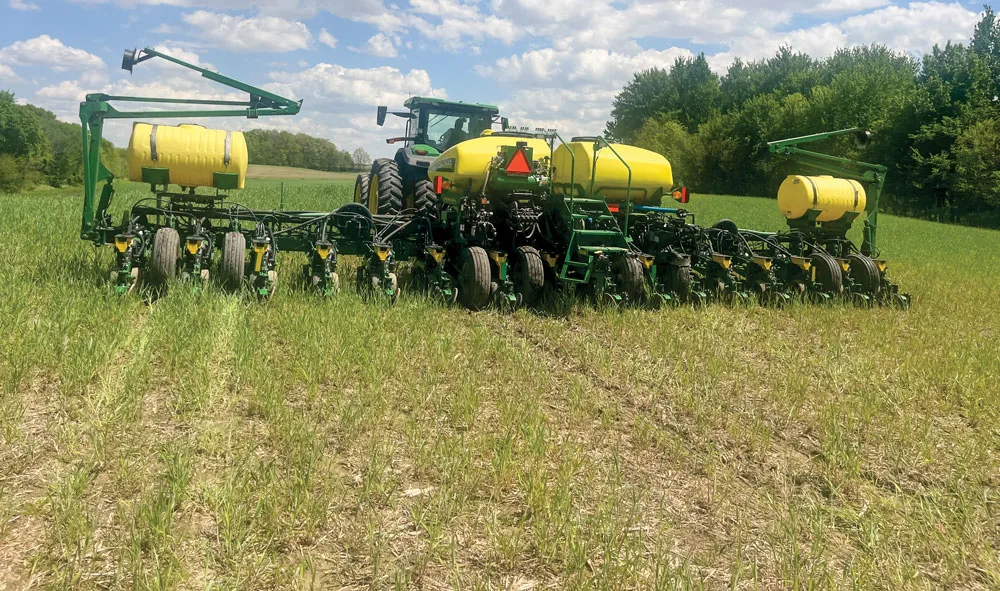
2) Apply nitrogen (N) at planting. Cereal rye does actively take N out of the soil and doesn’t release it back into the system until it’s dead and broken down. We apply 6 gallons of 28% N, 5 gallons of ammonium thiosulfate, and 32 ounces of boron through the 2X2 fertilizer system on our John Deere 1775 planter. The plant is able to use the applied N until the next application and until more N is released from the cereal rye residue.
3) Broadcast seed cereal rye. The first year we drilled our cereal rye cover. After the success of that first crop, we decided to seed all our corn acres. It wasn’t a feasible endeavor with a 15-foot drill. I was talking to an old farmer who de-brushed ditch banks and asked how he reseeded. He said he just walked down the ditch with a spreader and never had a failed crop.
We ended up buying a 3-point-mounted spreader. It spreads the cereal rye in a 30-foot pattern. With auto steer we never have any skips. We can seed about 80 acres per fill at a cost of $12-$14 for the seed. Just like we were told, the rye comes up. Our goal is to be done by Veteran’s Day to get a decent stand.
4) Don’t rush burndown. My rule is I don’t want the co-op out spraying the cereal rye until after May 1. Cereal rye maxes out at 3-4 feet here, depending on heat units. I’m not concerned much about the surface growth, though.
My goal is to allow as much root development as possible. The roots decompose in the soil and release nutrients, but the fine root hairs also create a web of voids in the soil. In drought, corn roots will use those channels to find pockets of moisture.
“We were some of the only people able to plant a crop that year…”
It doesn’t matter your tillage practice: in drought, your crop will suffer. However, my 5-year rolling average corn yield is 200 bushels per acre on pretty marginal ground. That tells me my corn is finding the water and nutrients it needs, more often than not.
Cereal rye cover crop roots also hold our soil. The rolling hills in our region will erode even with no-till or min-till. With cereal rye, we don’t have any erosion issues in our fields. We also have fewer weeds, as the dense cover crowds out many problem weeds like waterhemp, marestail and giant ragweed.
We used to think we needed our own sprayer to no-till, especially with cover crops. Due to an injury, we had to switch to the co-op. Fortunately, they have enough equipment to take care of us in a timely manner.
We use glyphosate to burn down the cover crop and DiFlexx to control broadleaf weeds. We also plant Liberty soybeans for more flexibility in our herbicide program.
Cutting Nutrients
In 2015 we purchased a John Deere 1775 planter. It was set up to apply fertilizer both 2x2 and in furrow. This worked out to be very valuable for our changing fertility strategies. We use the 2x2 to apply nitrogen (N) and we apply biologicals in furrow.
Biologicals now lead our fertilizer program. We haven’t applied synthetic phosphorus (P) and very little potassium (K) in 8 years. Instead, we’ve switched to biological products that add or work with existing soil microbes to release the nutrients in the crop residue and the soil profile.
Our program started with what was Biodyne at the time. We applied their 501 Meltdown product on our corn stubble. The product has microbes that work to decompose the corn stalks, releasing nutrients for the next crop.
CEREAL RYE. Planting into growing cereal rye helps manage moisture in spring. It also serves to keep the cover crop secure in the soil instead of wrapping in the planter. Greg Woll
We were impressed with the results, so we tried additional products throughout the following years starting with their 401 product at planting. Now we apply BW Fusion’s Biocast Max in-furrow at planting for corn and soybeans. The microbials cycle carbon and release nutrients. There are also microbes that extract nutrients from the atmosphere in addition to the soil.
More biologicals are applied at V5 in corn. We apply K-Ace — a potassium acetate liquid fertilizer — with BW Fusion’s AmiNo and calcium, zinc, and boron products. The biologicals keep the plants healthy, which reduces the need for fungicides.
If conditions warrant, and we feel we need to apply a fungicide in corn, we apply a low rate of generic Stratego at V5. It’s a cheap way to keep vigor in corn. We also sometimes make a third application of biologicals and amino acids at V10.
“The microbes eventually come back, but you can’t regenerate a dead earthworm…”
What we’ve found is that we no longer need to apply P. We spend around $100,000 on biologicals, but that’s half what we spent on fertilizer. Or what we did spend on fertilizer. With today’s markets being able to avoid P helps us avoid a very volatile market for the input.
This wasn’t a step we took blindly. An agronomist from Agronomy 365 takes tissue samples in 40 to 50 fields each July when corn is around V10 and soybeans are in the late reproductive stage. Those tests have consistently shown that the plants have the nutrients they need to hit our yield goals.
We do augment K needs with a natural liquid K. Mostly, though, I’m a fan of letting our regenerative practices take care of the soil instead of relying on industrial fertilizer. There’s so much P in the soil and in the corn stalks, we just have to manage the soil so the crop can access those nutrients instead of us constantly feeding the plants ourselves.
Pushing Soybeans
Our soybeans also benefit from our biological program. We seed soybeans in 7.5-inch rows with our 40-foot, 32-row John Deere 1795 planter.
In the last 5 years we’ve reduced soybean seeding populations from 175,000 seeds an acre to 125,000. When the plants aren’t so thick they branch more off the main stem and put on more pods.
Like corn, soybeans get 501, 401, amino acids and K-Ace. Those four products go on every acre. The amino acids are sprayed over the top at R3 to R4, just as the plants are coming out of vegetative growth.
With these products the plants seem healthier because they’re able to access more of the nutrients in the soil. As a result, we rarely need fungicides in soybeans though we do apply sulfur as sulfur deficiency is a problem that’s popped up in recent years.
Saving Worms
Earthworms are a key part of our regenerative farming system. Their burrows aerate our soils and improve water infiltration. They’re also the top of the soil food chain. They eat the fungi and microbes that live on the carbon taken from our crop residue and the atmosphere.
The first step to protect the balance of this system is to not till. Once you drag a disc or a vertical tillage tool through the field, you’re releasing all the carbon dioxide the crop sequestered in the soil the previous growing season. Without the CO2, there’s no food for the fungi and microbes and then there’s no food for the earthworms.
The No. 1 killer of earthworms, though, is anhydrous ammonia. It’s the cheapest form of N, so it’s the most popular. When that knife cuts through the soil in fall or spring, it kills every living thing in the soil one foot on either side of the knife. That soil remains lifeless for several weeks. The microbes will eventually come back, but you can’t regenerate a dead earthworm.
“In drought, corn roots will use those channels to find pockets of moisture…”
We never use anhydrous. Even if it’s more expensive, we prefer to use 28%. It protects our earthworms and it’s easier on the soil in general. We haven’t spread lime in years but note that anhydrous impacts soil pH. Since we don’t use it, our soils remain stable.
Our N applications are split. The balance of our N is sidedressed at V5. We knife in an additional 48-50 gallons. Not only is this good management, but it’s a requirement of carbon programs.
Nearly all the grain we produce is sold to biofuel companies. The soybeans go to biodiesel and the corn is sold to Valero. We’re setting ourselves up to take advantage of the 45Z Clean Fuel Production Credit when it’s fully implemented.
We’re working with Continuum Ag to tap into this opportunity. Practices like no-till, cover crops, and split N applications could result in a $1 per bushel premium for my crops. At 200-bushel corn, that would give us an additional $200 per acre for conservation practices we already do.
For a couple of guys that are 68 and 67, we’re pretty excited about what this system can do and how far it might take us.