
TAKEAWAYS
- Nitrogen (N) is a complicated nutrient because it can take several different paths in the environment.
- If N rates are going to be cut this season, it’s important to protect what you are applying.
- If growers apply N for a specific yield and a percentage is lost, that money doesn’t go into yield and it’s not going to be realized.
No-tillers facing pressure to maximize their return on nitrogen (N) may want to check out recent research on using ammonium thiosulfate to protect N sources.
Research done over the last 4 years in Iowa and Illinois shows thiosulfates can play an effective role as a nitrification inhibitor, which could ultimately help protect against N loss.
Dr. Jake Vossenkemper, director of research and agronomy at Twin State, says that given the commodity price landscape many growers share what N products they’re using and if they can reduce application rates.
“It depends, because when we plant the crop we don’t know how much nitrogen we actually need,” he says. “Because of that, it’s even more important to protect the nitrogen you’re going to apply. If you’re going to cut back, it’s even more important to protect what you’re applying.”
Dr. Zack Ogles, manager of agronomy at Tessenderlo Kerley, refers to N as “a complicated nutrient” because it can take several different paths in the environment.
Plants primarily take up N in two forms: ammonium and nitrate. Ammonium nitrogen has a positive charge, and nitrate nitrogen has a negative charge.
“We want to make sure thiosulfate sulfur is in a high enough concentration in the soil to be effective in slowing down the nitrification process…”
“What that means is that positively charged ammonium is relatively stable in the soil and provides a stable form of nitrogen,” Ogles says. “Nitrate nitrogen’s negative charge allows it to be moved through the soil profile with rain events and lost through leaching.”
Ogles said denitrification is another loss pathway to the environment. “This is essentially the reduction of nitrate into a form that can be lost back to the environment in the form of nitrous oxide gas,” he says. “This is obviously a concern.”
Dual-Role Thiosulfates
Collaborative studies from Tessenderlo Kerley and Auburn Univ. have shown thiosulfates inhibit nitrification while providing essential sulfur. This is increasingly important as farmers push for higher yields on less acreage, and with increased plant populations.
“What that equates to is the need for increased rates of sulfur to feed the plants and produce higher yields,” Ogles says, adding there is also an important environmental component. “Any way we can contribute to reducing nitrate leaching, ammonia volatilization and potentially nitrous oxide emissions is beneficial to the environment and to growers.”
Ammonium volatilization can occur in soils with a high pH or especially when urea N is used. Losses can be significant — up to 20% in some cases.
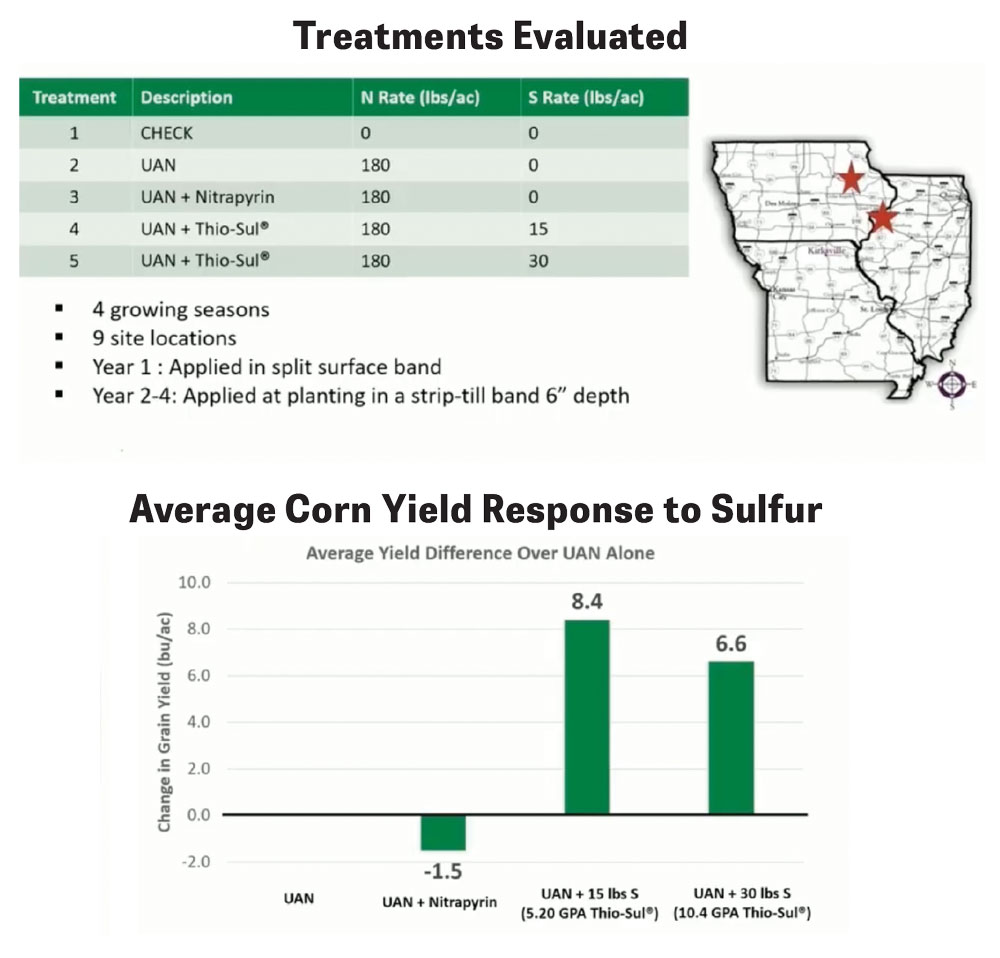
HIGHER YIELDS. Tessenderlo Kerley partnered with Twin State to evaluate the nitrification inhibition properties of thiosulfates in a field setting under true growing season conditions. UAN blended with 10% Thio-Sul increased yield by 8.4 bushels per acre compared to UAN alone, and 30 pounds of thiosulfate sulfur applied per acre in a band was as or more effective than commercially available inhibitors such as nitrapyrin. Tessenderlo Kerley
Ogles says thiosulfate products, such as those Tessenderlo Kerley has on the market, can reduce ammonia volatilization losses. They can also slow the conversion of ammonium N to nitrate, which can reduce the amount of N lost through leaching or denitrification.
N application to certain crops, like corn, can have a direct correlation to yield.
“If you fertilize for a specific yield and you lose a percentage of the nitrogen you’re applying, that’s money that’s not going to yield, and it’s not going to be realized by the farmer,” Ogles says.
Pushing Yields, Protecting N
Tessenderlo Kerley partnered with Twin State in 2022-2024 to conduct nitrification field research in eastern Iowa and northwestern Illinois to evaluate the nitrification inhibition properties of thiosulfates in a field setting under true growing season conditions.
Small-plot research trials were implemented with various treatments, which included:
- Banded urea ammonium nitrate (UAN) alone
- UAN and 10% Thio-Sul (applied at 15 pounds an acre)
- UAN and 20% Thio-Sul (applied at 30 pounds an acre),
- UAN with a standard inhibitor
- A check treatment where no N was applied.
In total, 180 pounds of N were applied across all treatments, except for the check plot. Weekly samples were taken from the soil-applied fertilizer bands for 2 months to monitor the rate of nitrification through soil testing, where samples were analyzed for both nitrate nitrogen and ammonium nitrogen levels.
When UAN was blended with 10% Thio-Sul (15 pounds of sulfur), researchers found yield increased by 8.4 bushels per acre compared to UAN alone, says Dr.Elizabeth Lemings, Tessenderlo Kerley’s Midwest regional agronomist.
Similar effectiveness in nitrification inhibition was seen in the field studies as was observed in the previous lab studies. Lemings said this showed 15-30 pounds of thiosulfate sulfur applied per acre was effective in slowing nitrification for 20-30 days.
It also showed that 30 pounds of thiosulfate sulfur applied per acre in a band was as effective or more effective than commercially available inhibitors such as nitrapyrin.
Lemings emphasized the importance of banded applications. “We want to make sure thiosulfate sulfur is in a high enough concentration in the soil to be effective in slowing down the nitrification process.”
Banding Nutrients Can Boost Efficiency
Experts from Tessenderlo Kerley and Twin State were very busy at the 30th annual Commodity Classic in San Antonio earlier this year fielding questions from growers about what nutrients can be cut, and by how much, due to stagnant cash grain prices and skyrocketing input costs.
Similar to N, there are many environmental dependencies and interactions with certain hybrids that affect how much potassium or phosphorus can be reduced. The best bet is to shoot for efficiency, Vossenkemper says, such as banding nutrients.
“You’re putting those nutrients in the root zone and that increases the concentration. And then even if you have a really dry year, you still have enough potassium available later, right?” he notes.
“It depends on the demand of the crop. If it’s really high you need that P and K through the root zone. If the demand of the crop isn’t very high, then it doesn't matter that much, right? In some cases you can cut, but you need to do it wisely.”
The field studies also focused on grain yields and profitability across 9 site-years of
data. They found when 20% by volume of Thio-Sul was added to UAN, yield increased by 6.6 bushels per acre when compared to UAN alone.
When 10% by volume of Thio-Sul was added to UAN, yield increased by 8.4 bushels per acre when compared to UAN alone. UAN with nitrapyrin did not show a yield increase.
The 8.4 bushel increase with 10% of Thio-Sul added to UAN equated to an increased profit per acre of $29.87, and the 6.6 bushel increase with 20% Thio-Sul equated in an increased profit of $13.83 per acre. The UAN with nitrapyrin treatment resulted in an loss on ROI due to an unchanged yield.
“It is important to note the nitrapyrin treatment did not receive added sulfur,” Leming says. “These differences in profitability demonstrate the value and importance of sulfur nutrition in addition to additional nitrogen protection benefits when using thiosulfates.”