 Premium content is for our Digital-only and Premium subscribers. A Print-only subscription doesn't qualify. Please
No-Till Farmer
Get full access NOW to the most comprehensive, powerful and easy-to-use online resource for no-tillage practices. Just one good idea will pay for your subscription hundreds of times over.
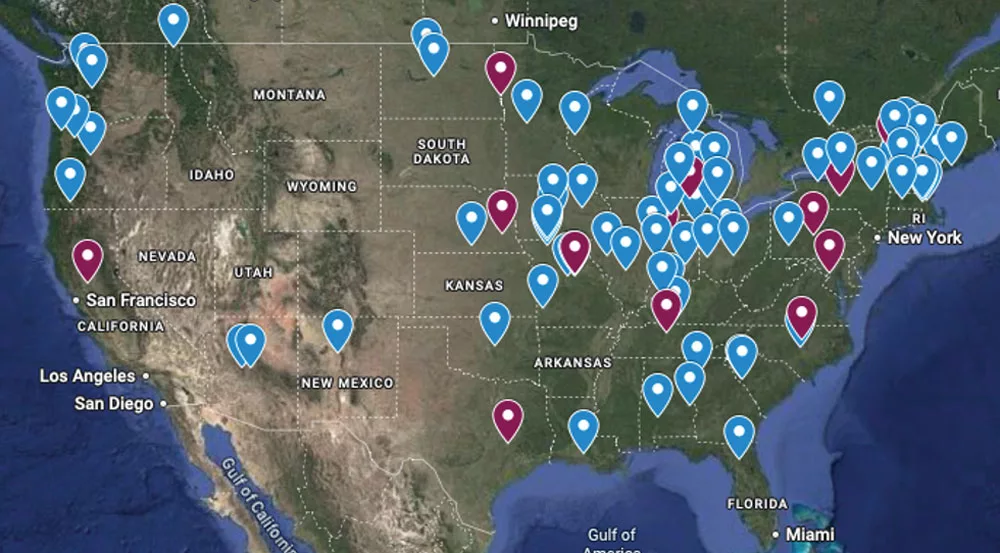
TESTING SITES. The map represents the current cover crop variety testing sites. The location pins in purple are university testing sites and the ones in blue are on-farm sites. The Center for Regenerative Agriculture hopes to continue expanding its variety testing efforts across the nation. CRA
Rob Myers never wants a farmer to believe that cover crops won’t work for their area.
“You have to tweak the management, you have to think about what’s the right cover crop, the right timing for the system,” says the director of the Center for Regenerative Agriculture at the Univ. of Missouri. “But they will work.”
To help farmers find success with the practice, the Center is leading a multi-partner National Cover Crop Variety Improvement and Seed Production Program, with the objectives of both improving cover crop varieties through breeding efforts and testing them on a nationwide scale to identify which ones perform best for each region.
At the 2026 National No-Tillage Conference in St. Louis, Myers shared some of the results they’ve seen since the project launched, as well as some strategies to maximize cover crops’ use and profitability.
One of the challenges with cover crops today is that a lot of seed being sold is Variety Not Stated (VNS).
“We don’t have enough name varieties that are locally adapted where we know the traits and how they’re going to perform in those areas,” Myers…

Get full access NOW to the most comprehensive, powerful and easy-to-use online resource for no-tillage practices. Just one good idea will pay for your subscription hundreds of times over.
Download these helpful knowledge building tools

We have engineered and developed the most advanced concave system that threshes all crops, eliminates rotor loss, improves grain quality, gives you a cleaner sample – all with one set of XPR concaves.

At Titan International, our product portfolio reflects our commitment to innovation and high-quality products. Titan International offers a full line of solution-focused wheel, tire, and undercarriage products for a wide variety of off-the-road equipment in agriculture, construction, forestry, mining, power sports, high-speed trailers, and outdoor power equipment segments. As one of the largest North American manufacturers, with a network of dealers all over the world, Titan is an industry leader that original equipment manufacturers and operators can count on for durable products and quality service.

Provide expert analysis and decision support to increase productivity and profitability.