TAKEAWAYS
- Wisconsin is paving the way and setting examples for other states with more than 50 farmer-led groups.
- Cover crops and no-till go hand-in-hand and work better when paired together, versus using either as a separate practice.
- The benefits of no-till extend beyond soil health conversation. No-till puts valuable time back on the clock.
After more than 40 years of farming in Watertown, Wis., a lot has changed for no-tiller Tony Peirick. Technology has certainly advanced since Peirick first started farming, and the agriculture economy has also seen its share of changes across those 40 years. But one thing that has remained constant for Peirick is his passion for no-till, cover crops and sharing what he’s learned about regenerative agriculture over the last several decades with other farmers.
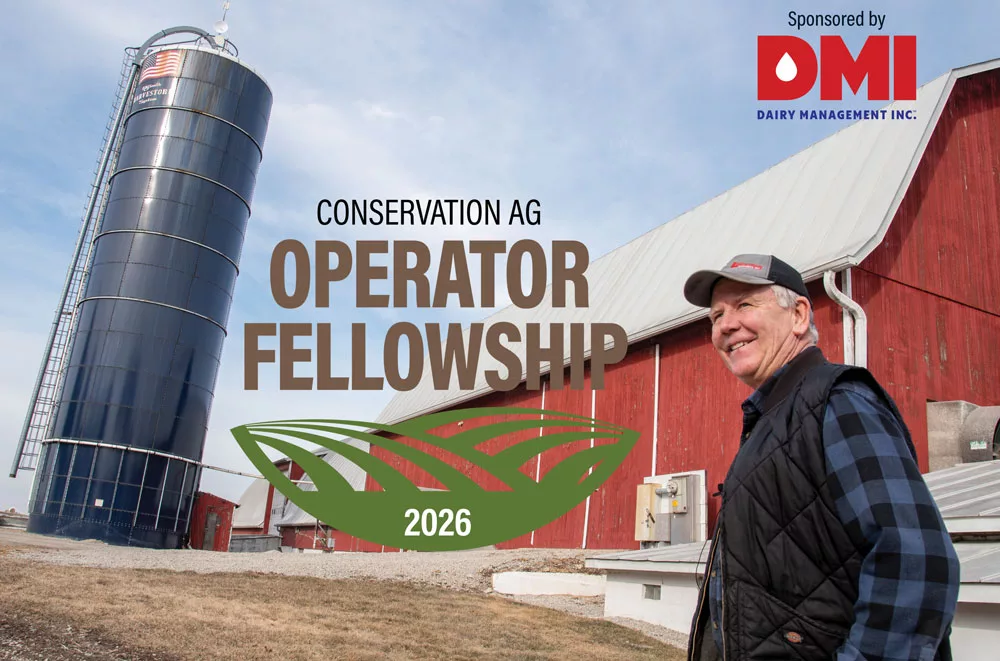
Peirick is No-Till Farmer’s 2026 Conservation Ag Operator Fellow, chosen for the honor due to his extensive experience with no-till and cover crops, his innovative approach to conservation practices and his inspiring leadership to help other farmers adopt no-till practices.
He farms with his son, brother and nephew, at T&R Dairy Farm where the four of them oversee a 200-cow dairy operation, grow cash crops on 1,100 acres and provide custom fieldwork for other farmers. A long time no-till operation, Peirick has also been planting cover crops since the late ‘90s and now aims to “plant green” whenever possible.
They also grow wheat with multi-species cover crops. Peirick says they will then use the wheat for bedding for their dairy operation.
Despite the large acreage and many responsibilities with the dairy operation, Peirick says the four of them are pretty comfortable with their individual duties and keeping the operation almost entirely family-run. In fact, Peirick says they even seek out more work and help their neighbors whenever they can.
“Wouldn’t you rather have soil that’s living rather than dead soil with full tillage…”
“We do a lot of custom work for the neighbors as well and we do some corn planting and a fair amount of spraying, so that gives us some extra work,” Peirick says. “But otherwise, most of the land is all pretty close here. We don't have to run too far, which has helped us out over the years, not doing a lot of traveling for the 1,100 acres that we do run. Plus, we have our own grain facility, so we just harvest it and put it in the bins and we have it custom hauled out.”
Getting Technical
Peirick uses a John Deere 1775 Exact Emerge Planter, but he does not run any fertilizer openers. He has made a few small modifications to the planter, which he will be running for the third season in 2026.
“We just got the air adjust row cleaners and we're running PTT blades on it — we're always running them on almost all of our planters,” Peirick says. “And then we've got the belt delivery system, hydraulic downforce and air-adjustable closing wheels.”
Peirick says they use five gallons of QLF starter fertilizer with 15 gallons of 32 with ammonia Thio-Sul, and that goes on at planting time. The rest of the N is typically side dressed later on.
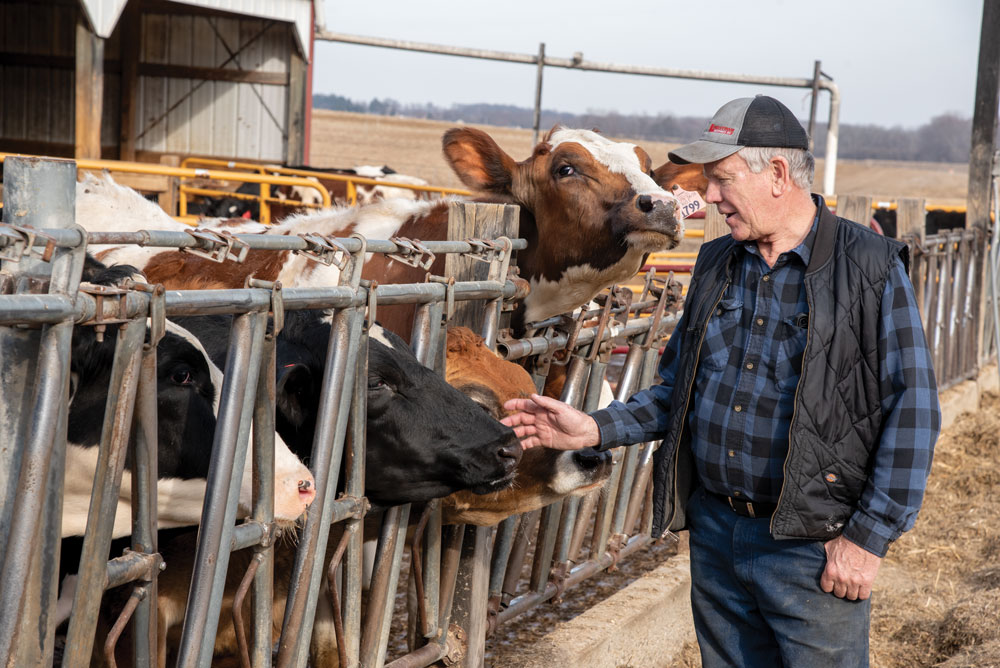
VARIETY THRIVES. At T&R Dairy Farm, Peirick farms with his son, brother and nephew, where the four of them oversee a 200-cow dairy operation, grow cash crops on 1,100 acres and provide custom fieldwork for other farmers. They also grow wheat with multi-species cover crops which often gets used for bedding on their dairy operation. John Dobberstein
Overall, Peirick says his planter is one of the “MVPs” of his farm operation, often planting over 2,000 acres per year in total.
“It's a high speed planter and it’s just very well equipped,” Peirick says. “The delivery system has been phenomenal. My son runs it all the time. And the accuracy has just been phenomenal as well with that brush delivery system with John Deere. It's been a really good planter for us.”
Peirick used to use Case IH early riser planters, which he also liked, but he credits the accuracy of the John Deere brush delivery system for eventually winning him over.
“Getting the seed to the ground, the accuracy is just amazing, I mean, what an idea that is,” Peirick says. “The seed is exactly there at the right time and the brush drops the seed in the ground at the same speed you're going so you don't have that hop in the seed that's down on the ground. But it's been a phenomenal planter. We really like it and we like to keep it simple.”
Looking Ahead
Peirick typically aims to plant in late April if all goes according to plan. Peirick and his son, brother and nephew all have their tasks divided up so that everyone knows what they are responsible for. He says it works well that way and has been working for long enough that they don’t plan to mess with that formula any time soon.
“My brother's a little younger than I am, and my nephew's on the farm here with us too. But they kind of take care of the cows,” Peirick says. “My son lives nearby and he does most of the cropping. And then when we make the hay, we all kind of work together. So we got about 130 of our own acres and we've got around 120 custom acres. So it's close to 200 acres cut four times a year, and that we bail. We make all baleage. We've been doing baleage for 20 years.”
“We know this stuff can work when you’re sincere about it…”
Peirick also notes that once corn planting begins, he can usually be found in their self-propelled sprayer.
Peirick says spraying the crops and applying nitrogen is needed for his operation.
Why No-Till?
Soil health is important to Peirick and his family, but there are several other reasons why no-till and cover crops have been at the forefront of everything they've done on the farm for the last several decades.
“We’ve got some hilly ground here but beyond that, no-till just reduces your planting time,” Peirick says. “When I was a kid, we had a moldboard plow and we would have to disc the field three times and it took a very long time to get a field prepped for corn. Nowadays with the no-till and covers, all we have to do is go out and start planting in spring.
“Just to see the soil and the better absorption of all your nutrients, your phosphorus, your potassium levels — you’re going to have a lot more availability with your mycorrhizal fungi and wouldn’t you rather have soil that’s living than dead soil when you’re doing full tillage?”
Tony Peirick is No-Till Farmer’s 2026 Conservation Ag Operator Fellow. He will be the subject of a unique year-long content series that includes a deep dive into his management practices throughout 2026 via articles, videos and webinars. This is the first installment of a 4-part written series. Stay tuned for part 2, which will be featured in the August Edition of No-Till Farmer’s Conservation Tillage Guide.
Launched in 2022 to mark the start of No-Till Farmer's second 50 years of publication, the annual Conservation Ag Operator Fellowship program follows one no-tiller throughout the year. The editors of No-Till Farmer and Cover Crop Strategies return to the farm all year long to share the challenges, solutions and real-time decision making needed to make no-till and conservation ag practices work in real-world conditions.
He also credits no-till and cover crops for making farming more fun and keeping things interesting. But at the same time, Peirick says he recognizes that not every farmer is going to be able to go full no-till all at once. Instead, he has a more realistic idea of what farmers can do to start moving the needle toward healthier soils, and it all starts with attitude.
“We can't continue to use large volumes of synthetic fertilizer and hopefully we can reduce that,” Peirick says. “Will we ever be able to get away from it entirely? I don't know. I think we can, but it's a slow process. But the key to all of this and to no-till is people just have to be willing to try something. You can't just say you're never going to try to change.”
Many Hats
If Peirick wasn’t already busy enough with his own farm operation and the custom work he does for neighbors, he is also heavily involved with two farmer-led groups. Roughly 10 years ago, he founded Dodge County Farmers for Healthy Soil and Healthy Water, and currently serves as the president of the group.
The group has monthly meetings and frequent field days and clinics where farmers can share ideas and learn from each other to advance their no-till skills and further grow in their knowledge of cover crops and other regenerative ag practices — all with the goal of improving soil and water quality in the region.
Peirick says the group is up to almost 100 members in its current form.
“There are 55 groups like this in Wisconsin alone and we're one of the larger ones, but we're doing it all ourselves,” Peirick says. “Every meeting, I am there to lead the meeting. We don't have government officials or government extension people running the meeting. It takes a lot of my time, but when I started it up almost 10 years ago, I said that we're not going to have extension people involved and it's going to be the farmer group.”
“The satisfaction of farmers coming back and saying ‘thank you,’ and seeing their excitement when this stuff actually starts to work, that’s what is most important…”
Peirick also notes that he does not get paid anything to be a part of the group. He does it purely because he wants to be a part of the greater change and to help other farmers get better at what they do.
The same is true for the other farmer-led group that Peirick is also the president of — Fields of Sinsinawa. This farmer-led learning center is located in southwestern Wisconsin at the Sinsinawa Mound. Peirick says Fields of Sinsinawa’s plan is to become a unique and educational hub where resources, demonstrations, community building and farmer-led learning are able to connect healthy soil, healthy food, healthy people and a healthy planet together.
“We are creating a living classrom where all are welcome to learn about the importance of soil functuality, plant interconnectivity and adaptive multi-paddock grazing,” Peirick says.
The farmer-led groups are very important to Peirick and he says that even when he is at his busiest with his own farming operation, he always goes out of his way to make time for farmer-to-farmer learning.
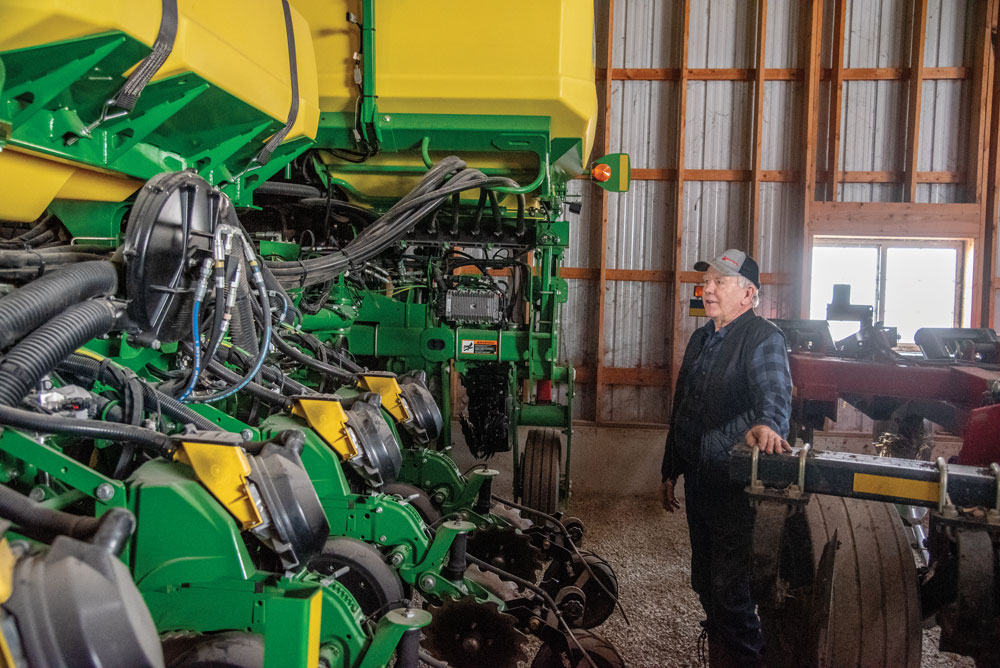
WORKHORSE. Peirick uses a John Deere 1775 Exact Emerge Planter which he will be running for the fourth season in 2026. He estimates each year he plants over 2,000 acres with it. John Dobberstein
“Wisconsin has really been looked upon as a leader in these farmer-led groups and getting regenerative agriculture going, which is pretty important,” Peirick says. “Farmers don't want to try this on their own and they need that group support there to help them through it."
Peirick hopes to continue the great example Wisconsin has set and help expand similar groups into other states.
“I do a mentorship for all different states,” Peirick says. “I've been in Iowa and Illinois and getting groups started and they're all kind of looking towards Wisconsin. Michigan's going to put a big effort on now as well and they've got a good shot of getting this all together.”
Even when free time is scarce and there is no monetary reward, Peirick says he is more than happy to do what he does for other reasons.
“The satisfaction of farmers coming back and saying ‘thank you,’ and seeing their excitement when this stuff actually starts to work, that’s what is most important,” Peirick says. “We know this stuff can work when you’re sincere about it.”
The 2026 Conservation Ag Operator Fellowship program is made possible with the support of Dairy Management Inc.

Dairy Management Inc. (DMI) is an organization funded by dairy farmers to increase sales and demand for dairy through research, education and innovation, while maintaining confidence in dairy foods, farms and businesses. Through our sustainability program, we create credible, science-based resources and partnerships that support farmers’ environmental journeys while building trust in dairy as part of a healthy, sustainable food system