On this episode of Conservation Ag Update, brought to you by Martin-Till, we head out to Commodity Classic in San Antonio, Texas, for key takeaways from the USDA press conference addressing its computer network overhaul.
Plus, Environmental Tillage Systems and Case IH give us a first-look at the companies’ new strip-till rigs that debuted at Commodity Classic.
In the Cover Crop Connection, Mackane Vogel catches up with Etienne Sutton from the Univ. of Missouri for a preview of her National Cover Crop Summit presentation about the Variety Improvement and Seed Production Program.
Later in the episode, PTI Farm Manager Jason Webster shares some eye-opening numbers from the first year of a chicken litter study at the Pontiac, Ill., research farm.
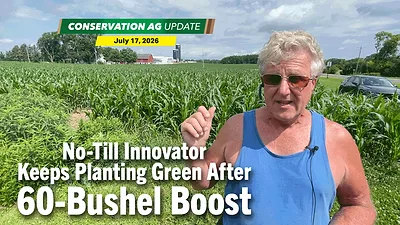
In the Video of the Week, No-Till Innovator Bill Lehmkuhl opens his Precision Agri Services display case for a look back at how he got started with precision technology in 1994.
This episode of Conservation Ag Update is brought to you by Martin-Till.
Since 1991, Martin Industries has designed, manufactured and sold leading agriculture equipment across North America and the world. Known for Martin-Till planter attachments, the company has expanded to include a five-step planting system including our floating, air or hydraulic and frame mounted row cleaners along with closing wheel systems, twisted drag chains, fertilizer openers, weight transfer systems and more in their lineup. Their durable and reliable planter attachments are making it possible for more and more farmers to plant into higher levels of residue & cover crops.
TRANSCRIPT
Jump to a section or scroll for the full episode...
- USDA Replacing Taxpayer Funded IT Nightmare
- New Strip-Till Units Debut at 2026 Commodity Classic
- Practical Insights from the Cover Crop Variety Improvement & Seed Production Program
- Chicken Litter Applications: What’s the ROI?
- Video of the Week: No-Tiller Reflects on 30 Years of Precision Ag
USDA Replacing Taxpayer Funded IT Nightmare
Welcome to the show! We’ll begin in San Antonio, where John had a front row seat to a press conference announcing sweeping changes to the USDA’s much-maligned computer network. USDA leaders say new upgrades will make it easier for farmers to apply for grants and disaster funding, update acreage and participate in other farm-related programs.
Richard Fordyce: “It’s long, long, long overdue. Some of the DOGE architects that looked at these antiquated legacy systems said, ‘Oh my gosh, these things are going to break,’ and they designed a pathway forward. I’m not a computer engineer or programmer by any means, but I do know when I see something that looks like it’s going to work and can say, “Yeah, let’s do that.”
Brooke Rollins: “I hope you all heard the staggering numbers. Hundreds and hundreds of millions of dollars of taxpayer money have gone into an antiquated and broken system that included over 1,000 contractors across hundreds of different platforms. I have no idea how farmers have been dealing with this all these years.”
The administration is also streamlining conservation programs to make it easier to bundle and apply for different practices. For a full breakdown on what the network upgrades will entail, head to No-TillFarmer.com.
New Strip-Till Units Debut at 2026 Commodity Classic
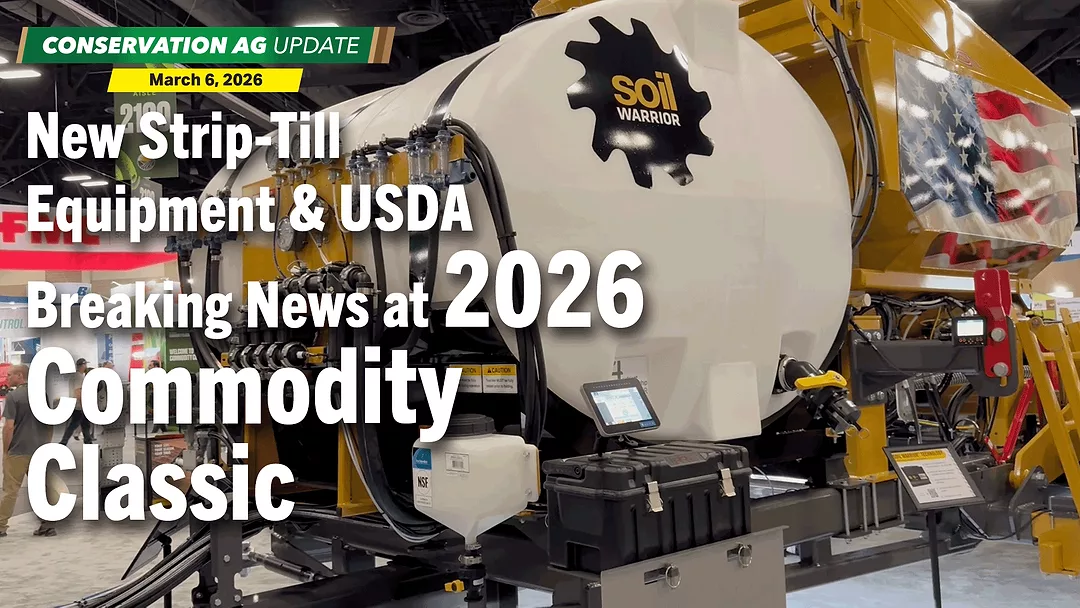
Elsewhere at Commodity Classic, a few companies debuted brand-new strip-till equipment. We got our first look at the ETS liquid and dry fertilizer system and the Case IH Nutri-Tiller 1000. Let’s check out some of the key features.
Environmental Tillage System: “This provides growers a larger tank for their liquid systems. This is a 1,250-gallon liquid tank. The dry bin behind it is a 5-ton fertilizer bin. It allows them to run dry and liquid together. Where the fertilizer is applied on the row units themselves, it’s a dual drop tube, so you’re applying your liquid and dry fertilizer right in the strip as you would traditionally with our equipment. This just brings it all together, giving growers a lot more versatility for their fertility programs. It’s all still run through our SoilWarrior technology — it’s a Raven RCM. It’s an ISO connection into your tractor.”
Case IH: “Then the final step of this system, the berm builders, berm conditioners to provide what we want the width of that strip to be and provide the nice strip out the back of the machine. That brings me ahead to the shank. This unit is a shank machine. You can run 6-9 inches. We offer fertilizer options to run liquid, dry, anhydrous or liquid and dry together. We also offer it without any fertilizer attachments.”
Looking forward to learning more about both of those at the National Strip-Tillage Conference, August 6-7 in Springfield, Ill.
Practical Insights from the Cover Crop Variety Improvement & Seed Production Program
In this video, Etienne Sutton, agroecologist for University of Missouri's Center for Regenerative Agriculture shares a preview of what she will talk about during her upcoming presentation at the 2026 National Cover Crop Summit.
Mackane Vogel: “I'm here today with Etienne Sutton, she is one of our presenters this year at the National Cover Crop Summit. Etienne, why don't you just tell us a little bit about your presentation and give everybody kind of a preview about what they might learn?”
Etienne Sutton: “Sure. So I'll be sharing some of the work that we've been doing as part of our cover crop variety improvement and seed production program. It's based out of the University of Missouri Center for Regenerative Agriculture. But includes collaborators all across the country, ranging from university extension and researchers to the seed industry, as well as a really exciting on-farm component where we're working actively with farmers to test different species and varieties in their fields.”
Mackane Vogel: “Yeah. And I guess what's kind of been, I don't know, one of the biggest surprises or one of the biggest takeaways for you kind of going through the data over the last little bit here?”
Etienne Sutton: “Yeah. So what we've been learning so far from the data is that there are some really strong regional adaptation trends. So when you're thinking about what cover crop species to plant, there are all of these different varieties within a given species. Some of those varieties may be better suited to, for example, the Southeastern US, some are better suited to the Midwest. So those are some of the things I'll be covering in my presentation. And hopefully will be useful to folks making cover crop decisions.”
Mackane Vogel: “Absolutely, yeah. Well, I don't want to give too much away, but it's a great presentation. So hopefully, guys, you're all signed up already. If you're not, be sure to sign up for the fully free, fully online National Cover Crop Summit this year.”
Chicken Litter Applications: What’s the ROI?
A couple years ago, Jason Webster, who manages the PTI Research Farm in Pontiac, Ill., was talking to a high yield corn grower, and he asked him, ‘Hey, what’s your secret sauce?’ The corn grower said, “That’s easy, it’s the chicken litter we’ve been applying the past 65 years.” Jason immediately knew he had to test it out on the research farm, here’s what he found out.
“This fall, we put on 2.5 tons of dry litter going across the cornstalks. It was super dry. We got it shipped in. Never got rain on it, it was spread pretty good. Nutritionally, that’s a pretty good product but I also look at it and say I think there’s some biology in this as well, so I almost consider this a soil health product.”
“My soil health testing at the PTI Farm has involved cover crops. I’ve been waiting to see the profitability of the cover crops, so I said let’s bring chicken litter in and add it to soil health study and see how long it takes for these guys to pay for themselves.”
“This is soybeans after corn. 2 tons of chicken litter right out of the gate first year has given me the highest yields and highest profitability. I kind of like that. This is corn on corn, we’re tickling 300-bushel corn, 2 ton chicken litter highest yield, not a whole lot of profit there but much higher than some of the other ones that have been in this for multiple years. And finally corn after soybeans, really nice yield gain and some profit in year one, right out of the gate.”
That was from Jason Webster’ PTx Winter Conference presentation.
Video of the Week: No-Tiller Reflects on 30 Years of Precision Ag
Now, to the Video of the Week. Bill Lehmkuhl’s been no-tilling for a long time in Minster, Ohio, and he also runs Precision Agri Services, Precision Farming Dealer’s 2026 Most Valuable Dealership. During my recent visit with Bill, I pressed record as he reflected on how it all started with technology on his farm.
Bill Lehmkuhl: “So some of the old field computers we used for sampling and that, we used the old Lynx computer here. I even did soil sampling off an old iPAQ, some of the Ag Leader handhelds as well. So with that being said, we also did topographic survey work, that's with some of the Trimble displays there. But when I started in 1994, we were doing soil sampling off of a little iPAQ computer for that, and looking at maps and sample points out there. And it's evolved from there. Of course, now we can use iPads and the different apps and software that are out there to do soil sampling. And bring that data back to the office and then go through it, match it to samples, do the mapping, and then get that back out to our customers.”
Noah Newman: “Seeing this stuff, does it bring back any memories from the good old days?”
Bill Lehmkuhl: “Oh yeah, it does. I mean, when I first started, I had a six by six set up with a field computer on it. We still probe everything by hand, we do not machine probe at all. We want to make sure that everything going into that bucket is of the same consistency from that zone as far as soil type and how it looks. So we do a lot of zone sampling. So we make sure that those zones match what's going on out there in the field. And of course, we bring the various layers into that, yield maps, topography, whether that's soil conductivity data by Veris or anything else. And we take a look and analyze all that data to get the best results back to our customers and see what's going on out there in the field.”
That’ll do it for this week’s episode. With planting season creeping up, I’d love to see your setup. Send photos or videos of your planters to Nnewman@Lessiter Media.com. Thanks for watching. Until next time, for more stories visit no-tillfarmer.com, striptillfarmer.com and covercropstrategies.com.