

Drift management has always been part of responsible application. But the stakes feel higher than ever: tighter windows, more sensitive acres nearby, more scrutiny, and less tolerance for misses, especially when product performance hinges on coverage.
Nozzle selection sits at the center of that challenge. The wrong droplet spectrum can push you into a bad tradeoff: go too fine and risk off-target movement; go too coarse and give up coverage and efficacy. The good news is that our nozzle designs and better testing methods are helping applicators reduce drift potential without automatically sacrificing coverage.
At Greenleaf Technologies, we’ve recently completed extensive third-party testing at the University of Nebraska’s Low Speed Wind Tunnel to bring our nozzle data up to the new ANSI/ASABE S572.3 standards. The wind tunnel testing moves air at 15 mph across the spray plume in contrast to static tests with little or no air movement can overestimate driftable fines because there’s no air shear pulling the smallest droplets away from the measurement zone. Wind-tunnel testing is designed to better capture what actually leaves the boom, vital information applicators need when dialing in nozzle choice and pressure.
One metric we’re emphasizing more directly is driftable fines: the percentage of spray volume in droplets below 141 microns. This is the fraction of the spray volume that is the most prone to moving off target under wind and turbulence, or even evaporation. Less driftable fines typically means less drift potential, without needing to guess based on droplet category alone. Going forward, our tabulation charts will show driftable fines percentage next to the droplet category.
Below is a practical look at several nozzle platforms and what the wind-tunnel data and independent studies show about optimizing droplet spectrum and pattern.
The drift/coverage balance starts with design not just pressure
Two applicators can run the same gallons per acre and the same pressure and still see different drift risk and different canopy penetration because nozzle internal design and spray pattern determine how the droplet spectrum is built.
Venturi-style air induction, for example, is one proven path to reducing driftable fines. But within that category, nozzle architecture matters: how the nozzle forms droplets, how it shapes the spray pattern, and how it behaves across a usable pressure range.
This is where modern nozzle selection becomes less about “one best nozzle” and more about selecting a tool matched to the product type and the target:
- Systemic herbicides often reward drift control and deposition consistency. Coverage is still important, but smaller droplets aren’t required for performance.
- Contact products and fungicides/insecticides in dense canopies often reward improved coverage and multi-angle deposition without falling into an overly fine droplet spectrum.
TurboDrop XL: a modular platform that adapts to different jobs
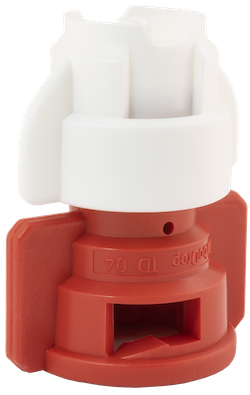
TurboDrop XL (TDXL) helped set the standard for low-drift performance with a modular two-piece approach: a Venturi air injector paired with a separate pattern tip. That modularity still matters today because it lets an operator adjust performance without replacing the entire nozzle.
In wind-tunnel testing, an 04-size TDXL spans a wide range of droplet classifications depending on pressure, moving from very drift-resistant (extremely coarse at lower pressures) toward more coverage-capable classifications (coarse/medium at higher pressures).
In the Nebraska wind tunnel results at a mid-range operating point (around 43 PSI), the TDXL showed low driftable fines under 141 microns (about 1%). Put another way, the nozzle can keep the “most drift-prone fraction” small while still giving the operator a usable pressure window.
Where it fits: A practical workhorse for operators who want drift reduction but don’t want to be boxed into a single droplet category across every product and acre.
TDXL-D: ultra-coarse performance via a tip change
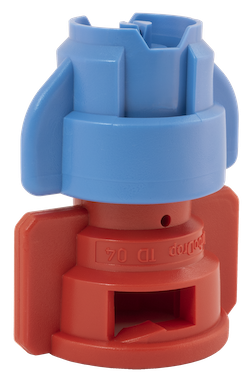
For applications where label requirements and stewardship demand an ultra-coarse droplet, changing your entire nozzle lineup can be expensive.
Because the TurboDrop system is modular, the TDXL-D configuration uses a different pattern tip (larger orifice) to coarsen the droplet spectrum while keeping the same Venturi base. In wind-tunnel testing for a TDXL04-D at roughly mid-range pressure (around 43.5 PSI), the nozzle classified as ultra coarse, with driftable fines often below 0.5%.
Where it fits: Sensitive application scenarios and systemic products when drift risk must be pushed as low as possible while maintaining a practical operating window.
DualFan coverage without “going fine”: TurboDrop Asymmetric DualFan (TADF)
Coverage problems don’t always show up as visible skips. More often, they show up as inconsistent performance in thick canopies, especially when leaf angles and layering reduce interception from a single direction.
That’s where multi-angle patterns can help. The TurboDrop Asymmetric DualFan (TADF) sprays at two different angles (10 degrees forward and 50 degrees backward). When mounted in an alternating configuration along the boom, it’s designed to deliver spray onto the target from four directions in one pass helping reduce shadowing.
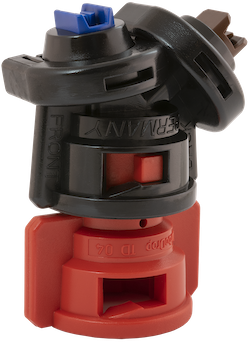
The design intent is balance:
- The inside pattern tips are selected to provide a coverage-oriented droplet size for performance.
- The outside pattern tips are designed to produce a coarser droplet “blanket,” helping control drift.
In wind-tunnel testing, TADF04 spans from very coarse at lower pressures to coarse at higher pressures. This results shows the low drift nature of the nozzle, but disguises the coverage capabilities of the asymmetric design. The smaller inside tip produces smaller droplets that work exceptionally well with contact chemicals.
On the field-performance side, the DualFan concept has been evaluated beyond lab measurements. A recent three-year multi-state study by Beck’s designated the TADF as PFR Proven and reported an average ROI of $23.29 per acre for fungicide and insecticide applications in soybeans.
TADF-D: when you want DualFan placement with maximum drift safety
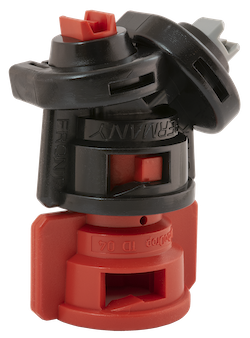
For operators who want the multi-angle deposition benefits but need an even more drift-reducing droplet spectrum, the TADF-D version shifts performance coarser. In wind tunnel comparisons, TADF-D produced less than half the driftable fines of the standard TADF across the usable pressure range.
Where it fits: Multi-angle placement where drift risk still needs to be tightly managed.
PWM changes the rules: why “PWM-ready” nozzles matter
Pulse Width Modulation (PWM) has become a key tool for improving rate control keeping pressure stable while varying flow through rapid solenoid pulsing. That stability can help keep droplet size more consistent across changing speeds.
But PWM also introduces its own realities:
- Rapid pulsing can challenge spray pattern integrity.
- Lower duty cycles can increase the risk of coverage gaps if the nozzle pattern isn’t stable.
Greenleaf’s Blended Pulse DualFan (BPDF) is built for pulsed environments and pairs that PWM stability with a DualFan approach for multi-angle deposition. For operators, that can be especially useful when operating at duty cycles where “one angle” coverage becomes less forgiving.
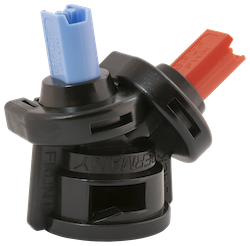
Independent research reinforces this coverage advantage. A 2020 Mississippi State University study comparing PWM-compatible nozzles found the BPDF delivered significantly improved ground coverage and more than twice the vertical coverage within the canopy versus standard 110-degree flat-fan nozzles.
For a BPDF 07 size, Greenleaf testing shows coarse to medium droplets across a pressure range common for PWM operation.
Setup considerations that typically help PWM performance: maintaining duty cycles above 50% when possible and reducing boom height (within safe and label-appropriate limits). Those two steps can support both drift reduction and more consistent application.
Where it fits: Operators using PWM who want more consistent coverage and canopy deposition without being forced into a fine-droplet strategy.
SoftDrop for PWM: drift control as the primary objective
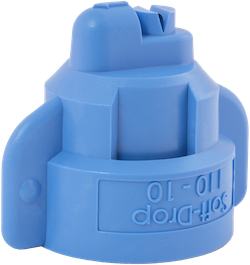
When the application goal is drift control first, like with systemic herbicides, nozzle design should prioritize minimizing driftable fines while maintaining a workable pressure range for PWM.
SoftDrop is engineered specifically for low-drift systemic applications. Wind-tunnel data on the SD11010 shows consistent ultra coarse to very coarse droplets across a wide pressure range (20–90 PSI). At the low end, driftable fines under 141 microns were effectively 0%; even near the high end (around 87 PSI), driftable fines remained very low (about 1.4%).
Where it fits: PWM operators applying systemic herbicides who need strong drift control while keeping the operational advantages of PWM.
AirMix: economical versatility with multiple pattern options
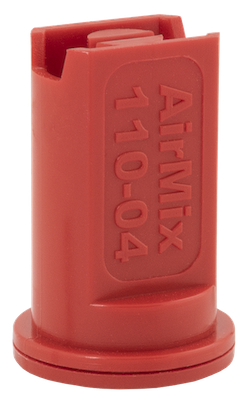
AirMix (AM) has remained popular because it’s simple, reliable, and flexible. By adjusting pressure, operators can shift the droplet spectrum across a broad range. Wind-tunnel data for AM11004 shows extremely coarse droplets at lower pressures for drift-responsible work, shifting toward medium classifications at higher pressures when added coverage is needed.
AirMix is also available in several patterns (including 80-degree, off-center, and hollow cone options for specialty uses). It can be paired with TipGuard, a spray tip protection system designed to help reduce damage from obstacles, an operational detail that matters when long booms, uneven terrain, or exposed setups raise the risk of broken tips.
Where it fits: Operators who want one economical nozzle family they can tune by pressure—and who value pattern options for specialized setups.
Making the data usable: print, web, and in-field tools
Nozzle selection decisions are made quickly, often in the shop or on the edge of the field. To support that, Greenleaf is updating how we publish nozzle performance information:
-
The 2026 catalog reflects the updated ASABE standard and adds a “Drift %” column so applicators can compare driftable fines under 141 microns by nozzle and pressure.
-
The website is being updated with expanded data across nozzle families, patterns, and spacings.
- The NozzleCalc app is being enhanced so users can view droplet classifications and drift percentages by PSI, along with improved pressure-drop calculations for PWM systems (including Capstan, John Deere ExactApply, Raven, and others).
The goal is straightforward: give applicators clearer comparisons so they can select nozzles with fewer assumptions and more confidence.
Bottom line
Modern application isn’t about choosing between drift control and coverage, it’s about matching nozzle design, droplet spectrum, and spray pattern to the product and the target. With wind-tunnel testing that better represents real-world air shear, and with driftable fines presented as a simple, comparable metric operators can make more informed decisions that protect both efficacy and stewardship.
Learn more at GreenleafTech.com