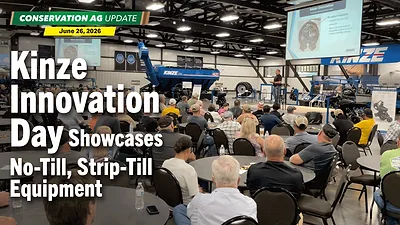
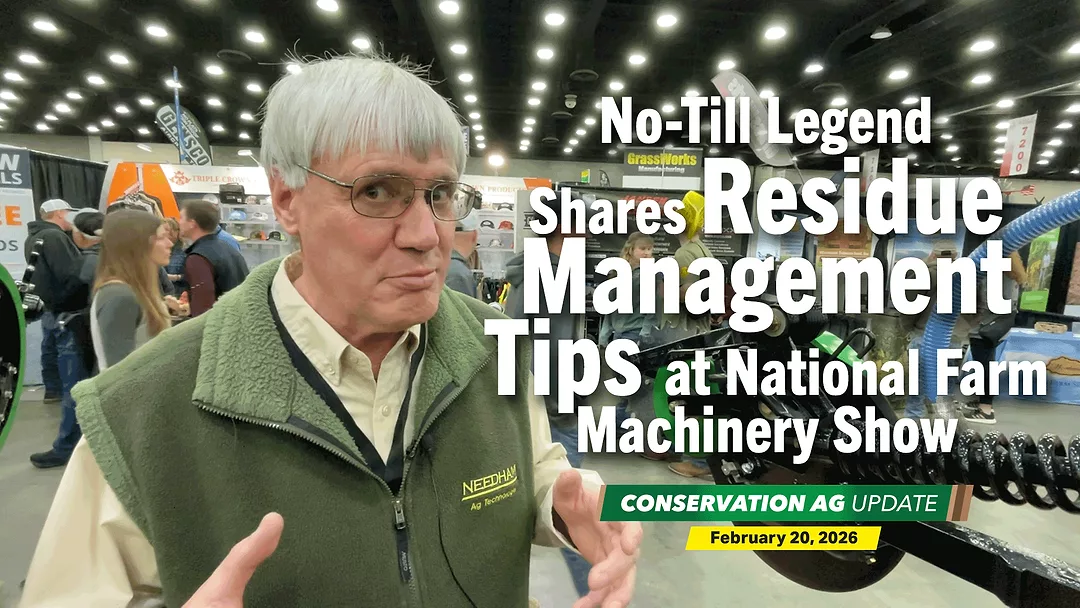
On this episode of Conservation Ag Update, brought to you by Martin-Till, we head inside the 2026 National Farm Machinery Show in Louisville, Ky., for a look at new equipment and residue management insights from No-Till Innovator Phil Needham. Plus, agronomist Brad Forkner shares some innovative new inputs, including a product called Squid Juice.
In the Cover Crop Connection, Mackane Vogel chats with Keith Berns about the 7 “bio-graces” for farmers and a preview of his upcoming National Cover Crop Summit presentation.
Later in the episode, we head out to the Midwest Cover Crops Council annual meeting in Dubuque, Iowa, where Ducks Unlimited lands biologists shared updates on a couple new grant programs.
Also in the episode, Beck’s agronomists reveal key takeaways from a nitrogen (N) application study in the 2025 Practical Farm Research recap. Finally, in the Video of the Week, Dawn Equipment’s Joe Bassett gets fired up over lost topsoil in a ditch!

This episode of Conservation Ag Update is brought to you by Martin-Till.
Since 1991, Martin Industries has designed, manufactured and sold leading agriculture equipment across North America and the world. Known for Martin-Till planter attachments, the company has expanded to include a five-step planting system including our floating, air or hydraulic and frame mounted row cleaners along with closing wheel systems, twisted drag chains, fertilizer openers, weight transfer systems and more in their lineup. Their durable and reliable planter attachments are making it possible for more and more farmers to plant into higher levels of residue & cover crops.
TRANSCRIPT
Jump to a section or scroll for the full episode...
- No-Till Networking at 2026 National Farm Machinery Show
- Squid Based Fertilizer Deliver Multiple Benefits
- The 7 'Bio-Graces' for Farmers
- Duck’s Unlimited Zeroes in on Boosting Conservation Ag
- Beck’s Agronomists Reveal ‘Favorite’ Nitrogen System
- Video of the Week: ‘This is How You Want to Farm?!’
No-Till Networking at 2026 National Farm Machinery Show
Double barreled intros to get us going on this action-packed episode! We’ll check back in with Mackane here in a minute but first let’s take you inside the 60th annual National Farm Machinery Show in Louisville, Ky.
And you never know what you’ll see or who you’ll meet at the Kentucky Expo Center. We’ve all heard of the No-Till Farmer, but what about the Gold Star Farmer! He drew a big crowd at the Fendt booth.
We got our first look at some new equipment, too. Like Landoll’s VertiSTRIP strip-till machine. It’s new under the Landoll brand, but farmers have already been using it the past several years. Landoll acquired the license to it from Hawkins and AGROdeviate. We’re told if you bought the unit from Hawkins, you’ll still be able to go through them to get the parts, but any new customers going into strip-till will have to do business with Landoll.
We also got an up-close look at Precision Planting’s ArrowTube seed-orienting delivery system, which could be available on a limited basis later this year.
The equipment’s great, but it’s also pretty cool being in the same building as some of the brightest minds in agriculture. We ran into No-Till Innovator Phil Needham, who filled us in on an interesting conversation he had with a grower about residue management.
“He said his residue management in the back spread 30 feet on average. So, he has a 40-foot head on the front spreading residue about 30 feet out of the back, and my guess is it wasn’t uniform across the width. Generally, that’s a problem.
“For any piece of seeding equipment, whether it’s a John Deere single disc opener like this or a planter of any brand, you absolutely have to start by spreading residue evenly across the header width. Nobody wants to hear this, but some of these manufacturers are putting headers on the front wider than the residue management solutions in the back can spread residue. That’s a problem. Now, the manufacturers over the past 10-20 years have made significant improvements to the residue management systems in the back, but the headers have gotten wider than the choppers and spreaders that can spread residue over.
“My conclusion to the grower yesterday was to find a chopper/spreader combination that spreads the width of the header, which means maybe not going with as wide of a head. People don’t want to hear that, but it’s really important to get uniform residue spread if you want uniform emergence and development of crops like cereal and soybeans.”
Squid Based Fertilizer Deliver Multiple Benefits
If you’ve ever been to the show, you’ve probably experienced the magic of the crowded West Wing, where a lot of the cutting-edge innovations and hidden gems are located. And that’s where we found Brad Forkner.
Owner of Nutrient Management Specialists, Brad showcased dozens of innovative micronutrient and biological solutions. Remember a couple weeks ago, we heard from no-tiller Jeff Martin, who was using crabs and oysters on his farm. Well, now he can add squid to his mix if he wants! Brad, fill us in.
“One of the newer things we’re using this year would be the Squid Juice. Think about the calamari in your restaurant. 48% of the squid goes there, 52% of the squid is left. Again, because it was a live animal, it’s got your omega oils in there. There was enough blood left in there, blood is protein, protein is nitrogen, so we’ve got a nitrogen component. We’ve got amino acids in there... We’ve got a fungi food, and we can have a natural insecticide, nematicide, fungicide. Because it is a faster release, now you can pair it with the ones already on the market. If you’re starting to talk about the algae, guess where these boys eat? At the bottom of the ocean.”
Catch the full interview with Brad on No-TillFarmer.com.
Keith Berns — The 7 'Bio-Graces' for Farmers
In this video, Keith Berns gives a preview of his upcoming National Cover Crop Summit presentation where he will talk about what he likes to call the 7 "Bio-Graces" for farmers. According to Keith, a true example of grace must be something that is free (you can't buy it), undeserved (you can't earn it) and unrestricted (everyone has equal access to it). Be sure to sign up for the FREE National Cover Crop Summit at https://www.covercropstrategies.com/national-cover-crop-summit.
Ducks Unlimited Zeroes in on Boosting Conservation Ag
Mackane also got the scoop on new grant programs from Ducks Unlimited lands biologists, who are helping farmers implement conservation practices throughout the Midwest and beyond. They say Ducks Unlimited — the world’s largest private waterfowl and wetlands conservation organization — is focusing more on the ag space and recognizing the game-changing impact that no-till, strip-till and cover crops have downstream.
Liam Bonk, Ducks Unlimited Working Lands Biologist: “One of the gateway programs for DU getting into this space in the Upper Midwest has been this Advancing Markets for Producers Partnership grant. We incentivize things like multi-species covers, no-till, strip-till, edge of field buffers and livestock integration – grazing cover crops. DU is involved in providing the technical assistance, guiding the producer through that program across the finish line.
Devin Stortz, Ducks Unlimited Working Lands Biologist: “We’re rebuilding our wetlands for waterfowl and water quality at the bottom of these watersheds. These watersheds, specifically in state of Iowa, consist of predominantly ag ground. Cover crops being the number one practice that can benefit an ag producer, that’s also going to benefit the water quality and wildlife habitat downstream.”
They encourage you to contact a Ducks Unlimited lands biologist for more information.
Beck’s Agronomists Reveal ‘Favorite’ Nitrogen System
Back to Louisville now. Beck’s agronomists shared a bevy of key takeaways from their Practical Farm Research studies this past year. Here’s one on the benefits of split nitrogen (N) applications.
“At Beck’s, we’ve been doing research on starter. Our favorite system is a 2x2x2, getting the nitrogen on the ground on both sides of the row and applying the rest at V3. It’s a split application; we’re making the most of it.
“What’s the right rate for that? This is a multi-location study, and we’ve done this for 4 years. We went from 130-250 units. The economic optimum nitrogen rate, which resulted in 236 bushels, was only 160 units. Some of us this year might be going a little higher than that. If you’re in a field that has some organic matter, you may consider lowering your nitrogen rate if you can split apply it.”
Video of the Week: ‘This is How You Want to Farm?!’
And we’ll wrap things up with our Video of the Week. This one comes to us from Dawn Equipment’s Joe Bassett, who shared this passionate response to lost topsoil in his neck of the woods.
“Look at this insanity right here. Look at this ditch. That is your topsoil that is leaving the field and is ending up in your ditch because of your tillage practices. Who wants this? Who wants to farm this way? This topsoil took millions of years to be created. And this is how you want to farm?! It’s turning me into a nihilist.”
Love the passion. Send your thoughts on Joe’s video and more to Nnewman@Lessiter Media.com. Thanks for watching. Until next time, for more stories visit no-tillfarmer.com, striptillfarmer.com and covercropstrategies.com.