On this episode of Conservation Ag Update, brought to you by Martin-Till, longtime no-tiller Chris Weaver explains how he prepared his record-breaking soybean plot with a roller-crimper in the fall.
Plus, we get the scoop on some breaking news in the equipment world, including Yetter’s plans to acquire Martin, and Horizon Ag’s big debut in the U.S.
In the Cover Crop Connection, associate editor Mackane Vogel sits down with Wayne Honeycutt, Shannon Moeller and Odiney Alvarez-Campos from the Soil Health Institute for a look at their new drought resilience calculator.
Later in the episode, we introduce No-Till Farmer’s 2026 Conservation Ag Operator Fellow, Tony Peirick in Watertown, Wis. Washington, Iowa, no-tiller and Continuum Ag founder Mitchell Hora breaks down key takeaways from the 45Z update. And in the Video of the Week, major differences are revealed between no-till and conventional soils.
This episode of Conservation Ag Update is brought to you by Martin-Till.
Since 1991, Martin Industries has designed, manufactured and sold leading agriculture equipment across North America and the world. Known for Martin-Till planter attachments, the company has expanded to include a five-step planting system including our floating, air or hydraulic and frame mounted row cleaners along with closing wheel systems, twisted drag chains, fertilizer openers, weight transfer systems and more in their lineup. Their durable and reliable planter attachments are making it possible for more and more farmers to plant into higher levels of residue & cover crops.
|
|
TRANSCRIPT
Jump to a section or scroll for the full episode...
- No-Tiller Breaks World Yield Record for Non-Irrigated Soybeans
- Breaking News: Yetter Set to Acquire Martin
- Soil Health Institute — Drought Resilience Calculator & Other New Tools
- Tony Peirick Named Conservation Ag Operator Fellow
- U.S. Debut: Horizon Showcases No-Till Equipment at NNTC
- Mitchell Hora Breaks Down 45Z Updates
- Video of the Week: Conventional vs. No-Till Slake Test
No-Tiller Breaks World Yield Record for Non-Irrigated Soybeans
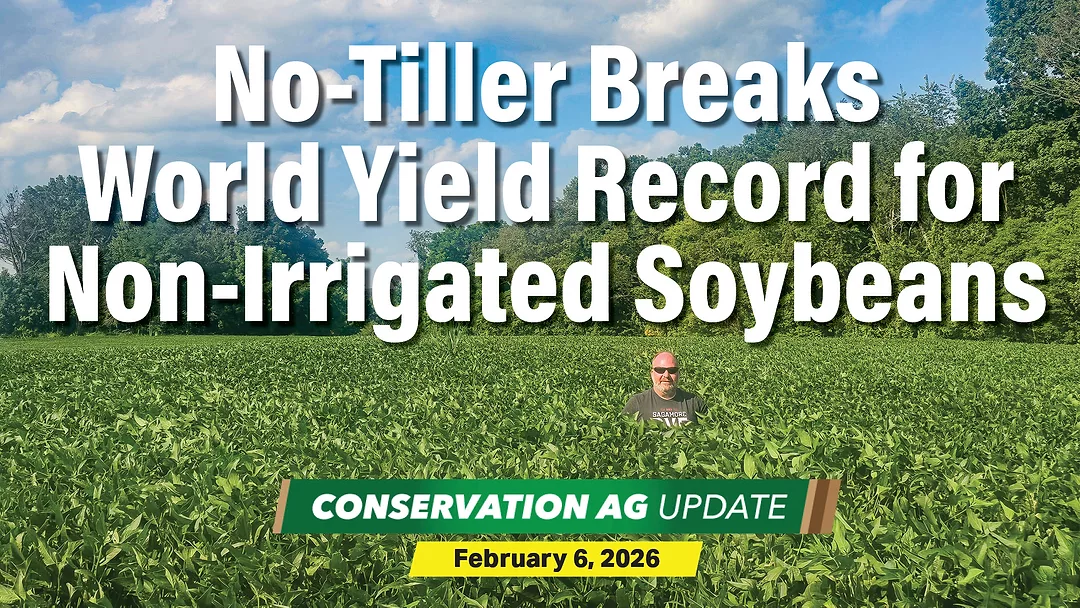
The “no-till, no-yield” myth is proven wrong once again. Chris Weaver just set a new non-irrigated world record with 154-bushel soybeans in Finksburg, Md.
No-till and cover crop mixes were huge pieces to the puzzle, along with an array of biological and foliar programs from Locus Ag, Concept AgriTek and AgroTech USA. He says he couldn’t have done it without his team of advisors. Weaver pulled tissue samples every other week and used a drone to apply foliar products. But the journey to high yields started with healthy soil, Weaver says, and residue breakdown in the fall.
Chris Weaver, No-Tiller, Finksburg, Md.: “We actually use a no-till crimper, like they use to mash down cover crops, but we use it in the fall. So, we take the crimper in, we mash down our corn fodder, and then we’re spraying Residue RX out the back of the machine. We mounted a boomless nozzle on that and it’s spraying out the back. We’re managing residue from the get-go along with Carbon RX and Sweet Success, and then we mix a little bit of molybdenum in with that as well in the fall. That’s all the prep we did. Then we’re watching the forecast. We’re checking the temperatures. We picked bean hybrids per field by the acre.”
Weaver says he didn’t chase a record with gimmicks. He did it with a real-world setup that others can relate to and stayed true to his soil health principles.
Breaking News: Yetter Set to Acquire Martin
We have breaking news from the conservation ag equipment world. Western Illinois-based Yetter Manufacturing and Kentucky-based Martin Industries announced to dealers this week Yetter’s intent to acquire Martin, with a deal expected to close this quarter.
The acquisition, say the two ag equipment manufacturers, brings synergy from their companies’ common mission of bringing innovations to the market that improve efficiency and profitability.
Both businesses are members of Alumni Group of the No-Till Innovator of the Year, an annual award recognizing the best of no-till agriculture and both attended the special Alumni Dinner at last month’s 34th annual National No-Tillage Conference in St. Louis.
Both companies grew from humble, deep roots in business, family, and innovation. Yetter has been family-owned and operated for 95 years while Martin was founded 34 years ago and led by the father son-duo of the late Howard Martin and son Steve. Both companies were profiled in the special of the How We Did It docuseries from the editors of Farm Equipment and No-Till Farmer.
The move combines decades of expertise, engineering excellence, and farmer-focused innovation. Yetter and Martin Industries will continue to deliver their lineup of planter attachments, fertilizer equipment, closing wheels, and more, designed to meet the evolving challenges of modern agriculture.
Derek Allensworth, Vice President of Yetter, says the acquisition means continued access to existing products, enhanced innovation through resources and expertise and greater commitment profitable solutions that boost farmers’ productivity and ROI.
More to come on this development in an exclusive interview with No-Till Farmer and Farm Equipment editors. Stay tuned to the Conservation Ag Update and the No-Till Farmer e-newsletters for ongoing coverage.
Soil Health Institute — Drought Resilience Calculator & Other New Tools
A few weeks ago at the National No-Tillage Conference in St. Louis, I sat down with Wayne Honeycutt, founding president and CEO of the Soil Health Institute, as well as Shannon Moeller and Odiney Alvarez-Campos, two soil health educators with the Soil Health Institute. The three of them told me about the origin story of the institute more than ten years ago as well as some of their most exciting plans for the rest of 2026. Let’s take a look at a clip from our conversation about their new drought resilience calculator.
Odiney Alvarez-Campos: “One of the things that comes to mind that we’re working on right now is the drought resilience calculator that is an exploratory tool that the Soil Health Institute developed and now that that’s getting ready to be launched, we are developing materials to share that information with farmers and conservation specialists so that it can start to be used. A lot of it, we think about how we can make the information accessible even with the language that we use — short, concise, to the point, in fact sheets — and also meetings where we can share the information. We sometimes also do our technical advisor provider meeting which is almost like an education meeting for the Farmers for Soil Health program. We did one in Kansas City last year and we will do that again. We can share information with the technical advisors from this program and then they can go on and share it with the farmers that are enrolled in the program and so forth. I know there has been a lot of work done with SLAKES which is the app we are using to measure aggregate stability and we just had some farmers ask for us to show them how to download it and there’s already fact sheets that are easy to follow on how to do that so a lot of the education programs we have focus on resources that make this information available for them.”
Well that’s only scratching the surface of all the interesting things we talked about during that 15 minute conversation, so if you want to watch the full video and learn more about upcoming webinars and other soil health resources and tools from the Soil Health Institute, you can find that video at cover crop strategies dot com. That’s all for this week’s Cover Crop Connection, until next time, I’m Mackane Vogel. Back to you, Noah.
To view his full presentation, plus several other videos from various cover crop experts, sign up for FREE at covercropstrategies.com.
Tony Peirick Named Conservation Ag Operator Fellow
No-Till Farmer has selected its 2026 Conservation Ag Operator Fellow…it’s Tony Peirick from Watertown, Wisconsin!
We’ll take you deep inside his operation with a series of articles, videos and webinars throughout the 2026 growing season. Peirick oversees a 200-cow dairy operation, no tills 1,100 acres and also provides custom fieldwork for other farmers. He’s big into cover crops and tries to plant green whenever possible. He’ll no doubt be an excellent fit for this program due to his extensive experience with conservation practices and his commitment to mentorship and education.
U.S. Debut: Horizon Showcases No-Till Equipment at NNTC
British manufacturer Horizon made its U.S. debut at the National No-Tillage Conference last month in St. Louis. The company makes seeding and planting equipment designed specifically for no-till and strip-till systems. In just 5 years, they’ve already sold machines in 40 countries, and now they’re breaking into the North American market. Charlie Eaton gives us an up-close look at one of their new seeding units.
Charlie Eaton, Sales & Marketing Director, Horizon Ag“This is our Gen 3 DSX row unit. We launched this row unit about a year ago and it’s been really well received. What we’re striving to achieve here is to do a fantastic job of managing the challenges of no-till. That would be residue management at the front, cutting into and penetrating hard, heavy soils, accurately placing seed and nutrition and then closing the slot in the back. Those are the 4 main challenges that we’re trying to overcome with this drill. I won’t go into all the details of it but if you take a look at our website, or get in touch with me and my colleagues, we’ll talk you through everything on it.”
Mitchell Hora Breaks Down 45Z Updates
The U.S. Department of Treasury released updates to the 45Z Clean Fuel Production Credits this week, implementing changes from the One Big Beautiful Bill Act, including extending the credit through 2029. Mitchell Hora, Iowa no-tiller and Continuum Ag founder, explains how farmers growing low-carbon corn can cash in.
Mitchell Hora, No-Tiller, Continuum Ag Founder/CEO: “More to come, big win for farmers. The takeaway on that is farmer data has a role here. So, get your data organized. At least 2025 data, start working on 2026. So, fertilizer you might’ve put on this past fall, or a crop this past fall, practices you’re going to do this spring. You have to have good records. We’d love to help with that with our software TopSoil. TopSoil.ag — we’ve designed it specifically to help you manage all this data, and that’s the spot to start.”
We’ve included a link to Mitchell’s press conference on No-TillFarmer.com.
Video of the Week: Conventional vs. No-Till Slake Test
And let’s wrap things up with our Video of the Week. This one comes to us from north central Iowa no-tiller Doug Adams on X.
Check it out. It’s a slake test showing the difference between conventional tillage and no-till. Can you guess which soil is no-till? Yep, the one on the right. Doug says, “This is what happens when water hits your soil. Do you want it to hold together or wash away? Adding cover crops improves the soil structure faster than going no-till alone.”
And that’ll wrap things up. Story idea? Shoot me an email at Nnewman@Lessiter Media.com. We’re off to Louisville next week for the National Farm Machinery Show. We’ll have plenty of coverage on the next episode of Conservation Ag Update. Thanks for watching. Until next time, for more stories visit no-tillfarmer.com, striptillfarmer.com and covercropstrategies.com.