 Premium content is for our Digital-only and Premium subscribers. A Print-only subscription doesn't qualify. Please
No-Till Farmer
Get full access NOW to the most comprehensive, powerful and easy-to-use online resource for no-tillage practices. Just one good idea will pay for your subscription hundreds of times over.
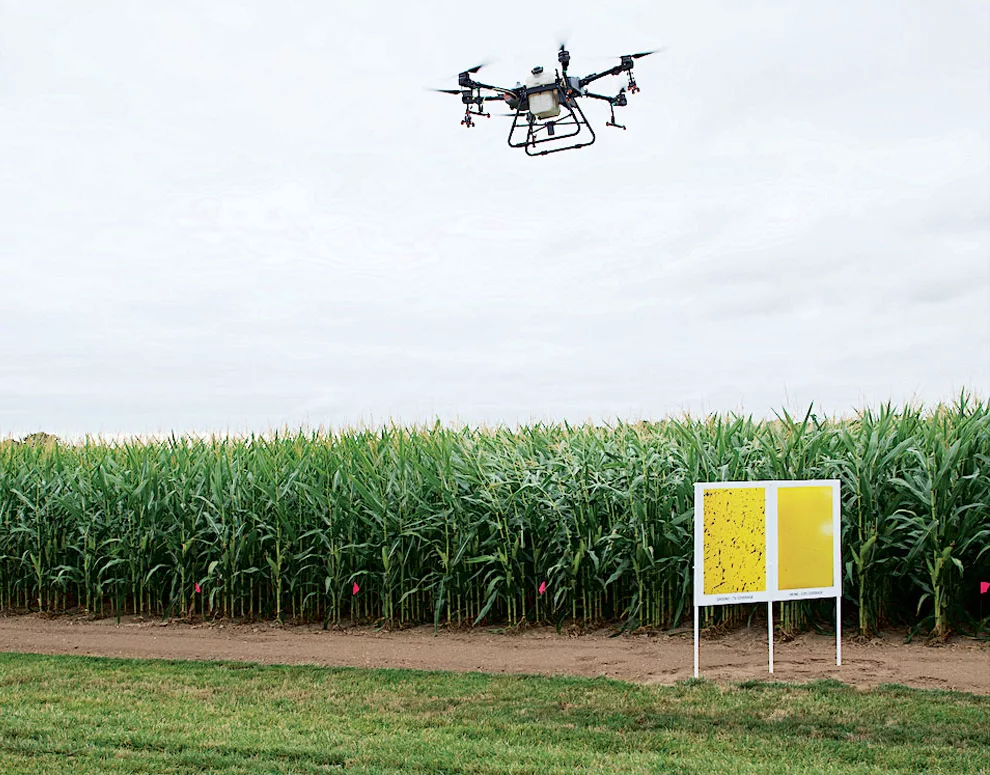
FLYING LOW. Research over the last 3 years at Beck’s Hybrids’ research fields has shown unmanned aerial vehicles, or drones, provide a comparable ROI to ground rigs, helicopters or planes, especially in low-volume situations. John Dobberstein
DRONES ARE quickly becoming a valued tool for no-tillers for many tasks, such as seeding cover crops in a timely manner after harvest, crop scouting or monitoring livestock.
But applying crop protection products, including fungicides, is another possibility as technology and reliability improves. Researchers at Beck’s Hybrids say they’ve been getting many questions about whether drones are just as effective as ground rigs, helicopters or planes.
Over the last 2 years, trials have found drones have consistently performed the same or better as a ground rig. Growers must still think about logistics, as far as the time of day to spray, how batteries, parts and service will be handled and how the drone will be hauled. But drones are expanding the toolbox.
“If someone says to me, ‘I need to spray and I have a choice between the drone plane and a ground rig.’ I'm going to say, ‘They all work. Go for it,’” says Luke Schulte, a field agronomist for Beck’s in Ohio. “I'm not ready to tell anybody to buy a drone yet, but I’m surprised, shocked, and pleasantly happy that drones work just as well.”
In Beck’s on-farm spray trial locations in Indiana, central Illinois and Ohio, 2025 was the first year researchers experienced heavy disease pressure, leading to concern that drones wouldn’t perform well.
Control plots with no fungicide recorded a yield of 227 bushels per acre. Corn where the ground rig applied fungicides at 15-20 gallons per acre was harvested at 235 bushels…

Get full access NOW to the most comprehensive, powerful and easy-to-use online resource for no-tillage practices. Just one good idea will pay for your subscription hundreds of times over.
Download these helpful knowledge building tools

We have engineered and developed the most advanced concave system that threshes all crops, eliminates rotor loss, improves grain quality, gives you a cleaner sample – all with one set of XPR concaves.

At Titan International, our product portfolio reflects our commitment to innovation and high-quality products. Titan International offers a full line of solution-focused wheel, tire, and undercarriage products for a wide variety of off-the-road equipment in agriculture, construction, forestry, mining, power sports, high-speed trailers, and outdoor power equipment segments. As one of the largest North American manufacturers, with a network of dealers all over the world, Titan is an industry leader that original equipment manufacturers and operators can count on for durable products and quality service.

Provide expert analysis and decision support to increase productivity and profitability.