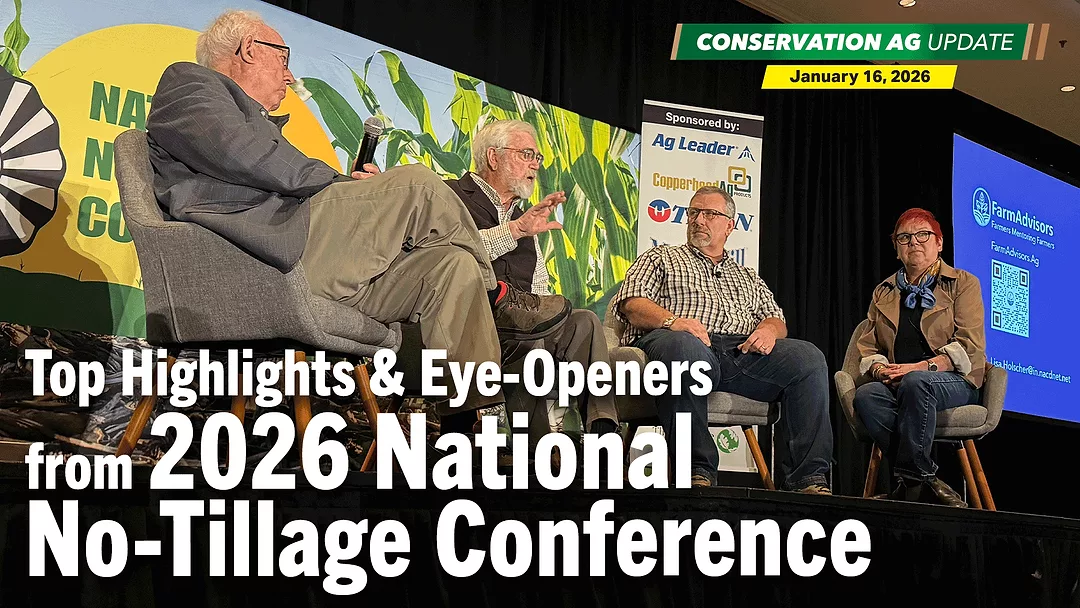
On this episode of Conservation Ag Update, brought to you by Martin-Till, we’re headed inside the 34th annual National No-Tillage Conference in St. Louis. Both longtime and first-time attendees share some of their biggest takeaways from the conference. We catch up with Jeff Martin from Mt. Pulaski, Ill., during one of the networking breaks for a conversation about how the longtime no-tiller is applying ocean water and more to his crops.
In the Cover Crop Connection, Mackane Vogel goes 1-on-1 with a cover cropper who’s attended every single National No-Tillage Conference!
Later in the episode, we listen in to Austin, Minn., no-tiller Tom Cotter’s presentation as he shares a simple way to measure soil health. Ag tire expert Ken Brodbeck clears up a common misconception about ag tires. And in the Video of the Week, Steve Martin unveils a brand-new product from Martin-Till.
This episode of Conservation Ag Update is brought to you by Martin-Till.
Since 1991, Martin Industries has designed, manufactured and sold leading agriculture equipment across North America and the world. Known for Martin-Till planter attachments, the company has expanded to include a five-step planting system including our floating, air or hydraulic and frame mounted row cleaners along with closing wheel systems, twisted drag chains, fertilizer openers, weight transfer systems and more in their lineup. Their durable and reliable planter attachments are making it possible for more and more farmers to plant into higher levels of residue & cover crops.
TRANSCRIPT
Jump to a section or scroll for the full episode...
- No-Tillers Reveal Key Takeaways from the 2026 National No-Tillage Conference
- Ocean Water in Illinois?! No-Tiller Gets Creative with Biologicals
- No-Tiller with Perfect NNTC Attendance Shares Cover Crop Lessons Learned
- Tom Cotter Shares Soil Health Report Card
- Engineer Ken Brodbeck Shares Tire Tips at the 2026 National No-Tillage Conference
- Video of the Week: Martin Unveils New Row Cleaner at the 2026 National No-Tillage Conference
No-Tillers Reveal Key Takeaways from the 2026 National No-Tillage Conference
We’re back from the 34th National No-Tillage Conference, and what an inspiring week it was in St. Louis with hundreds of conservation-minded farmers from all over the world. Let’s recap the action.
It all started with a pair of pre-conference workshops led by a trio of No-Till Innovators in Kris Nichols, Phil Needham and Bill Lehkmuhl. That set the tone for an action-packed conference, which included over 12 general sessions, 25 classrooms, 40 roundtables and hours of networking with fellow farmers, educators and title sponsors. We also had our first ever No-Till Ted Talks session. And congrats to Soil Action for winning the inaugural No-Till Shark Tank competition. The Super Bowl of no-till once again delivered moneymaking insights to no-till veterans and first-time attendees.
Carrie Vollmer-Sanders: “This is my first time here at NNTC and it’s been eye-opening. I wasn’t sure what I was getting into. But everywhere I look there’s a farmer with a different experience, setup or system to talk with or ask questions to. I farm, so I know some things about no-till and cover crops, but there are so many different things that I didn’t think about. Yesterday we learned about tire pressure and how that impacts the timeline it takes for a seed to come up out of the ground and how that impacts yield. I hadn’t thought about that before.”
Rodney Rulon: “There’s been so much data shared within a short amount of time it’s been really exciting and I have 10 pages of notes probably that I’m going to have to pour through. A lot of exciting things to think about both in our overall philosophy of how we do things, and some very specific technology things, exciting new cover crops, new closing systems and all those things (we’ve learned about) already (in less than a day).”
Clare Lindahl: “This is my first NNTC, and it’s been awesome. I’m here to listen to farmers. The people that we serve who are the conservation professionals supporting farmers to adopt practices like regenerative ag, soil health practices. They’re always telling me that they want to know more about how they can serve farmers better. So, this has been a good experience to just listen, and hear what the challenges are, what the barriers are and how I can take that back to them to better support farmers.”
Ocean Water in Illinois?! No-Tiller Gets Creative with Biologicals
You never know who you’re going to run into during those networking breaks in the hallways. We caught up with Jeff Martin, who’s been no-tilling in Mt. Pulaski for decades. And during our conversation we discovered he’s doing something very unique with biologicals.
“We use a compost that is locally produced and is run through an extractor, which turns the microbes, the fungi and the bacteria into a liquid form. We spray that liquid in the fall as a digester. We also apply it in furrow with the planter onto corn and soybeans. We also put food sources in with it. We use ground up crab and oyster shells, which have nutrients in them. We also use ocean water that we buy from a company. Ocean water has every mineral known to man in it, and it’s run through a process so the salt doesn’t hurt anything. We’ve had great success with it.”
Ocean water in central Illinois! He’s had great success with it. Martin says if you’re thinking about adding biologicals to your bag of tricks, he recommends starting out with a broadcast application in the fall after harvest.
No-Tiller with Perfect NNTC Attendance Shares Cover Crop Lessons Learned
You can count on one hand the number of people who have attended each and every single one of our now 34 National No-Tillage Conferences. Cole Camp, Mo., no-tiller Bryan Von Holten is one of them and I had a chance to catch up with him in between sessions last week in St. Louis. We talked a lot about what he’s learned each year and why he keeps coming back, but here’s a quick snippet of our conversation.
“Well, I was kind of fortunate. There was a fella about 50 miles from me to the east who had been no-tilling for 14 years already. And he's a teacher. He was very generous with his knowledge and he sat down with me and helped me put together a plan that ... And so really right out of the gate, I had pretty good success the first year. And so right away I was pretty comfortable with it. It's just, you got some learning curves, but by and large, thanks to his help and then coming to this ... I started no-till in 92, came to this conference in 93. And of course that was a big part of it too. People like Dwayne Beck and different ones that really helped a lot of good speakers and learned a lot from all this too. And so…
“I've experimented with a number of different things. Two years ago, I had a lot of cover crop behind wheat, about 500 acres of real diverse 19 species mix. My struggle with that is how do you grow a wheat crop as a standalone crop without double crop beans and then spend 50, $55 on a cover crop. But it did tremendous things for the soil, but how to make the economics. And that's where I think the livestock integration has got to come. I personally don't have any livestock, but I'm trying to figure out how to make that happen because I think we have to have a livestock system in place to utilize the cover crops and then kind of help pay for the cost of them. And I think the whole system together worked great, but now we're talking a whole different management team and a lot more work for somebody.
Always fun chatting with the no-till and cover crop experts like Bryan. And if you want to hear from more cover crop experts, go to CoverCropStrategies.com and sign up for our upcoming FREE and full digital event that will feature lots of great topics and experts in the world of cover crops. I’ll have lots more on the full speaker lineup for the Summit in the coming weeks.
Tom Cotter Shares Soil Health Report Card
Tom Cotter had the audience on the edge of their seats with his primetime presentation on the true potential of soil health. Fresh off his Leopold Conservation Award-winning year, the Austin, Minn., no-tiller compared his soil to a bank. Farming practices are the deposits and the withdrawals, and as he explains here, that’s an easy way to measure your soil health.
"My “pluses” — no-till, plant a cover, reduce chemicals, add rotation, diversity, non-GMO traits, biologicals, livestock manure and grazing, we can go on and on about the good things we do on our soil. But we have to be honest and talk about the negatives too — every time you do a tillage pass, a chemical pass, insecticides, fungicides, synthetics, they all are hurting."
"On my farm (when I was conventional 15 years ago), and a lot of conventional farms out there, there are a whole lot of negatives. I’m a farmer. I want it (soil health measurements) simple, and I want to use my senses. I can tell I had bad soil health. Nowadays, there’s my no-till, my organic. Plus 3, plus 4. That doesn’t mean that’s the same thing every year because soil health isn’t a plateau you get to, it’s ever-changing and flowing. All I have to do is make sure my trajectory goes up.”
Engineer Ken Brodbeck Shares Tire Tips at the National No-Tillage Conference
Reducing compaction will definitely help with that soil health trajectory, and one way to do that is by having the right tire pressure in the field. Ag tire expert Ken Brodbeck was on hand to teach us about central tire inflation systems and clear up some common misconceptions about tires.
“People think tires, as long as they’re round and black, are perfect. I can remember as a teenager we had to repair a tire, I asked the tire guy how much pressure we should have on the tire and he said 20 psi, which is way too high. Your tire people will err on the side of being higher because they know that’s going to cause them less headaches for having unhappy customers if the tire failed and was overloaded. The challenge becomes when you overinflate the tire, you’ve taken this nice soft footprint that you need for the field and you made it real hard, and you’re packing the ground. If you look at a construction site or you see people packing silage, they want high pressures, heavy loads. It’s really important if you check your pressure, whether you have an inflation system to change it on the go or just set it to the proper pressure, you’re going to get all the advantages of better traction, lower compaction, better fuel economy, longer tire life and the biggest one you’re going to preserve your soil.”
Video of the Week: Martin Unveils New Row Cleaner at the 2026 National No-Tillage Conference
We also saw a big equipment reveal at the National No-Tillage Conference. Martin debuted a brand-new row cleaner. Let’s check it out in our Video of the Week.
“We’re here at the NNTC launching our new frame-mounted row cleaner, the Rider. It’s very similar to our Walker, but without the walking tandem bottom. It’s more compact. It fits on toolbars where the walker won’t. It’s totally behind the front of the toolbar, so we can fit it in places our competitors can’t. It floats off the side wheels like standard floating row cleaners do, and it still has the up and down airbag that floats on these ball bearings. It’s very smooth, floating action, very heavy-duty made, nice pivot bushings. It’s more economical pricewise. We’re really excited and think this unit has possibilities to fit into a lot more areas than most frame-mounted row cleaners will.”
That’ll do it for this week. Got something you’d like to feature on the program? Shoot me an email at Nnewman@Lessiter Media.com. Thanks for tuning into Conversation Ag Update. Until next time, for more stories visit no-tillfarmer.com, striptillfarmer.com and covercropstrategies.com.