Keep it Simple
Single-species rye, wheat or oats can be an excellent option for many farms. Single-species cover crops are cheaper and typically easier to terminate.
For those interested in multi-species cover crops, opt for ready-made mixes, which are less expensive and have also gone through rigorous testing to ensure the components are well balanced within the mix.
Pay Attention to Percent Live Seed (PLS)
Seeds with a low purity and tested germination rate are often sold at a reduced price.
“Bargain” bulk seed with a low percent live seed (PLS) rating may end up costing more in the long run.
See “Calculating Pure Live Seed (PLS)” on p. 104 for more information.
Consider Bin Run
Bin run seed is harvested by a farmer, stored and planted. Bin run cover crops can cost as little as $5 to $10 an acre.
If you plan to buy bin run seed, strongly consider having it professionally tested first. If improperly stored, the seed may not germinate well. It may be contaminated with noxious weed seeds.
Certified or VNS
Variety Not Stated (VNS) seed can be a good low-cost option. Sometimes VNS seed has the best genetics for the area.
But be wary, as it can also have noxious weeds and lower germination rates.
Incorporation Saves Money
To get a full stand of cover crop through broadcasting, you need to apply nearly twice as much seed. Even with a much higher application rate, surface application of cover crop seed may result in spotty germination.
Drilling the seed takes more time and can require renting/using a drill. It will ultimately reduce the total price per acre, however.
Another good option is to lightly incorporate the seed in the upper 1/2 inch of the soil profile using some form of vertical tillage or rotary hoe.
Did You Know? Low-Cost Drill Rental Options
Many soil conservation districts and agricultural non-profits have no-till drills available for rent at a reduced rate.
Take Advantage of Volunteers
Cover cropping after a small grain crop is the easiest place to start. Allow volunteer small grain seed to grow, add a legume and terminate broadleaf weeds.
No-Till Farmer's "Getting Started With No-Till Farming" is brought to you courtesy of Calmer Corn Heads.
Farmer Invented. Farmer Tested. Farmer Proven.® Calmer boasts this motto proudly as it references our farmer-first mentality and state-of-the art technology.
Calmer offers a custom experience, suited to your farm’s needs. Whether its talking with our experienced sales team or directly with the folks who designed and built your corn head, we are committed to providing you top-notch service without the red tape of a big corporation. Calmer specializes in products suited to benefit your no-till operation including the patented BT Chopper® Stalk Rolls, versatile Corn Head Upgrade Kit for harvest efficiency and residue management, and the High-Performance Concave Upgrade Kit.
We know Calmer products work because we run them on our own farms; that’s why we offer a 100% Satisfaction or Your Money Back Guarantee!
Getting a Handle on Cover Crop Costs
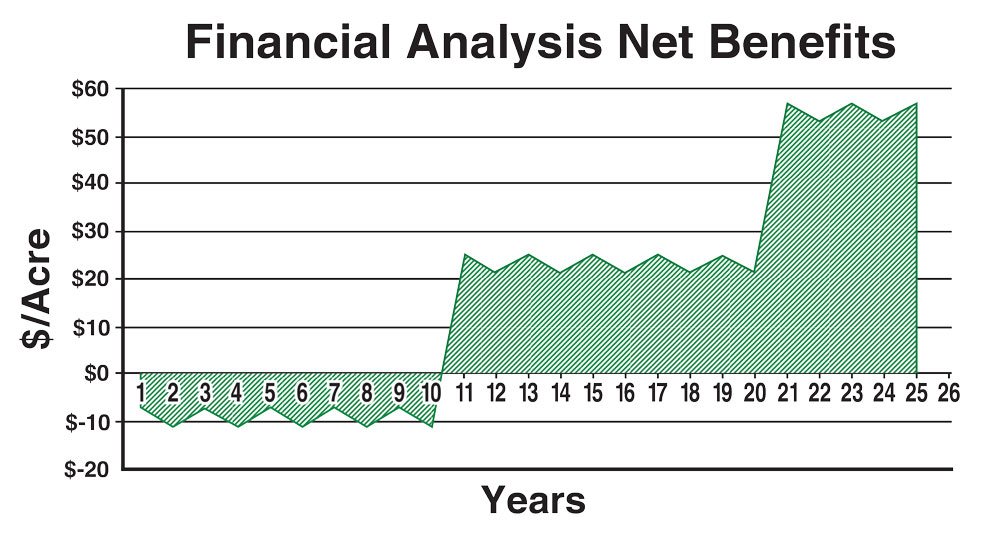
This example from the Cover Crops Economic Decision Tool shows the financial results of a scenario assessing 25 years of incorporating covers into a corn-soybean rotation, where 10 years are required to change soil organic matter by 1%. The display shows the change in operating costs, and negative numbers represent increased operating cost.
The NRCS has developed a spreadsheet-based partial budgeting tool to help address some of the economic and financial questions that arise.
This tool is designed to help growers, landowners, planners and others make informed decisions when considering adding cover crops to their production system.
The tool is free and available for download from the following websites:
NRCS Missouri Soil Health Website: bit.ly/missourisoilhealth
NRCS Field Office Technical Guide: bit.ly/nrcsftog
When unsure of the exact variables, use the tool to run “what if” scenarios based on different potential ranges on inputs.
Results are presented showing immediate short-run net benefits and long-run net benefits (up to 50 years). The long-term benefits assess the impact of improved soil health with continued use of cover crops.
Source: No-Till Farmer Covering Up, Part 3: Branching Out with Your Cover Crop Program