
Herbicide Carryover
Some herbicides will remain in the soil for months after application; these residual herbicides can significantly harm subsequent cover crop stands. When selecting cover crop seeds, pay attention to potential for herbicide damage.
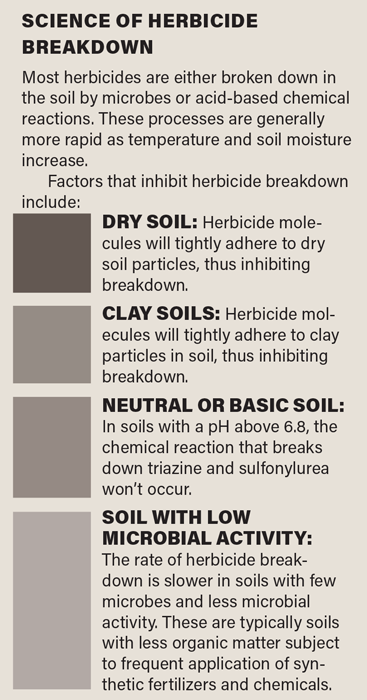
The potential for herbicide carry-over damage depends on (1) weather and soil conditions that influence the rate of herbicide breakdown, (2) cover crop species sensitivity and (3) how long it takes a particular herbicide to break down.
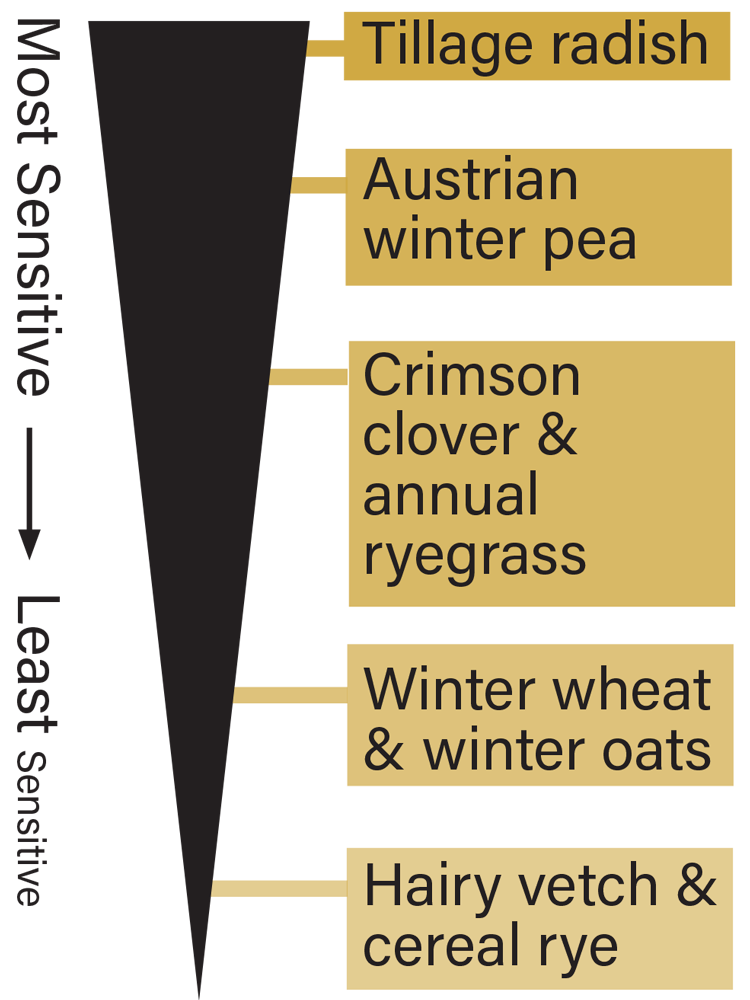
Be wary of planting sensitive cover crop species (see the image at right for more information) following a dry growing season or within four months of applying a herbicide.
Farmers concerned about potential carryover of herbicides should usually opt for cereal rye. Cereal rye is much less likely to be impacted by herbicide residuals. However, even cereal rye isn’t a sure bet.
Most Sensitive Cover Crops
Research by the University of Missouri evaluated the sensitivity of fall-seeded cover crops to carryover from common pre-emergence and post-emergence corn and soybean herbicides.
Results indicated that tillage radish, winter pea, crimson clover and annual ryegrass are among the most sensitive common cover crop species.
Hairy vetch, cereal rye, winter wheat and winter oats are less sensitive.
Herbicides Most Likely to Impact Fall Cover Crops
Research by the University of Missouri found that certain common pre-emergence and post-emergence corn and soybean herbicides are more likely than other herbicides to negatively impact cover crops stand development, particularly sensitive species.
Soybean Herbicides That May Inhibit Growth of a Fall-Seeded Legume or Radish:
- fomesafen (Flexstar, Prefix, Reflex)
- pyroxasulfone (Zidua)
- imazethapyr (Pursuit)
- acetochlor (Warrant)
- sulfentrazone (Authority)
- chlorimuron (Classic, Canopy, Cloak, etc.)
Corn Herbicides That Inhibit the Growth of Fall-Seeded Ryegrass:
- pyroxasulfone (Zidua)
- metolachlor (Dual, etc.)
Corn Herbicides That May Inhibit Growth of a Fall-Seeded Legume or Radish:
- mesotrione (Callisto, Halex)
- flumetsulam (Python)
- clopyralid (Stinger)
- topramezone (Impact)
- isoxaflutole (Balance Flexx)
- nicosulfuron (Accent Q, etc.)
Adapted from “Using herbicides and cover crops in corn and soybean” by Lizabeth Stahl, Extension educator; Jeff Gunsolus, Extension weed scientist and Jill Sackett-Eberhart, former Extension educator
Planting Restrictions Following Common herbicides
Glyphosate: None
Paraquat (Gramoxone): None
Dicamba: Dicamba can be a concern when applied at high rates or planting cover crop less than 120 days after application; cover crops planted 120 days after dicamba application with 24 fl oz/acre or less should not be impacted.
“In general, herbicides with crop rotation restrictions of 4 months or less should be safe…”
2,4-D: Wait at least 30 days after 2,4-D application before planting sensitive broadleaves; amine formulations are more water soluble and can leach into the seed zone.
Glufosinate (Liberty): Glufosinate should not cause cover crop injury. However, be aware that glufosinate should not be applied to food or feed residues within 45 days of harvest.
Atrazine: Herbicide carryover from atrazine is a concern for cereals, ryegrass, legumes and mustards. Atrazine is more persistent in high pH soils. At rates less than 1 lb/acre, Atrazine impact will be minimal; half-life of Atrazine in the Mid-Atlantic for example, is probably close to 30 days.
Adapted from “Corn Herbicides and Rotation to Cover Crops” and “Soybean Herbicides and Rotation to Cover Crops” by Dwight Lingenfelter, Senior Extension Associate – Weed Science Penn State Extension (2017)
Grazing Resrictions Following Common Herbicides
Designing effective herbicide programs with rotations that include forage and cover crops is challenging. Many producers don’t think to consider that once a herbicide is used in the previous corn or soybean crop, the grazing and feeding restrictions on those herbicide labels must be followed for that crop AND the subsequent cover crop until the restrictions on those labels have been met.
If the specific cover crop species you have planted is not listed on the herbicide label, this does not mean that the species you have planted can legally be fed or grazed. In fact, most of the species being utilized for cover crops are not specifically mentioned on current herbicide labels. In those cases, growers must fall back to the default listing on the label, which usually states something to the effect of “all other crops” or “all others” to find the grazing and/or feeding restrictions that they must follow. Most often, the average rotation restriction for cover crop species that fall into this “all other crops” category is between 12 and 18 months after treatment.

No-Till Farmer's "Getting Started With No-Till Farming" is brought to you courtesy of Calmer Corn Heads.
Farmer Invented. Farmer Tested. Farmer Proven.® Calmer boasts this motto proudly as it references our farmer-first mentality and state-of-the art technology.
Calmer offers a custom experience, suited to your farm’s needs. Whether its talking with our experienced sales team or directly with the folks who designed and built your corn head, we are committed to providing you top-notch service without the red tape of a big corporation. Calmer specializes in products suited to benefit your no-till operation including the patented BT Chopper® Stalk Rolls, versatile Corn Head Upgrade Kit for harvest efficiency and residue management, and the High-Performance Concave Upgrade Kit.
We know Calmer products work because we run them on our own farms; that’s why we offer a 100% Satisfaction or Your Money Back Guarantee!