 Premium content is for our Digital-only and Premium subscribers. A Print-only subscription doesn't qualify. Please
No-Till Farmer
Get full access NOW to the most comprehensive, powerful and easy-to-use online resource for no-tillage practices. Just one good idea will pay for your subscription hundreds of times over.
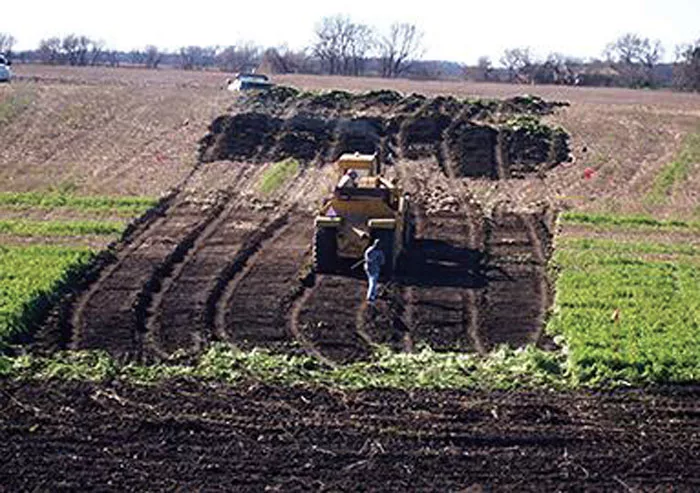
SHIFTING SOIL. Researchers moved deposited topsoil from lower slopes to the upper slopes, where soil erosion has reduced the amount of topsoil present. USDA American Society of Agronomy
Researchers estimate that soil erosion costs $44 billion each year in the U.S., mostly due to lost soil productivity, and hilly farm landscapes are some of the most challenging to preserve.
Soil erosion on hilly farm landscapes can be a significant problem because soil properties and crop yields can vary throughout the field and often reflect the pattern of soil movement, resulting from the combined erosive effects of tillage and water.
Often, nutrient-rich topsoil will naturally move downward on a farm, which means elevated slopes may be depleted of soil organic matter, plant-essential nutrients and available water, rendering those areas low-yielding — especially in dry years, researchers say.
Conversely, lower elevated slopes may have deep topsoil accumulation, with soils high in organic matter and nutrients, making them high-yielding in dry years but low-yielding in years with excess moisture. Most growers want consistency, which can be a challenge on a farm with varying elevation.
“We need to restore the productivity of eroded land without undermining the productivity of “good” soils,” says Sharon Schneider, research leader at the Integrated Cropping Systems Research Unit in Brookings, S.D.
One method is reversing the soil erosion by moving soil from where…

Get full access NOW to the most comprehensive, powerful and easy-to-use online resource for no-tillage practices. Just one good idea will pay for your subscription hundreds of times over.
Download these helpful knowledge building tools

We have engineered and developed the most advanced concave system that threshes all crops, eliminates rotor loss, improves grain quality, gives you a cleaner sample – all with one set of XPR concaves.

At Titan International, our product portfolio reflects our commitment to innovation and high-quality products. Titan International offers a full line of solution-focused wheel, tire, and undercarriage products for a wide variety of off-the-road equipment in agriculture, construction, forestry, mining, power sports, high-speed trailers, and outdoor power equipment segments. As one of the largest North American manufacturers, with a network of dealers all over the world, Titan is an industry leader that original equipment manufacturers and operators can count on for durable products and quality service.

Provide expert analysis and decision support to increase productivity and profitability.