Takeaways
- Look deeper than N, P and K and micros for better ROI on inputs.
- Treat the soil as a living system and not merely an anchor for plants.
- Invest in integrated “complete” soil analysis with labs capable of timely, precision testing.
Big changes are under way in the soil testing industry as digital technology demonstrates the importance of viewing farm fields as a living system — requiring more than a yearly grocery list of plant nutrients.
No-tillers and strip-tillers take soil biology seriously and many of them are looking beyond traditional soil tests to boost soil health while reducing input expenses. Typically, that leads to investing in data-driven soil analysis, which includes an integrated look at chemical, biological and physical properties of soil — not just plant nutrient availability.
While still important, the days of traditional soil sampling for nitrogen (N), phosphorus (P), potassium (K) sulfur (S) and micronutrients as a single agronomic best management practice are rapidly fading, experts say. What’s taking its place, however, promises far better precision nutrient management and timely, actionable in-season decision-making information.
Testing for Function
Colorado State Univ. soil health researcher Lexi Firth is well acquainted with the new face of soil testing in her work with soil carbon and water relationships. She coins a kitchen metaphor to explain the difference in traditional soil testing and what she calls “testing for function.”
“Traditional soil tests are like checking your pantry for how many pounds of flour you may have, but not whether the oven is on or who’s going to make the dinner tonight,” Firth observes. “Testing for function goes beyond producing an inventory of ingredients and seeks to answer how those ingredients will be blended, by whom and how long cooking will take. It can also give you clues of what to expect.
“The tests we’ve used for years tell us how much phosphorus, potassium or nitrogen was in the soil when the sample was pulled. But they don’t answer the question of, ‘Is the system actually working?’ That would involve determining: Is the soil cycling nutrients efficiently? Is it holding water? Is biology alive and actively working to break down organic matter?
“Testing for function by examining chemical, biological and physical soil properties provides an integrated look at soil as a system and how well it’s performing,” she adds.
Learning to Ask the Right Questions
In visiting with Mike Evans, Lexi Firth, Clint Frese and Kris Kinnaird, No-Till Farmer compiled the following list of curated questions and answers for growers to ask if they are interested in taking the next step into predictive agronomy or “testing for function.”
- What problems am I seeking to solve? Problems ranging from compaction, water holding capacity/infiltration, yield barriers, input costs, disease and pest control all have likely roots in soil health relationships. Seek advice from others using high-tech sampling for suggested resources.
- What does it cost? Buying in to high-tech integrated soil testing likely carries a higher cost than traditional soil tests, which mainly identify nutrient content. And, like other investments the cost-benefit ratio and timely ROI figures will be specific to individual operations. For a large grower who can save $20-$30 per acre on fertilizer, the ROI for advanced testing could be easily amortized. Frese says his Illinois operation was spending $1.40 per acre overall for traditional soil testing, but with the integrated approach he’s spending just over $2.
- What lab do I use? Firth recommends laboratories certified by the Soil Science Society of America’s North American Proficiency Testing (NAPT) program.
When testing for function, Firth looks at soil chemistry (available through traditional soil sampling) to know what raw materials are available. She also looks at biological indicators, which in terms of function, will tell her how well the soil is cycling nutrients.
“A measure of microbial respiration shows how active your biology is, and a strong burst of respiration indicates how busy your microbes are breaking down nutrients,” she explains.
She also looks for physical indicators (soil structure), which tell how well the soil is handling oxygen and water movement through pore spaces to gauge water infiltration, moisture retention and aggregate stability.
“This information shows whether soil pores are open, and water and oxygen can circulate,” Firth explains. “A soil that seals over quickly and doesn’t hold structure well is going to struggle to support root growth. It’s also going to struggle to support an active biological community, which again is connected to nutrient cycling.
“All these things combined give me clues about management decisions down the line and what might be helpful to optimize crop development,” she adds, noting the integrated soil sampling/analysis approach is part of a growing move to “predictive agronomy.”
Predictive Agronomy
Firth says traditional soil testing provides a “still snapshot” of plant nutrients in the soil, whereas predictive agronomy can provide a “time-lapse video” of likely in-season growing conditions.
It does this using digital data from many real-time soil and weather sensors, historic chemical samples, soil inventory maps, yield maps, satellite imagery, cropping history and historic rainfall and temperature data — all examined with the help of artificial intelligence (AI).
“AI is useful as a tool to find patterns in huge piles of data and then using those patterns to make predictions,” Firth explains.
As an example, an AI model for predictive agronomy would be created by feeding millions of data points from the above-mentioned sources into the system so it can learn which combinations of variables leads to high nutrient availability and which leads to deficiencies.
“Once we train an AI model it can use the data and make a prediction about what’s likely to happen next,” she says.
“For no-till farmers this can be a very powerful tool. In a conventional tillage system nutrients are incorporated and mixed and the results are quite predictable,” she explains.” In no-till systems, nutrients tend to be more stratified, and their release depends heavily on residue breakdown or soil moisture microbial activity.
“By knowing rainfall patterns and soil moisture conditions, predictive agronomy can help a no-tiller anticipate nutrient flushes or shortages rather than waiting to see visible signs of crop stress.”
A Grower’s Perspective
Using emerging technology for ever-more-precise soil and water testing, Jon Abrahamson discovered his irrigation groundwater was working against him on his 1,900 acres of watered no-till corn and soybeans.
Abrahamson’s 25-year history of 100% no-till near Axtell in south-central Nebraska includes adoption of both variable rate (VR) planting and dry fertilizer applications with calcium, lime and sulfur products, along with in-furrow phosphorus, portions of his expected nitrogen needs, and micronutrients applied 2X2 on the planter. Generally, the remainder of his nutrient program is applied through sprinkler fertigation.
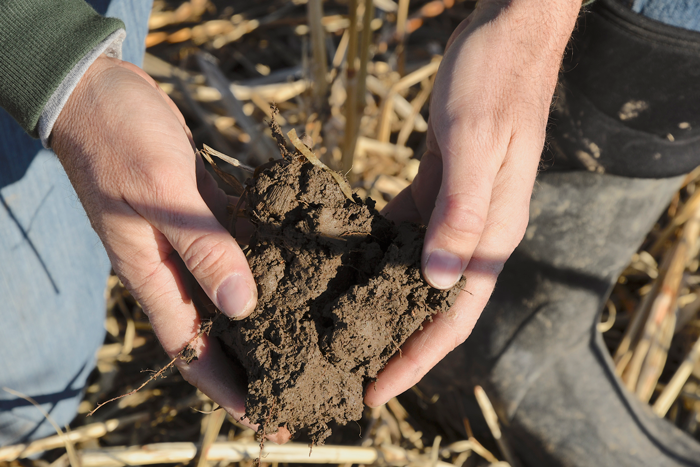
HEALTHY AND PRODUCTIVE. Rapid advancements in technology allows farmers to now test for the factors that will help provide growers a healthy soil that can defend itself from pathogens and produces healthier plants resilient to weather and disease stresses, says Clint Frese, a founder of Calibrate Agronomy. Source: John Dobberstein
“We’d been using many of the proven tools for optimum yields and precision nutrient management and were still raising good crops, but several years ago it just seemed like we were hitting a plateau,” Abrahamson recalls. That’s when he began working with other high-intensity farmers in the area looking for clues to better yields and lower inputs.
This included Jared Cook from Idaho who was familiar with poor irrigation water quality in his sugarbeet and potato production; Mike Evans in Iowa, and Clint Frese, an Illinois strip-tiller and no-tiller. All were interested in making their operations more productive by leveraging emerging technology to reduce inputs.
“They introduced me to new testing methods and laboratory services that almost immediately helped me reduce nitrogen inputs for my crops,” Abrahamson says.
Evans, Frese and Cook eventually formed Calibrated Agronomy, an Iowa-based data-driven, farmer-focused company using new technologies that increasingly offer predictive agronomy benefits through various laboratories and new in-field sensor technology.
Working with Cook, Abrahamson employed a rapid soil test to compare soil performance with his irrigation vs. soil and water known to have no counteractive qualities. He found his untreated irrigation water was tying up P and other nutrients.
When P levels aren’t at capacity, crop plants suffer from the deficiency and other nutrients also become less available.
“Once I began treating my irrigation water, the available nitrogen levels climbed sufficiently to allow me to apply less N without affecting yields,” Abrahamson explains. “Using untreated water we were getting single-digit P levels under the irrigation system, but on dryland areas and un-watered corners near our pivots, the levels were in the 20-40 ppm range. It just made sense to me to check the water, and the advanced testing identified the problem.”
Beyond the rapid soil test, over the next several years Abrahamson adopted additional precision testing and in-field soil sensors that are now saving him money.
The year after he solved the water issues, he started using SoilTech Wireless’s Beacon, a tool Cook is using in his work with potatoes, Abrahamson says.
“It’s a loaf-of-bread-sized unit we buried in our fields that measures soil mineralization in real time to let you know when you’re getting a flush of microbial activity and increasing nitrogen levels.”
Abrahamson is also using plant sap analysis as part of his adoption of high-tech technology aimed at optimizing plant and soil relationships.
Sap analysis measures the active liquids in plant vascular tissues (xylem and phloem) and provides a nearly real-time assessment of the nutrients available at the time of sample. In Abrahamson’s sap tests, the fluids are collected with linear pressure to preserve the leaf and cell structure and give a picture of what is active in the plant at sampling.
“Standard soil testing labs are not going to disappear, but their role will likely change…”
“The weekly sap test has helped me monitor the dry calcium we apply,” Abrahamson says. “We’re able to quantify it in nearly real-time and can quickly be reactive within 2-3 weeks instead of waiting for plant stress to become visible.
“To me traditional soil tests are old technology. With the rapid soil test and weekly sap tests, it’s like looking out your windshield, while a tissue test is like looking in the rear-view mirror, and a standard soil test is like looking at your fuel gauge.”
Future Face of Soil Testing
Abrahamson likely won’t be returning to a traditional soil sample and a paper nutrient RX, but Firth, Frese and Evans say traditional visits to the field to pull core samples and send them for analysis aren’t going away. They may just become less frequent or collected by robots.
“Standard soil testing labs are not going to disappear, but their role will likely change,” Firth says. “The physical tests we do now are going to be used more for ground-truthing and calibration checks for the emerging AI-based systems, but the depth of analysis you’ll do with these legacy tests will certainly be scaled back in the next 10 years.
“I envision integrated soil testing to become a ‘dashboard’ of dynamic sensor-based data on which growers can monitor real-time soil chemistry and biological activity, compared with laboratory spectral analysis of field-collected soil samples — providing a ‘living system’ that you monitor throughout the season rather than generating a chemical analysis report on a piece of paper.”
Firth explains digital systems are only as good as the data they’re fed, however, and field soil samples likely will remain important to provide baseline data as well as on-going information to teach and calibrate virtual and precision systems.
Kris Kinnaird, director of farm and retail growth for FarmersEdge, in Canada, agrees, noting his firm developed an AI-assisted Virtual Soil Testing (VST) product and for about 8 years has been fielding it on millions of acres. Still, he says traditional soil sampling chores are at the heart of baseline operations — even for growers who depend upon advanced modeling VST to “fill in the gaps” on some fields while they actively sample others.
“Traditional soil tests are like checking your pantry for how many pounds of flour you may have, but not whether the oven is on, or who’s going to make the dinner tonight…”
FarmersEdge has customers in Canada, the U.S. and Brazil using the VST product to take massive amounts of information and turn it into insight that drives a decision.
“We apply different growth stage disease and pest models in our platform, along with satellite imagery, weather data and other remote sensing information and use that with soil data we’ve collected to give growers highly-correlated data to yield prediction.
“As growers use it, they become more comfortable relying on it even when the acres on which it is used were not sampled for the immediate season,” he say. “Likely they were able to spend their soil-collecting and lab expense budgets on other acres of their operation to either scale up acres farmed, or to hold the line on soil analysis costs.”
Testing for Soil Health
Kinnaird, himself a southwestern Manitoba small-grains producer, says the company has farmer and agronomist clients who’ve seen return on investment upwards of $30 per acre with VST and complete soil analysis.
Firth says with rapid adoption of complete analysis and AI-assisted virtual systems, crop consultants will remain important in the future as soil-testing evolves. Kinnaird, Frese and Evans agree, saying the new technologies are rapidly become part of the interaction between crop advisors and growers, with advisors explaining how the avalanche of data can be best used.
Evans says the launch of Calibrated Agronomy in 2024 was based on belief growers can benefit from the newer technologies to be more predictive and capable of realizing, with some certainty, what may occur in fields before problems become obvious.
Frese notes the principal members in the new company have experience in reduced tillage, reduced fertility, no-till, strip-till, cover crops and the different management of each of those practices as well as work with biological inputs.
“We’ve pulled every soil test for a biological, nutrient or chemistry perspective that exists to enter the predictive agronomy business,” Frese says. “Technology now allows us to test for the factors that will help provide growers a healthy soil that can defend itself from pathogens and produces healthier plants resilient to weather and disease stresses.
“Only 8-10 years ago such analysis was financially out of reach for growers who might want to determine different soil-borne microbes in their fields. Today, however, it’s cost-effective we can identify the genetics and size of various populations of each in a biological profile.
Frese says the biological profile should be of particular interest to no-tillers — particularly those who think because they aren’t disturbing the soil they are building their ecosystem and improving soil health with annual cover crops.
“We see many no-tillers incorporating cereal rye as a cover crop which is very likely helping them improve their soil aggregate stability and water-holding capacity,” he notes. “We’re finding however, without a diverse crop rotation or biological inputs we can never outcompete some of the pathogens that are building up in those soils. They really need to know the basic pathogen profile of their fields.