
With the average U.S. soybean yields not moving much in the last decade and weather shenanigans making planting decisions more difficult, growers might consider what fall-seeded soybeans have to offer to improve economics and time management.
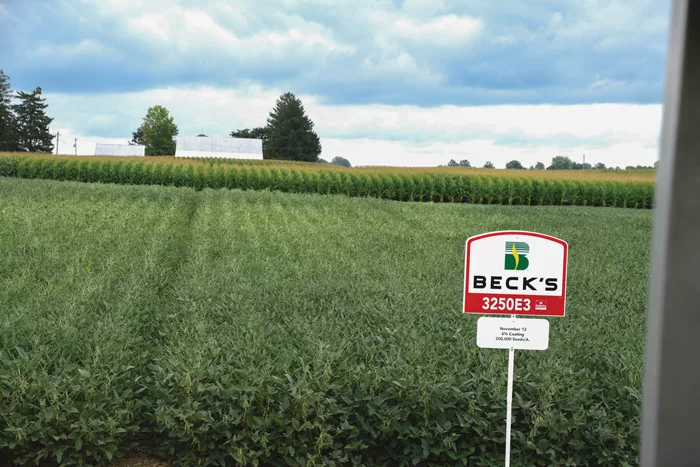
Beck’s Hybrids has been studying a fall soybean system for the last 2 seasons and has noted potential advantages by planting a portion of the bean crop in October, November or even December.
Researchers are using a proprietary coating not commercially available yet on the soybean seeds to keep moisture away during the winter so it doesn’t rot. Spring heating and moisture breaks down the coating so the seed germinates at the optimal time.
The ‘Why’ Question
What’s the major reason to plant soybeans in fall? It has to do with sunlight, says Scott Dickey, a regional agronomy manager for Beck’s who works in Nebraska, Kansas and Missouri.
The highest quality and quantity of light occurring in the summer is June 21, “so think about the depth of atmosphere that light must penetrate when it's directly overhead versus when it starts getting lower and lower on the horizon every day,” Dickey told attendees at the recent Becknology Days field tours at Beck’s headquarters in Atlanta, Ind.
“In August we lose, in this latitude, 70 to 80 minutes of light per day. The sun is having to travel further to get across our horizon. There's just more energy earlier in the summer,” Dickey says.
By planting soybeans earlier in the new cropping season, “we can harvest more of that high-quality light in June. If we can take a few of those acres we would've planted in May or June and get them planted in November, and see them emerge in May, they're going to be a bigger, more robust plants that can harvest more of that light.”
Any light hitting the soil is wasted yield, he adds. “We want all the light hitting a leaf to be converted into sugars for yield.”
Another potential benefit of fall beans is lengthening the reproductive window. Dickey noted customers of his who planted soybeans the last week of March in the Kansas City area and their crop was very healthy and productive.
“They also started blooming about a month earlier than they would've if they’d have planted their normal planting date. “We were seeing blossoms in late May. If I can get that same group of guys, if they normally plant a 4 to 4.5 variety to go to a 4.6 or 4.7 and plant them earlier, it will lengthen that reproductive window.
“And if we can control the bugs, diseases and weeds, and get some timely rains we've done a lot to grow more pods, which will give us more potential yield.
Seeing the Advantages
Tony Uthell, a technician with Beck’s Practical Farm Research program, said conducting the fall-soybean study this year has been a struggle due to poor emergence, possibly because of the commercial-level seed treating that was used instead of treating the seed in smaller batches.
Ahead of soybean harvest this fall, attendees were able to see the plant morphology affects in the side-by-side plots with different seeding rates, with thinner soybeans stands branching out and thicker stands growing more vertically.
More than two decades of PFR research data has shown soybeans planted in April or early May tend to yield better. So a finely tuned fall soybean system could reduce or eliminate late-planted soybean fields, reduce spring labor crunches and still pick up yield. Obviously, higher seed populations and treatments will have a higher cost.
“If we do fall seeding and it costs more,” Uthell says, “a customer will have to decide whether it’s worth it to have better time management or see improved yield.”