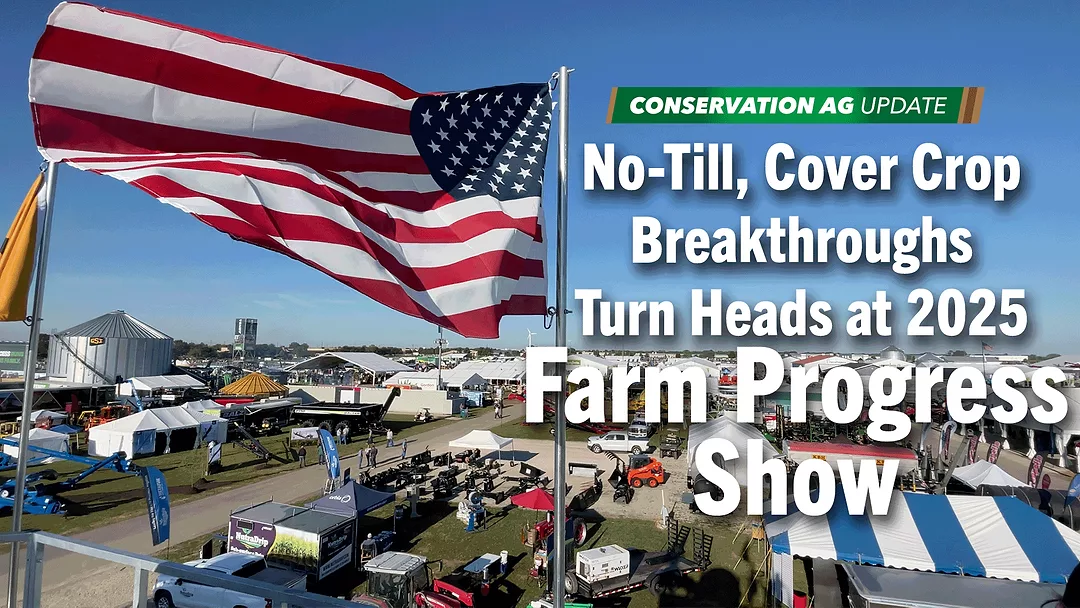
On this episode of Conservation Ag Update, brought to you by Yetter Farm Equipment, we go inside the 2025 Farm Progress Show in Decatur, Ill. Our first stop takes us to the Syngenta tent, where a roots demonstration showcases the impact of a brand-new solution for nematode defense.
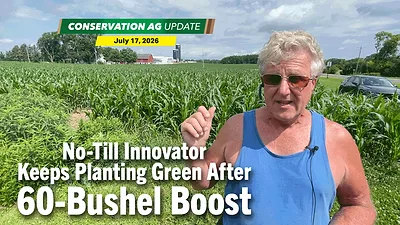
Technology editor Noah Newman catches up with Warrensburg, Ill., no-tiller Dave Brown for an update on the 2025 growing season and some of his top takeaways from the show.
Associate editor Mackane Vogel checks in from the Green Cover cover crop plots for an up-close look at a new product from Terraform that maps compaction in no-till systems.
Later in the episode, Precision Planting PTI Farm Manager Jason Webster reveals the no. 1 “money loser” at the research farm. In the Ahead of the Curve segment, InnerPlant showcases a first-of-its-kind platform that helps farmers detect early stress in soybeans. Plus, Charles City, Va., no-tiller and strip-tiller David Hula receives a big-time honor on the main stage.
This episode of Conservation Ag Update is brought to you by Yetter Farm Equipment.
Since 1930, Yetter Farm Equipment has been providing farmers with profitable solutions. From residue management and fertilizer placement to seedbed preparation, our equipment is designed to maximize your inputs, save you time, and deliver a strong return on investment. Explore our full line of planter attachments, precision fertilizer placement options, strip-till units, and stalk rollers at yetterco.com. Let Yetter help you prepare your equipment lineup for success today.
TRANSCRIPT
Jump to a section or scroll for the full episode...
- Welcome to the 2025 Farm Progress Show!
- Syngenta Roots Demonstration Compares Different Nematicides
- No-Tillers Looking to Do More with Less at Farm Progress Show
- Farmer Launches Terraform SmartProbe System to Map Compaction
- Jason Webster Reveals Biggest ‘Money Loser’ at PTI Farm
- Ahead of the Curve: InnerPlant Gives Farmers Superpowers
- Dave Hula Receives Lifetime Achievement Award at Farm Progress Show
Welcome to the 2025 Farm Progress Show!
We are high atop Decatur, Illinois, for this Farm Progress Show edition of Conservation Ag update. We'll be covering a lot of ground over the next 10 minutes. And you see that Syngenta tent all the way in the distance? That's where Mackane Vogel is right now. Mackane, let's kick things off with a report from you. Take it away.
Syngenta Roots Demonstration Compares Different Nematicides
Thanks, Noah. Well, we're here at the Syngenta tent where I just spoke to Dale Ireland who told me all about a new product from Syngenta. It is a nematicide product that's going to help protect roots against nematode infection. Let's head inside and check it out.
"This is just a melon plant root system without any infection at all. Okay. This is the same melon variety, but it's been infected by root-knot nematode and you can see all the galling and much less hair-like root system. So compare it to this and you see this has maybe half the amount of fine roots. That's what nematodes do. They destroy rooting potential."
"This is the leading competitive treatment. And you can see that it's better than this fully infected root system. They have the same number of original infection and this protected some of that root potential when you compare to this, but it's still only about half of the amount of root system of the original plant that's uninfected."
"This is our new product that'll be called VICTRATO when it's registered. TYMIRIUM technology is how we refer to it now. It's a new nematicide that will be applied to the seed. And you can see that this root system has been protected much like the uninfected root system. So again, the same number of nematodes were infected on all three of these treatments and this particular treatment protects the most potential for that root."
Interesting stuff there from Dale Ireland. We'll have more on that product as it becomes available. You can find all those updates at notillfarmer.com. Well, I'll check back in a few minutes, but we'll send it back to Noah for now for what's next.
No-Tillers Looking to Do More with Less at Farm Progress Show
Thanks a lot, Mackane, for that report. Now a lot of the farmers we talked to here are finding ways to slash inputs and increase their efficiency in pretty challenging times, economically. I caught up with local farmer, Dave Brown, who no-tills and strip-tills near Warrensburg, Illinois, and he talked about how the growing season is going so far for him and also some of the things he's looking forward to seeing at the show this year.
Dave Brown: "Personally, I think on our farming operation, it looks pretty darn good. Maybe above our five-year average. I'm hoping for that, but we've had some nice rains here in the last couple of weeks, but there is areas in central Illinois that were without. And looking at what the Pro Farmer Tour said, that's probably going to be a realistic number I think for us. But here in central Illinois, we need a good crop because the prices aren't very good, but that's the same everywhere."
Noah Newman: Anything you're really looking forward to seeing here at the show this year. Has anything caught your eye yet in this first day here?
Dave Brown: "Well, I think there's a lot of things going on here. There's a lot of technology, always. The big equipment, I'm wondering where it's going to fit in on operations our size, the 16-row corn heads, the 50-foot platforms, the X9 combines. We're looking at things that are looking to maybe use less horsepower per acre. That's kind of our goal at our size, but we're even looking at other things that we can do with regenerative agriculture. I think that is going to be key. But always value added if there's some place to do it. But it's about trying to figure out either how to cut costs or to sell at a break-even price."
Some great perspective there from Dave Brown. As I said, he no-tills and strip-tills a lot of acres here in central Illinois and he also does a lot of cover crops as well. All right, I have to see what Mackane's getting into now. Mackane, take it away.
Farmer Launches Terraform SmartProbe System to Map Compaction
All right, well, I'm over here standing in a big field of cover crops where Green Cover has lots of different cover crop species and mixes on display. Something else interesting going on at the Green Cover tent this year is a cool new product from Terraform. This is a product that helps you determine if cover crops might be able to solve compaction issues on your farm. Let's hear from Josh Jeske of Terraform to tell you more about it.
"This measures in pounds per square inch, how much force it takes to poke down into your soil and that mimics what a root is feeling. So a lot of things can influence that. Your soil texture can influence that. Soil moisture can influence that as well. But what we're looking for is your soil to be as mellow as possible. That's what's going to help you in your cash crop the very best. So let's just measures in PSI. So anything under 200 PSI is fantastic. That's exactly what you're looking for. Some of the best fields I've ever done in the four years of doing this as a service for different farmers around the country, I found that no-till with specific cover crops can have a beautiful effect on mellowing out that soil."
"We just released these one year ago today and I'm super excited to say that we're now in 32 countries. And it's not just your regular corn and soy that we're seeing. To my surprise as a corn and soybean farmer, I thought that was going to be the big hit. It still is, but we're seeing all sorts of different species in food and produce, agroforestry, lawn and turf even is another great application for using compaction testers. All we've really done here is made smartphone mounts for all the different brands and gave a free app so that you can download and collect these measurements and map them out in real time."
Interesting stuff from Josh Jeske. We'll have a lot more about his research and more about that product. Again, you can find all that at notillfarmer.com. Well, I'm standing in the field here with, yeah, you read that right, 14 different species in this cover crop mix. It says it's a warm season soil builder. This is just one of about a dozen different mixes that Green Cover had on display this year. So lots of awesome cover crop learning. And again, more to come on that in the coming weeks. Well, I think we'll throw it back to Noah Newman now to see what he's up to. Noah, take it away.
Jason Webster Reveals Biggest ‘Money Loser’ at PTI Farm
Good stuff. Thanks, Mackane. Let's head over to the PTx Trimble Precision Planting tent now. Hey, look who it is. PTI Research Farm Manager, Jason Webster, doing his thing on the main stage. So Jason shared a list of the top 10 money losers at the PTI Farm. Number one is corn that's planted too early.
"Yeah, so early planted corn. I know everybody wants to get in, get acres done fast. With soybeans, we can get in and plant early with a very low risk. Corn, however, our data would say over the last seven years, that conditions have to be about perfect for corn on the early side. The risk-reward ratio is a little off on planting corn too early. We've shown that we can plant corn a little bit later without suffering yield loss, but those early planted dates in late March or even in the 1st of April, they've been really suspect and we just haven't been fit. And corn has responded with yield losses."
Ahead of the Curve: InnerPlant Gives Farmers Superpowers
We're always trying to stay ahead of the curve here at Conservation Ag Update. And I think we did just that with this next thing from InnerPlant. I mean, crops that can talk? You got to see it to believe it.
"What we have here is a traditional soybean, and when I laze it, you can see the chlorophyll fluorescence. So if we went outside and looked at the corn, looked at the grass, you'd see this red glow because that's just chlorophyll. Over here, you can see the inner soy, inner plant signal, which is the plant saying, "Hey, I've activated genes in my immune system to fight off fungus. I'm infected, come help me." So what that looks like commercially is we create a fungal detection network similar to a cell network. Instead of cell towers, we build plots using this sensor to create a network of plots that are imaged twice a day by this machine. And when we see a signal like the bright green on the left-hand side of the screen, we know that there's a fungal infection in that area and we alert farmers via text or John Deere Operation Center that they have an infection near their field. And because it's tied to the plant's immune system, it's weeks before they see the symptoms in the field., So they have plenty of time to take action to preserve their yields."
"This year has been amazing. We are covering 50,000 acres in our initial year. We had actually the world's first detection of an active fungal infection in real time. First time in 10,000 years of agriculture that's happened. We detected in July in northeast Nebraska an active fungal infection. We notified the farmers and we actually have control plots in that area. So four and a half weeks after we notified those farmers, we actually saw white mold symptoms in our fields. So the farmers that we alerted had a four and a half week head start to take action in their field to preserve their yields."
Dave Hula Receives Lifetime Achievement Award at Farm Progress Show
And let's wrap things up with our video of the week. A big moment for David Hula. The Charles City, Virginian no-tiller and strip-tiller received a lifetime achievement award here at the show and he was joined on stage by representatives from all the companies that help him achieve those bin-busting, record-setting yields. Dave says having mentors and a strong network are two big keys to his success. And he gave credit to his late dad for being his mentor and always being there for him.
That’ll do it for this week. Got something you’d like to feature on the program? Shoot me an email at Nnewman@Lessiter Media.com. Thanks for tuning into Conversation Ag Update. Until next time, for more stories visit no-tillfarmer.com, striptillfarmer.com and covercropstrategies.com.