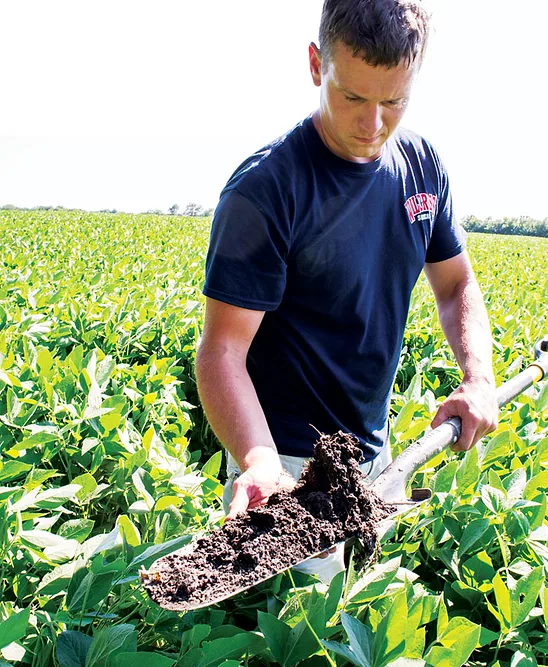
No-till relies on a thriving soil ecosystem. Under no-till and cover crop management, soil organisms accomplish the actions previously performed by tillage. Earthworms and other beneficial soil invertebrates break down and incorporate residues deeper into the soil profile. Soil microorganisms and fungi excrete glue-like substances that create soil aggregates and soil structure.
It takes a few years for soil organism populations to build up to high enough levels to accomplish all of these important functions. As a result, most soils will take a few years to function optimally.
Wetter Soils & REDUCED Infiltration
At first, the soil particles may clog soil surface pores in the uppermost few inches of the soil profile. Farmers should expect water infiltration rates to temporarily slow, resulting in wetter, poorer-draining soils.
Residue Buildup
After transitioning to continuous no-till, residue will build up on the soil surface. The existing biological systems that break down residues, such as earthworms, soil invertebrates and soil fungi will not be initially sufficient to decompose the increased quantities of soil residues. It takes a few years for populations of these organisms to grow to the quantity needed to decompose residues in a timely fashion.

Slower Germination
Slower and uneven germination can be an outcome of no-till at first.
Germination can be delayed as much as 7-10 days in no-till vs. tilled fields because of cooler soil conditions.
Nutrient Stratification
Phosphorous (P) and potassium (K ) will build up in the upper few inches of no-till soils when surface applied nutrients aren’t incorporated and as roots translocate nutrients from deeper in the soil profile to the leaves of plants.
Stratification of P and K in the top few inches of the soil’s surface should not be a concern except under drought conditions. Under normal conditions, the largest percentage of root growth in no-till is in the top 3 inches of the soil where P and K concentrations are highest.
“Every 1% increase in organic matter results in as much as 25,000 gallons of available water per acre…”
Stratification of P is a water quality concern ... when soil P concentrations are extremely high and soils are poorly drained. Under these conditions, P will dissolve in surface run-off in the form of orthophosphate, a leading cause of harmful algal blooms in surface waterways.

Potential Decreased Yields
With proper preparation, it is possible to have no yield loss during transition to no-till.
However, be prepared for a potential 10% decrease in corn yield. Yield losses with soybeans and other crops are less dramatic.
Cost-share programs through NRCS EQIP and other state agencies are available to offset the potential income loss.
What to Expect in 3 – 5 Years

Thriving Soil Life
A few years without tillage will change the soil biology. Mycorrhizal fungi will proliferate, creating strong micro-aggregates that lead to a loose, crumbly soil structure.
Earthworm populations will skyrocket to as many as 120,000 per acre, creating pores up to 5 feet deep through which plant roots can grow to access water and nutrients.
In the absence of tillage, residue decomposition within the soil profile slows, enabling organic matter concentration to increase.
Better Nutrient Availability
Approximately 75% of nutrient cycling is biologically driven. Bacteria and mycorrhizal fungi break down residues and manure, releasing nutrients into the soil for plant uptake. Higher soil biological activity increases nutrient availability.
Increased organic matter and soil organic carbon concentrations will improve the soil cation exchange capacity (CEC). Higher CEC increases a soil’s ability to hold and store nutrients and buffer against changes in pH.
Nutrient exchanges between organic matter, water and soil are essential to soil fertility and need to be maintained for sustainable production purposes.
Less Soil Compaction & Greater Infiltration
The higher organic matter content and biological activity characteristic of no-till soils makes the soil more resistant to soil compaction.
Residue protects the soil surface from the impact of raindrops and reduces soil crusting, which in turn increases infiltration rates and gas exchange.
“No-Till soils are resilient…”
Over time, no-till soils develop a well drained, loose, crumbly structure through which rainfall easily percolates, and the seedbed will become softer and more forgiving.
Less Erosion
Residues on the soil surface will protect soil from soil erosion. Under no-till management, erosion rates typically decline by more than 60%; fields accustomed to losing many tons of topsoil per year through erosion will experience minimal soil loss.
Improved Drought Resistance
Reduced Evaporation. No-till management leaves plant residues on the soil surface, keeping soil cooler. Cooler soils experience less evaporative loss from sun and wind exposure. The lower soil temperature reduces evapotranspiration rates of cash crops during hot weather, thus further conserving soil moisture.
More plant-available water: The increase of organic matter in no-till soil is a 2-fold benefit when it comes to water. First, the organic matter wicks more water down into the soil, providing for better rainfall capture and less loss to runoff. Second, the organic matter holds more moisture in the soil increasing the water holding capacity.

More Profits
Yields will typically rebound to the same levels achieved under conventional management a few years into the no-till transition.
At the same time, input costs under no-till management are typically lower. Less tillage means less fuel use. Lower soil disturbance reduces weed pressure and the need for herbicides. More microbial activity leads to more efficient nutrient uptake and lower nutrient inputs. All together, long-term no-till management systems are more profitable.
Expert Tip...
No-Till Fields Win Yield Contests
In national corn-growing competitions, no-till fields have consistently beat conventionally tilled fields in the non-irrigated crop category.

No-Till Farmer's "Getting Started With No-Till Farming" is brought to you courtesy of Calmer Corn Heads.
Farmer Invented. Farmer Tested. Farmer Proven.® Calmer boasts this motto proudly as it references our farmer-first mentality and state-of-the art technology.
Calmer offers a custom experience, suited to your farm’s needs. Whether its talking with our experienced sales team or directly with the folks who designed and built your corn head, we are committed to providing you top-notch service without the red tape of a big corporation. Calmer specializes in products suited to benefit your no-till operation including the patented BT Chopper® Stalk Rolls, versatile Corn Head Upgrade Kit for harvest efficiency and residue management, and the High-Performance Concave Upgrade Kit.
We know Calmer products work because we run them on our own farms; that’s why we offer a 100% Satisfaction or Your Money Back Guarantee!