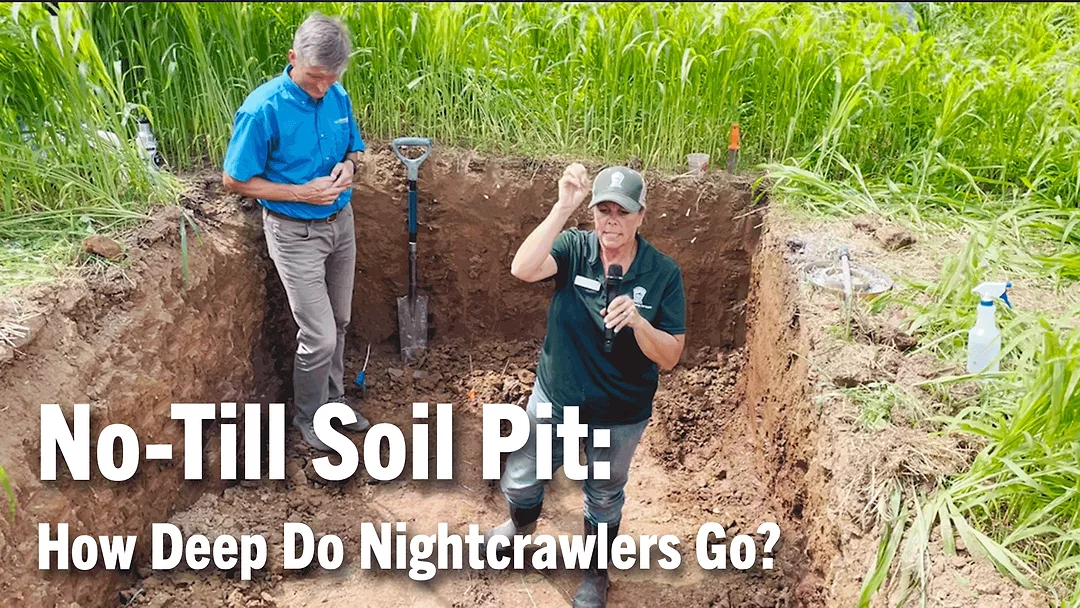
Let’s kick things off right there at the Pennsylvania No-Till Alliance field day, where attendees got an up-close look at how deep Jim Hershey’s roots run after 25-plus years of cover crops and no-till. Lisa Blazure of the Stroud Water Research Center and Sjoerd Duiker, Penn State no-till and cover crop researcher, conducted a soil pit session. Let’s dig deep for some highlights.
Lisa Blazure, Soil Health Coordinator, Stroud Water Research Center: “Everything green that we see around us is photosynthesizing. Photosynthesis grabs that carbon dioxide that’s in the atmosphere, combines it with water and sunlight, and makes simple sugars. Anytime we have a living photosynthetic plant, it is producing sugars, building that root system and pumping those simple sugars and other compounds out into the soil. We call those root exudates, or the liquid carbon pathway. That carbon, through that process, is five times more likely to stay in that soil and contribute to long-term stable organic matter.”
Sjoerd Duiker, Professor of Soil Management, Penn State University: “We see a lot of nightcrawler channels in the soil. You have them everywhere. One study says our subsoils are so dense and so compact naturally, that roots cannot really penetrate them. How do those roots come down in here? They grow predominantly through the cracks and the micro-pores. All those roots are following the nightcrawler channels. Those nightcrawlers have shown to be very sensitive to tillage because they need crop residue right here at the surface.”
Lisa Blazure, Soil Health Coordinator, Stroud Water Research Center: “If you can calibrate your eye to identify those nightcrawler mittens, that is a great tool as you’re walking across your field because once you recognize that little cluster of residue, it gives you a great indication to how your nightcrawler population is doing. Those nightcrawlers can live 5-7 years, and once they die, if there’s not tillage in the system, that burrow stays in place for 25 years, and that is easy access year after year for your roots to get down in dry years to that water table, and to those micronutrients as well.”
Watch the full version of this episode of Conservation Ag Update.