 Premium content is for our Digital-only and Premium subscribers. A Print-only subscription doesn't qualify. Please
No-Till Farmer
Get full access NOW to the most comprehensive, powerful and easy-to-use online resource for no-tillage practices. Just one good idea will pay for your subscription hundreds of times over.

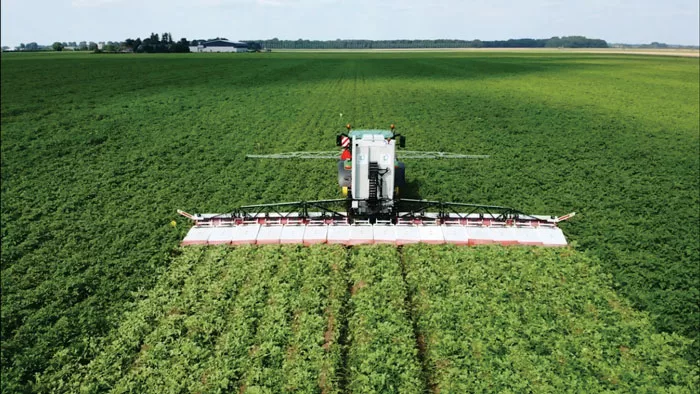
Germany’s Crop.Zone developed a tractor-mounted electro weeding system that combines an electrical current with a proprietary conductive-enhancing solution dubbed Hybrid Herbicide to kill affected plants at the root. Source: Crop Zone
While chemists have done most of the heavy lifting in agriculture’s battle with weeds since World War II, electrical and mechanical engineers are increasingly supporting the fight with innovations to make herbicides more efficient, and in some cases, bypass chemistry altogether.
Throughout history, mechanical tillage provided the most effective method to separate the crop from the tares.
Fighting weeds was simple, but hoeing and cultivating were wearisome, and quietly contributed mightily to worn-out farms, as disturbed, bare topsoil washed or blew away. The degradation of the soil was accepted as part of doing business.
By the middle of the 20th Century, however, chemistry provided some of the first compounds — namely 2,4-D — to kill broadleaf weeds with a spray. Killing weeds got easier, but as recent history has proven, keeping farm fields free of weeds began to get a lot more complex.
“Nobody likes complex,” says Univ. of Missouri weed specialist Kevin Bradley, “but weed control is going to continue to get more complex as we move forward. We’re faced with implementing more integrated approaches to weed management. It’s not that I dislike herbicides, since they are still going to be a fundamental part of the way…

Get full access NOW to the most comprehensive, powerful and easy-to-use online resource for no-tillage practices. Just one good idea will pay for your subscription hundreds of times over.
Download these helpful knowledge building tools

We have engineered and developed the most advanced concave system that threshes all crops, eliminates rotor loss, improves grain quality, gives you a cleaner sample – all with one set of XPR concaves.

At Titan International, our product portfolio reflects our commitment to innovation and high-quality products. Titan International offers a full line of solution-focused wheel, tire, and undercarriage products for a wide variety of off-the-road equipment in agriculture, construction, forestry, mining, power sports, high-speed trailers, and outdoor power equipment segments. As one of the largest North American manufacturers, with a network of dealers all over the world, Titan is an industry leader that original equipment manufacturers and operators can count on for durable products and quality service.

Provide expert analysis and decision support to increase productivity and profitability.