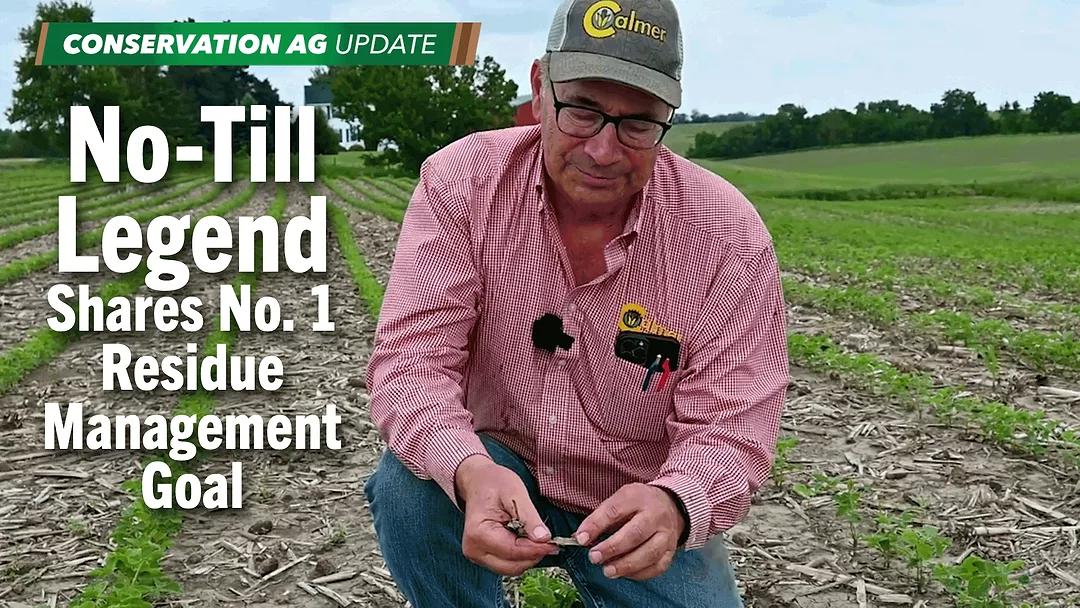
On this episode of Conservation Ag Update, brought to you by Yetter Farm Equipment, Alpha, Ill., No-Till Innovator Marion Calmer discusses his top goals when it comes to managing heavy residue at harvest time.
Plus, we catch up with Field to Market president Carrie Vollmer-Sanders for a look at the new FieldPrint Platform 5.0, which helps farmers measure the environmental impacts of their crop production and increase profitability.
In the Cover Crop Connection, Nelson, Mo., no-tiller Alan Weber uses cover crops to reduce weed pressure and save up to $50 per acre on hay needed for grazing in his diversified crop and livestock operation.
Later in the episode, The Fertilizer Institute launches NuGIS 2.0, a system that integrates multiple data sets to create county-level estimates of nutrients applied and removed. And in the Video of the Week, Warren Dick reflects on the early days of the first no-till plots in Wooster, Ohio.
This episode of Conservation Ag Update is brought to you by Yetter Farm Equipment.
Since 1930, Yetter Farm Equipment has been providing farmers with profitable solutions. From residue management and fertilizer placement to seedbed preparation, our equipment is designed to maximize your inputs, save you time, and deliver a strong return on investment. Explore our full line of planter attachments, precision fertilizer placement options, strip-till units, and stalk rollers at yetterco.com. Let Yetter help you prepare your equipment lineup for success today.
TRANSCRIPT
Jump to a section or scroll for the full episode...
- Turning No-Till Cornstalks into Confetti
- New Field to Market Platform Shares Key Crop Production Metrics
- Multi-Tasking Cover Crops Suppress Weeds, Help Boost No-Tilled Soils
- The Fertilizer Institute’s NuGIS 2.0 Compiles Nutrient Use Data in U.S.
- Video of the Week: Visiting the World’s Longest No-Till Plots
Turning No-Till Cornstalks into Confetti
Happy 4th of July, welcome to CAU! Harvest season will be here before you know it. Let’s check in with No-Till Legend Marion Calmer, who shares some insights on how he’s dealing with heavy residue on his Alpha, Ill., farm.
“We planted into corn and we’re in a corn-soybean rotation. This cornstalk residue here was actually harvested about 18 months ago. You can see how well it’s decomposed, and you can see the pieces that were cut with a BT Chopper about an inch long or so. What’s interesting is the earthworms were able to come in here and grab all of that small confetti and pile it up around the hole here. You can see there’s the earthworm hole. He was able to take all that residue and pile it up and make a nice little home for himself. I still believe the faster I can get cornstalk residue to decompose, I get it back in the soil and I don’t have to deal with it, and I don’t have to worry about it washing away with all the heavy rains we had this year.”
Marion says it’s the same principle with soybean harvest. When he’s harvesting soybeans, he keeps the teeth engaged on the straw chopper. He wants the soybean straw to decompose as quick as possible.
New Field to Market Platform Shares Key Crop Production Metrics
Field to Market recently held its annual meeting in Kansas City. During the event, attendees got a sneak peek at the Fieldprint Platform 5.0, which helps farmers measure the environmental impacts of their crop production and increase profitability. We caught up with Field to Market president Carrie Vollmer-Sanders in Kansas City for a look at how it works.
“Sometimes it's helpful to look back at the data and say, did that really work the way we thought it would? Or what were all the variables? So, with the Fieldprint Platform, there's an opportunity to put in data that goes beyond carbon. So, other metrics that they're evaluating, energy use, biodiversity, water use, water quality. Essentially, there's three different things that look at soil and give you kind of this overarching impact of the farm. And one of the things that we've been talking about is in this new platform, could we also add insights for the grower?”
“So, for example, you've inputted all the data. You might ask the platform, how could I decrease my energy use? So, we've been testing this out. It hasn't launched yet. It's going through some iterations still. But what in preliminary results have shared is it gave the farmer three different areas where it could change energy use. And then within those three areas, it gave three or four different examples of what the farmer could look at to decrease the energy use on the farm.”
Version 5.0 is expected to launch August 1. Head to FieldToMarket.org for more information on the platform.
Multi-Tasking Cover Crops Suppress Weeds, Help Boost No-Tilled Soils
Mackane Vogel here with this week’s cover crop connection. For this episode, we are going to Nelson, Missouri to visit with Alan Weber as he discusses his use of cereal rye and other cover crops on his farm. Weber runs a diversified crop and livestock operation and he’s found cereal rye especially useful in reducing pigweed and waterhemp pressure.
“One of the reasons that I was initially attracted to the use of cover crops was actually for weed resistance or being able to decrease our dependence in terms of herbicide. It’s been more than 10 years actually since I first started using cover crops and at that point we were using red clover and cereal rye. And cereal rye we were trying to take advantage of the allelopathic effects in terms of the following crop. So I actually got a small grant from the state of Missouri and the department of agriculture to look at a control versus the use of cereal rye. And we took weed stand counts in terms of that control and we definitely found that anywhere we used cereal rye, that the weed populations, specifically the summer annuals like pigweed and waterhemp were significantly reduced. So that was actually my original reason for wanting to use cover crops. But now, after several years of use I’ve kind of pivoted to the point where I’m more looking at ways to be able to increase soil organic matter and thus water holding capacity so we’re in a position here geographically where many times we are short of water in july and august and being able to have a little bit more water holding capacity can benefit us significantly in terms of the economics.”
Weber also says that cover crops as a whole are saving him between $35-$50 an acre on hay needed for grazing.
The Fertilizer Institute’s NuGIS 2.0 Compiles Nutrient Use Data in U.S.
The Fertilizer Institute is launching NuGIS 2.0. It’s the Nutrient Use Geographic Information System, which integrates multiple data sets to create county-level estimates of nutrients applied and removed. Kathy Mathers with the Fertilizer Institute shares how this project is helping farmers across the U.S.
“The Nutrient Use GIS information system originally started or originally built by IPNI, by the International Plant Nutrition Institute. It is now ready for what we're calling NuGIS 2.0. And what NuGIS does is it allows us to tell our advocacy story by looking at data on nutrient use, nutrient uptake, and other related, like for example, other inputs such as manure use on watershed-by-watershed basis. And that is really allowing us to better tell or better counter those who say that we're using too much fertilizer, we're just dumping it on indiscriminately, and again, really attempting to find evidence ways to step up for the growers.”
NuGIS is free to use, but you have to register.
Video of the Week: Visiting the World’s Longest No-Till Plots
Glover Triplett and Dave Van Doren seeded the first no-till plots in Wooster, Ohio in 1962. They’re still going strong 60-plus years later. In our Video of the Week, Warren Dick, who managed the plots for nearly 40 years during his time at Ohio State, reflects on the early days of the project.
“My dad used to always say, if you grow a crop, you have to plow. Everybody knows that. You look at the history, back in the pyramids, what do you see? Oxen pulling a plow in Egypt. Tillage is synonymous with agriculture for thousands of years. To change that took a whole new mindset. When Glover, Dave and Jim Henry started this, the main things they wanted to answer was: Can you grow a crop with no-tillage? If you do, what is the effective rotation? How does that affect soil properties? Those were the main things right at the beginning. Glover Triplett was a great guy. He said the dean came to visit and they took him to the plots here in the spring. His wife told him, “Glover, the dean is going to fire you,” because it was so un-green.”
And that was filmed by our Mackane Vogel and Christine Book during their visit to the plots during the spring.
That’ll do it for this week. Got something you’d like to feature on the program? Shoot me an email at Nnewman@Lessiter Media.com. Thanks for tuning into Conversation Ag Update. Until next time, for more stories visit no-tillfarmer.com, striptillfarmer.com and covercropstrategies.com.