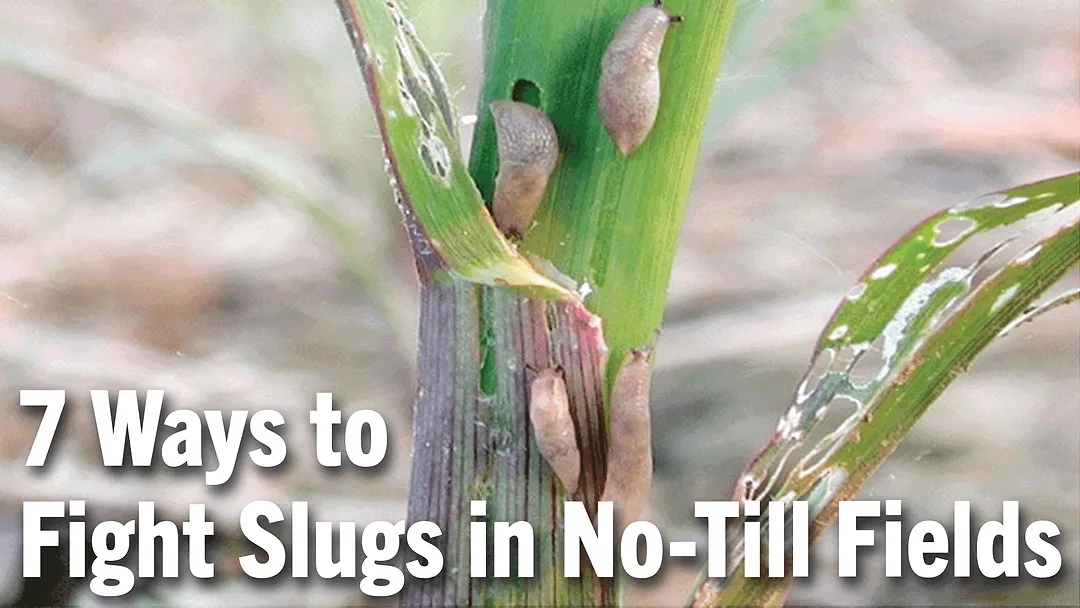
A north central Ohio no-tiller is having a terrible time with slugs in his cereal rye-soybean fields this growing season. He asked for some help in the No-Till Farmer Email Discussion Group. Let’s see what people said.
Doug Honeck, Marshall County, Iowa
Do you have copper in your soil? I read that slugs are sensitive to copper. I tested my soil — in 10-acre grids — to determine if any copper was available. The test showed a 0 value for copper. I applied a product called Orbix that contains many micronutrients.
H. Grant Troop, Oxford, Penn.
1. Don’t use broadcast insecticide and be careful with seed-applied neonic insecticides. Both are effective at eliminating slug predators
2. Spread or band fertilizer (salt) over the soybean row at planting. Muriate of potash (0-0-60) alone or combined with ammonium sulfate (21-0-0-24S) works well. Slugs and salt don’t get along well.
3. Apply seed treatments such as NutriPak Prima or Adrenaline and hopperbox seed treatment such as GroPak A.I. to speed emergence and early growth to help outgrow the slug.
4. When able, clean the row of crop residue and cover crop to eliminate day housing for the slug population. Slugs take cover on sunny days. Make sure they need to go to the row middles for protection from direct sunlight.
5. Make sure the planter is doing a positive row closure by interlocking the seed furrow sidewalls, so they don’t open after a couple wetting and drying cycles. An open seed furrow is a superhighway for slugs and other soybean pests.
6. As far as copper and other micronutrients go, the main concern is having the right amount in the soil for optimum soybean growth and high yield. Too much copper is not where you want to end up.
And Grant says if all else fails, there are slug pesticides as a rescue treatments.
Watch the full version of this episode of Conservation Ag Update.