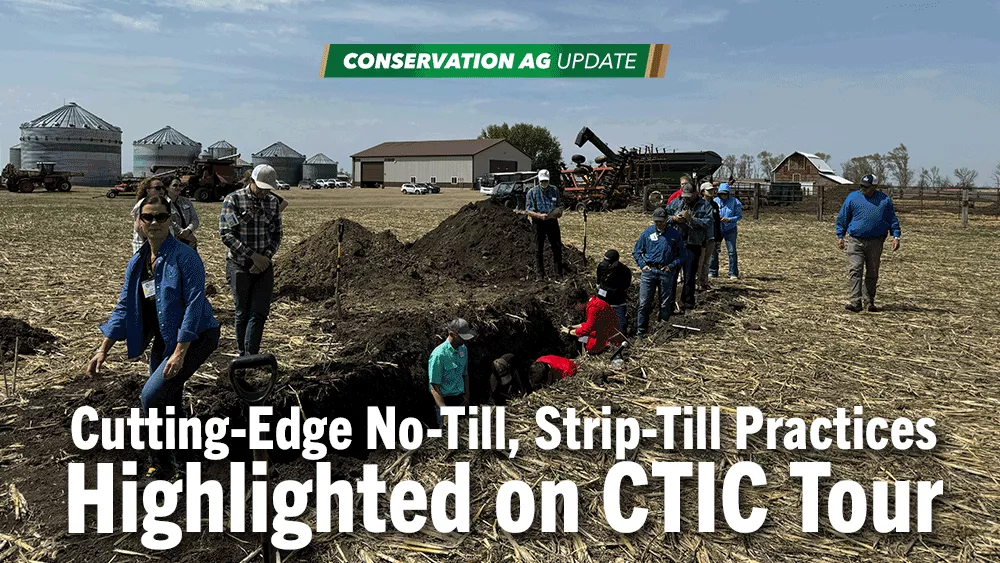
On this episode of Conservation Ag Update, brought to you by Yetter Farm Equipment, we’re headed inside CTIC’s Conservation in Action Tour in Sioux Falls, S.D., where a pair of conservation ag legends were inducted into the CTIC Hall of Fame. Dwayne Beck, Dakota Lakes Farm Research Manager, and Jay Brandt, son of the late no-till legend David Brandt, explain how they’re continuing to blaze the trail for conservation ag.
In the Cover Crop Connection, associate editor Mackane Vogel pays a visit to the Brandt family farm in Carroll, Ohio, where David Brandt’s grandson, Christopher, shows how he’s bringing his own flavor to their cover cropping approach.
Plus, we swing by the historic no-till plot at Wooster, Ohio, which is the longest continuously managed no-till plot on the planet. Ohio State’s Manbir Rakkar and Warren Dick share their biggest takeaways from the historic field.
Moundridge, Kan., Strip-Till Innovator Ray Flickner details his crop rotation and shows us how his strip-tilled corn is holding up in dry conditions so far.
Finally, Daniel H. Smith, nutrient and pest management program manager for the Univ. of Wisconsin, breaks down a 6-year study exploring a systems-based approach to weed management using cereal rye in corn-soybean rotations.

This episode of Conservation Ag Update is brought to you by Yetter Farm Equipment.
Since 1930, Yetter Farm Equipment has been providing farmers with profitable solutions. From residue management and fertilizer placement to seedbed preparation, our equipment is designed to maximize your inputs, save you time, and deliver a strong return on investment. Explore our full line of planter attachments, precision fertilizer placement options, strip-till units, and stalk rollers at yetterco.com. Let Yetter help you prepare your equipment lineup for success today.
TRANSCRIPT
Jump to a section or scroll for the full episode...
- Sights & Sounds from CTIC Conservation in Action Tour
- Dave Brandt’s Legacy Lives On for Generations
- 60 Years & Counting: Lessons Learned from Historic No-Till Plots
- Strip-Till Innovator Provides #Plant25 Update
- Crushing Herbicide-Resistant Weeds with Cereal Rye
Sights & Sounds from CTIC Conservation in Action Tour
Cover crops, new equipment, cutting-edge no-till practices and more were on full display at the CTIC’s Conservation in Action Tour in Sioux Falls, S.D.
No-Till Farmer’s John Dobberstein and Mike Lessiter had a front row seat to all the action, which included on-farm visits to local no-till and strip-till operations as well as stops at POET headquarters and the U.S. Geological Survey’s Earth Resources Observation and Science Center.
Two conservation ag giants were inducted into the CTIC Hall of Fame — longtime Dakota Lakes Research Farm manager Dwayne Beck and the late no-till legend David Brandt, whose son Jay and daughter Amy accepted on his behalf. We caught up with the Brandts and Beck afterwards to discuss how they’re still blazing the trail for conservation ag.
Jay and Amy Brandt, David Brandt’s Son & Daughter, Carroll, Ohio: “What brought the greatest pleasure to David, my dad, is that my son, Christopher, was able to take over the farm operation using the same practices that he was promoting and bringing in his own flavor into that. We’re trying to continue with our farm as an example farm in conservation agriculture, using no-till practices, crop rotations, cover crops. We can entertain people to see it in practice and develop confidence to take away how it would work in their system.”
Dwayne Beck, Dakota Lakes Research Farm Manager, Pierre, S.D.: “One of the things that we do now (at Dakota Lakes Research Farm) just as a demo for people — if you come in the summer, when we have the irrigators fired up, we’ll have an irrigator put on 2 inches of water, it goes on in 9 minutes, we’ll set a bucket there and they can see it. Then we walk them behind the irrigator, and they don’t get their feet muddy. If you think about it, you can do the same think in the lawn or a pasture or anywhere in the woods. The only place you get your feet muddy is in tilled fields.”
Head to No-TillFarmer.com for more on the Conservation in Action Tour, including video coverage of that CTIC Hall of Fame ceremony. Jay just talked about his son Christopher bringing his own flavor to the family farm, Mackane Vogel shows us how in today’s Cover Crop Connection.
Dave Brandt’s Legacy Lives On for Generations
We are in Carroll, Ohio at Walnut Creek Seeds Farm, home of the legendary Dave Brandt and we are going to toss it off to our cover crop segment here with Dave Brandt’s grandson — Chris.
“So this is a cover crop of cereal, rye, winter pea, hairy vetch, flax, and balansa clover. That was planted early September, and it got terminated about three or so days after we planted into it, and that would’ve been around May 8th or so. But this is probably the lowest density, in biomass, part of the field. There’s poor emergence here. And then everywhere where you actually see biomass, there’s one coming out. So I guess that’s what counts.”
“What my grandfather David was primarily focused on was proving it can be done. No tilling in the early ‘70s, working with Monsanto and Glyphosate to prove that no-till was something you could do in the nineties. And then into their early, mid-2000s proving that cover crop single species can work. 2010s, cover crop mixes work, and they’re really good. That was his focus. My focus is on how can the average farmer start using these practices without changing their operation in a large way. What I want to do is I want to figure out how the average farmer can adopt these practices.”
Very cool to see Chris following in his grandfather’s footsteps.
60 Years & Counting: Lessons Learned from Historic No-Till Plots
Since we’re in Ohio, let’s pay a visit to the town of Wooster, home of the world’s longest continuing no-till plots.
Glover Triplett and Dave Van Doren arrived at Ohio State University in the late 1950s, and not too long after that, the duo seeded this no-till research plot in 1962. And it’s still going strong today. Manbir Rakkar and Warren Dick from Ohio State check in with some key takeaways from the historic field.
Manbir Rakkar Ohio State Soil Fertility Extension Specialist: “Last year in the summer and fall, there was extreme drought. We took pictures. You could visibly see in the no-till vs. the tillage plots a huge visual difference in how the crops were doing. Same fertility, hybrids and everything. You could see how much difference it makes when you invest in these kinds of soil health practices.”
Warren Dick, Managed Historic No-Till Plots from 1980-2016, Wooster, Ohio: “You start reading about it more and more, but no-till is much more resilient to climate change. Everyone talks about climate change. I don’t think conservation ag is going to be the answer to preventing climate change from happening, but it is a good system to adapt to what’s happening. If it’s drier, wetter or hotter, the no-till plots adapt much better to that climate change. And I think that’s another story that needs to get out more. Instead of chasing carbon, carbon, carbon….I agree, carbon has many benefits and we need it in the field. It's absolutely important. But if we do all the right things, the carbon is going to come naturally.”
Ohio State No-Till Innovator Randall Reeder says the plots need to go on for another 60 years because there’s still so much to discover.
Strip-Till Innovator Provides #Plant25 Update
Let’s head out to Moundridge, Kan., now where 2025 Strip-Till Innovator Ray Flickner shows us how his corn’s holding up in dry conditions.
“We have a living root growing throughout the year. We get 3 crops (corn, wheat, soybeans) out of 2 years. Basically, everything has a crop growing with the exception between soybeans and corn. The challenge I’ve had is, I’ve experimented, and I haven’t found the answer, is to what kind of cover crop arrangement should I be using before I plant corn.”
“If we dig here in the strips, it’s really mellow. We’ve got good moisture and we’re behind on moisture level by about 10-12 inches for the year. We did have an inch of rain about 10 days ago. That strip held the moisture and got a good stand.”
“The challenge is, trying to make sure the planter stays on the strips. This particular field here was planted with a 24-row John Deere planter, and he did a good job with that one. I’ve got another field where I had one of my neighbors plant with a 16-row, 3-point mount, and you can tell he had a hard time keeping it on guidance with the strips. I had that experience with my 8-row planter. Unless you have a lot of weight on the front end and a lot of tires, it will pull you around pretty good. You’ll end up fighting the strip-till. That is something one has to worry about when you go to strip-tillage, how do you maintain the planter on top of strips.”
Looking forward to learning more about Ray’s system at the 2025 National Strip-Tillage Conference, which you can sign up for now at StripTillConference.com.
Crushing Herbicide-Resistant Weeds with Cereal Rye
And before we go, let’s send it out to Daniel Smith at the Lancaster Ag Research Station at the Univ. of Wisconsin.
“Hi, I am Daniel Smith, outreach program manager for the University of Wisconsin-Madison, division of extension is Nutrient Pest Management Program. Today I'm at the Lancaster Agriculture Research Station, chatting to you about research that I'm going to be presenting at the 2025 National Strip-Till Conference in Iowa City, Iowa. Very excited about this project because we're comparing conventional till to no-till to various termination timings of cereal rye. We're very interested in using the cereal rye cover crop for weed suppression, and at the Lancaster Farm, we're lucky enough to have a decent population of waterhemp. During the talk, you're going to learn all about the various yields of this study, comparing again, no-till, conventional till, and those termination treatments of cereal rye, which include two weeks before planting, at planting, two weeks after planting, and finally, a rye rich harvest for our livestock farmers. We're also going to dive into weed control aspects, so in this study, we're also combining pre-emergent herbicides compared to no pre-emergent herbicides. So we've got a lot of weed data to dive into as well.”
“Finally, we're going to talk about how to incorporate some of these systems into your strip-till system. So how can we use winter rye in a strip-till system for weed control? And then thinking about pre-emergent herbicides that might be options as well within that system. Very excited to share this work with you. Look forward to meeting everyone at the conference.”
That’ll do it for this week. Got something you’d like to feature on the program? Shoot me an email at Nnewman@Lessiter Media.com. Thanks for tuning into Conversation Ag Update. Until next time, for more stories visit no-tillfarmer.com, striptillfarmer.com and covercropstrategies.com.