Under no-till management, fertilizer & manure are typically broadcast on the soil surface & residues are not incorporated. These practices have a number of profound impacts to nutrient cycling & availability, as described below.
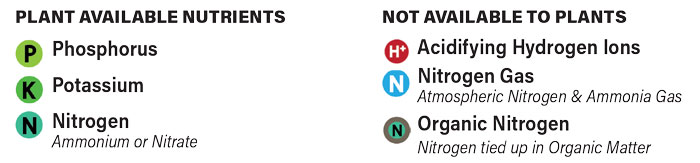
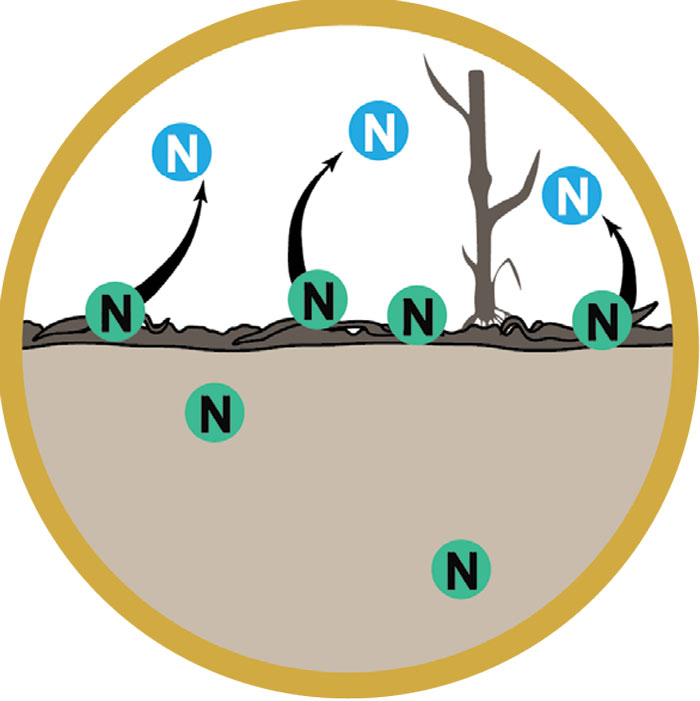
Surface applied N is lost to the atmosphere
What
As much as 50% of the nitrogen in urea-containing fertilizers and manure will be lost to the atmosphere (as ammonia gas) when not incorporated into the soil.
Solution
- Use fertilizer with lower urea content
- Consider adding a urease inhibitor
- Inject or apply N subsurface whenever possible
- Surface apply N before a light rain

Surface applied nutrients can run off in storm events
Problem
Surface-applied nitrogen and phosphorus will wash away in storm water runoff, either dissolved in rainwater or stuck to sediment.
Solution
- Avoid spreading fertilizer and manure before large storm events
- Inject or apply N subsurface when possible
- Apply nutrients to a growing cover crop to prevent runoff
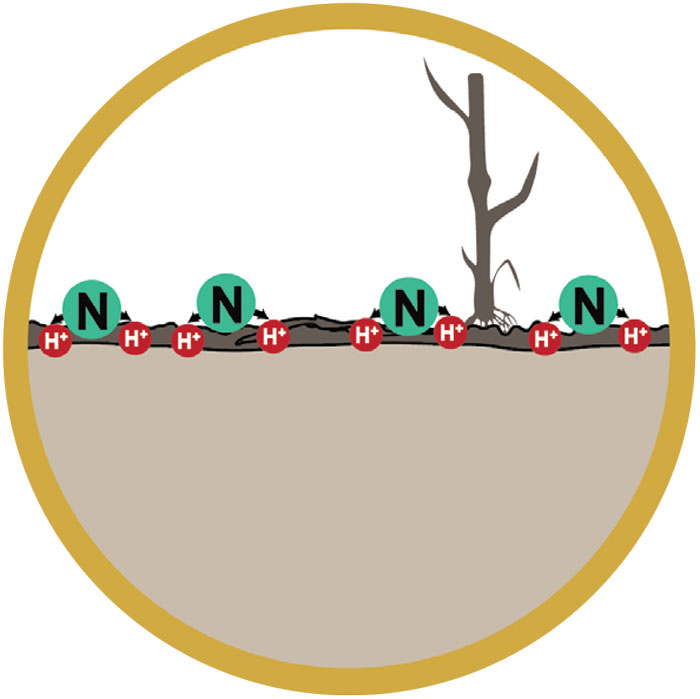
Acid layer in top 2-3 inches
Problem
When ammonium nitrogen breaks down in the soil, it releases acidifying hydrogen ions into the soil surface. Low surface soil pH can impede germination and damage seedlings.
Solution
- Apply lime more frequently
- Check the surface pH annually
- Inject or apply N subsurface whenever possible
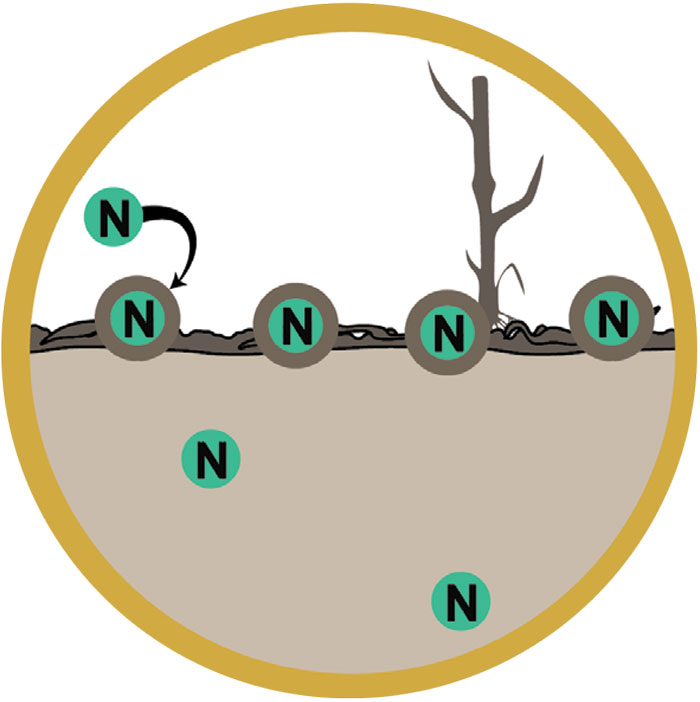
Carbon-rich residues tie up N (Carbon-penalty)
Problem
When applying nitrogen to carbon-rich residues ( i.e. corn, wheat stubble and mature cereal rye cover crop), soil microbes decomposing the residues will out-compete crop seedlings for the nitrogen. Substantial amounts of nitrogen won’t be available to the growing crops until previous residues are decomposed.
Solution
- Provide the microbes with extra nitrogen to accelerate the breakdown of residues early in the growing season
- When possible, inject or apply N subsurface near the plant where it is available in the early growth stage
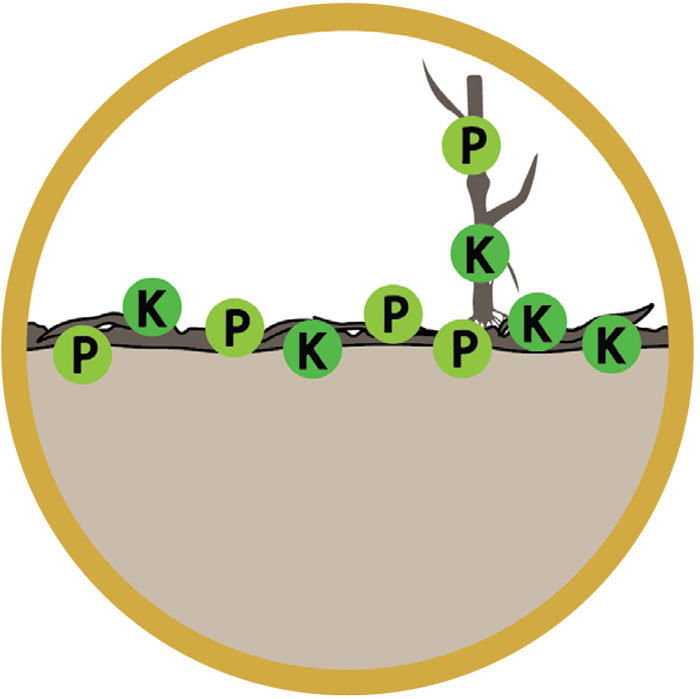
P & K build up on soil surface
Problem
Non-mobile nutrients, like phosphorus and potassium, concentrate on the soil surface when fertilizer and other nutrient-rich residues are not incorporated into the soil. Seedlings cannot access nutrients on the soil surface.
Solution
- Band fertilizer (ideally 2 inches below and to the side of seed)during planting and/or use pop-up (starter to supply seedling roots with nutrients)
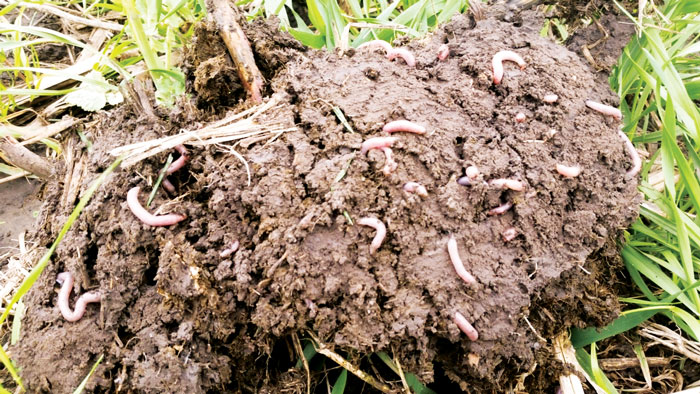
Univ. of Maryland researcher Ray Weil says high-quality soils no-tilled for more than 20 years likely contain 1 ton per acre of earthworms, a level 10 times greater than heavily tilled soils. Soil structure, nutrients and biological activity are improved by earthworms. No-Till Farmer Management Report No. 58, Managing Residue to Make No-Till More Effective
Sampling No-Till Soils
No-till management affects soil nutrient cycling. Top-dressed ammonium-based fertilizers and manure acidify the uppermost few inches of the soil through naturally occurring chemical reactions.
Non-mobile soil nutrients like phosphorus (P) and potassium (K) become highly concentrated at the top of the soil profile. As a result, farmers practicing continuous no-till should adjust their soil sampling protocol to accurately assess soil chemical properties.
Tilled Soils
In conventionally tilled systems, nutrients are generally evenly distributed to the depth of the plow disturbance.
Collect soil samples from the uppermost 6 inches
No-Till Soils
In no-till systems, the soil surface will be both more nutrient-rich and more acidic. The effect will be particularly pronounced during the first few years of transition, when large soil organisms, like worms, aren’t present in high concentrations to “mix” the soil.
Farmers should still collect a soil sample from the uppermost 6 inches for fertilizer and lime recommendations. It is very important that the soil sample be a 6-inch deep composite; a shallower sample will make the soil appear more nutrient rich than it really is.
If the P and K levels in the 6-inch sample are low or very low, then injecting P and K with the planter or a separate fertilizer injector is recommended. These nutrients may be in higher concentration in the uppermost 2 inches, but seedlings won’t be able to access the nutrients.
In addition, collect a sample of the uppermost 2 inches to monitor surface acidity. In long-term no-till fields, surface fertilizer application and accumulation of organic matter concentrates acidity at the soil surface. These no-till fields may have surface soil pH in the 4.0-5.0 range, which can cause aluminum toxicity for young seedlings and poor performance of some herbicides.

No-Till Farmer's "Getting Started With No-Till Farming" is brought to you courtesy of Calmer Corn Heads.
Farmer Invented. Farmer Tested. Farmer Proven.® Calmer boasts this motto proudly as it references our farmer-first mentality and state-of-the art technology.
Calmer offers a custom experience, suited to your farm’s needs. Whether its talking with our experienced sales team or directly with the folks who designed and built your corn head, we are committed to providing you top-notch service without the red tape of a big corporation. Calmer specializes in products suited to benefit your no-till operation including the patented BT Chopper® Stalk Rolls, versatile Corn Head Upgrade Kit for harvest efficiency and residue management, and the High-Performance Concave Upgrade Kit.
We know Calmer products work because we run them on our own farms; that’s why we offer a 100% Satisfaction or Your Money Back Guarantee!