

Brought to you by:
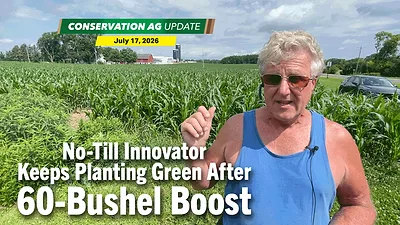
On this episode of Conservation Ag Update, brought to you by Yetter Farm Equipment, No-Till Innovator Rick Clark gives a presentation at the Regenerative Agriculture Summit in Chicago, Ill., explaining how cover crops are saving him hundreds of dollars on inputs per acre.
Ottawa, Ohio, no-tiller and strip-tiller Jeff Duling shows us his custom-built toolbar that’s capable of performing up to 6 different tasks, including the interseeding of cover crops around V4-V5.
David Stark, president of agriculture at Holganix, breaks down the true nutrient value of corn and soybean residue in no-till systems.
In the Cover Crop Connection, Mackane Vogel catches up with weed science specialist John Cussans for a conversation about annual ryegrass and Italian ryegrass as they relate to herbicide resistance.
Three Forks, Mont., no-tiller Franck Groeneweg explains how he’s giving a boost to crops with compost extract from his Johnson-Su bioreactor system.
In the Video of the Week, Precision Planting PTI Farm Manager Jason Webster shares data showcasing the benefits of early-planted soybeans.




Conservation Ag Update is brought to you by Yetter Farm Equipment.
Since 1930, Yetter Farm Equipment has been providing farmers with profitable solutions. From residue management and fertilizer placement to seedbed preparation, our equipment is designed to maximize your inputs, save you time, and deliver a strong return on investment.
Explore our full line of planter attachments, precision fertilizer placement options, strip-till units, and stalk rollers at yetterco.com. Let Yetter help you prepare your equipment lineup for success today.
Full Transcript
Noah Newman:Conservation Ag Update is brought to you by Yetter Farm Equipment. Hey, welcome to the show. Great to have you with us as always. We begin in downtown Chicago where hundreds of major companies and dozens of farmers gathered for the Regenerative Ag Summit last week. No-till innovator, Rick Clark, gave a presentation about his farm and he really turned heads when he talked about how he saves millions on inputs with his no-till organic system. And of course, a big part of that is his use of cover crops. As we check out some of this data showing the amount of nutrients sequestered by cereal rye that Clark drilled in after corn harvest. Now, there are also four or five other species in the mix that winter killed, and the numbers keep going up, as you can see, the longer the rye grows before termination. And on this next table, there's a lot of money in that biomass. Clark calculates $435 worth of nutrients in the 28-inch tall rye. And this is a big reason why he's going on six years without any applied nitrogen and 11 years without any phosphorus, potassium, or starter fertilizers.
Rick Clark:When you look at a two or three species cocktail and then you increase that to 10, 12, 14, that's increasing diversity. Always look to increase diversity. We've got nine crops of rotation, that's diversity. But I'm no longer looking at species specific cocktails, I'm looking at families of plants for the cocktail. If you were to put together seven or eight key specific families, you could raise enough nitrogen to where you would not need to add any synthetic fertilizers. I'm over here, we've taken everything away, the majority of the farming community is over here. Let's meet right here somewhere in the middle and figure out how do we make it work within your context of how far we can [inaudible 00:01:59].
Noah Newman:Now, Clark also looked at the value of legume cocktails ahead of corn, which sequestered $969 worth of MPK in early June. Long time no tiller and strip tiller, Jeff Duling meanwhile is finding creative ways to maximize the benefits of cover crops in his Ottawa, Ohio operation. He collaborated with Fennig Equipment on this custom-built toolbar that allows him to intercede covers at V-four, V-five. Duling says he gets up to six different uses out of this bar. It can also be adjusted to seed covers between rows ahead of strip-tilled corn. Jeff, show us how it works.
Jeff Duling:Set up 17 row, I plant 16 row corn. So, that outside row there is putting on half rate of cover crop, half rate of 28%. Go back to 28%, we're Y-dropping, it's not a Y-drop, but it's where you put the nitrogen on right beside the row, the corn row. And then we're putting my blend of cover crop on, my annual rye [inaudible 00:03:05], sun hemp, radish in a Valmar blower, puts it on every row, right in front of these little tillage tools that Fennig's made. It's like 12 inches wide. It's hydraulic adjust. It's a three point model, so I put it down three point. I got these set. So, it's just tickling that cover crop in just to get some seed to soil contact.
Noah Newman:Yeah. Moments ago, Rick Clark talked about the value of those cover crops, but what about the value of all that corn and soybean residue after harvest? Dave Stark, president of agriculture at Holganix, breaks it down for us.
Dave Stark:Every 40 bushels of corn produces about a ton of stover. In that ton, you've got 17 pounds of nitrogen, about four pounds of phosphorus, 34 pounds of potassium. Potassium is very important to stock and stem strength. You've got a lot of that nutrient out there, and some sulfur. Do the math. If you've got a 200 bushels an acre corn crop, five tons of residue, you got a lot of nutrient out there you've already bought, you got to return it to the soil. You want the carbon in the soil, you want the nutrients in the soil. None of that happens without microbes breaking it down and releasing these nutrients so next year's crop can take advantage of it.
Noah Newman:And that was from a recent No-Till Farmer webinar, which you can check out on no-tillfarmer.com. One of Dave's favorite quotes is, "plants farm microbes because microbes mine the soil." And on that note, let's send it over to Mackane Vogel for today's Cover Crop Connection. Mackane.
Mackane Vogel:Thanks, Noah. Well, it's no secret that glyphosate-resistant weeds are becoming more of a problem for farmers all over the world. But what role do cover crops play in this situation and how does it vary between the US and the UK? Check out a clip from the latest episode of the Cover Crop Strategies Podcast where weed science specialist, John Cousins, talks a little bit about annual ryegrass and Italian ryegrass as they relate to herbicide resistance.
John Cussans:Now with glyphosate, we see issues with Italian ryegrass where we don't see the same problem with black grass, alopecurus, which would be our most widespread weed. We don't see the same problem in our brome species or wild oats, or it really does seem that Italian ryegrass has this disproportionate propensity to develop herbicide resistance. As to why that is, all projects end with a requirement for more funding. That's where we'll finish. But I think one of the things that we're seeing with, as we begin to look a little bit more at ryegrass, is just how incredibly, genetically diverse the background is. So, we have all sorts of types. We have all sorts of different levels of dormancy and germination patterns. We see differences in vernalization requirement in wild populations. So, there's this massive genetic diversity, and there's almost a soup of lowlium genetics in the landscape because we've got perennial living in the landscape. And it's just the super genetics and I think that gives you the raw ingredients to go on and select for herbicide resistance.
Mackane Vogel:Well, if you want to hear more about John's research and why glyphosate resistance in the UK might be an even bigger deal than it is here in the US, be sure to head to covercropstrategies.com to check out the full episode of the podcast. Well, that's all for this week's Cover Crop Connection. Until next time, I'm Mackane Vogel. Back to you, Noah.
Noah Newman:Thanks, Mackane. Next up, we're headed all the way to Three Forks, Montana, where no-tiller, Frank Groeneweg grows a variety of crops on more than 12,000 acres. And he has this Johnson-Su bioreactor system, which allows him to apply compost extract in furrow during planting season. University of New Mexico biologist, David C. Johnson, developed this system. Built to bring lifeless soils back to life by reintroducing beneficial microorganisms with biologically enhanced compost. Groeneweg shows us how his John Deere air seeder carries the compost extract to the crops.
Franck Groeneweg:Liquid goes into the tanks there. We have a liquid set up here, a pump there, and then we have squeeze pumps. These basically meter, they're more of a metering pump because the volume is set by this one, and this one just sends liquid to each row unit. So, the seed is coming here, liquid is coming there, being thrown out into the furrow, and liquid comes right on top of it. Now, probably some people are going to say, "This is not a John Deere opener here. That doesn't look like a John Deere at all." And no it isn't. It's a [inaudible 00:07:57] hard opener.
Essentially it's called a, it is a double disc because there are two discs, as you can see here on the one here. It's two discs. One is to cut at an angle, and if you come back at the bottom, this one is the cutting discs and the one that's beside acts as a rolling boot. So, what it does is when it opens up, it keeps the soil from falling into the trench. This seed is being pushed into the soil and then the liquid comes on top of it, gets closed, and then the packer is closing the furrow better, but also acts as a depth gauge.
Noah Newman:Very interesting stuff there. Moving on, some of you might be planting soybeans already as we wrap up the first week of April, and that might not be a bad idea, says PTI Farm Manager, Jason Webster, in our video of the week.
Jason Webster:We're coming in with net profits over $135 an acre. So, it shows you the power of what early planting soybeans can do for us. So, why is this? Well, why do we need to plant soybeans earlier? Well, the PTI Farm in Pontiac, Illinois, we don't have a long enough growing season and we would like to extend the growing season to offer us some higher yield ability. So, what we're going to do to cheat the system, if you will, is to try to plant earlier. And so every year we get into our soybean planting date studies. This is data from 2018 to 2024, and what we found is that the second week of April is actually offering us, on average, the highest yields here to PTI Farm.
Noah Newman:All right. That'll do it for this episode. Story idea or just want to chat, shoot me an email in newman@lessermedia.com. Thanks so much for tuning in. As always, have a great day. We'll see you next time.