 Premium content is for our Digital-only and Premium subscribers. A Print-only subscription doesn't qualify. Please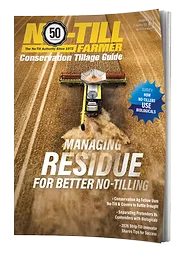
No-Till Farmer
Get full access NOW to the most comprehensive, powerful and easy-to-use online resource for no-tillage practices. Just one good idea will pay for your subscription hundreds of times over.

With corn and soybean harvest over, many no-till fields are green with cover crops or possibly covered with snow. Others have the soil protected by crop residue. (If your neighbors have freshly tilled bare ground you may be dreading what’s likely to come: muddy runoff and/or dust storms.)
Are you planning to just relax through the winter? Of course not — there’s always work on the farm!
That work probably includes analyzing data recorded from the growing season and building on data from previous years. You may spend hours scouting your fields with maps in hand (paper or on a laptop). What needs to be changed or adjusted to set the stage for improvement in 2026?
“In December, most work is being done at the desk, rather than in the field,” says Joe Nester, owner of Nester Ag in Bryan, Ohio. “Analyzing yield data and figuring out how 2025 yields relate to various input maps and previous years is key to improving net income.”
Five or 10 years ago you had a thousand data points to analyze: now it’s millions. Nester has decades of experience consulting on tens of thousands of acres.
“Where we used to make a recommendation for a field, now…

Get full access NOW to the most comprehensive, powerful and easy-to-use online resource for no-tillage practices. Just one good idea will pay for your subscription hundreds of times over.
Download these helpful knowledge building tools

We have engineered and developed the most advanced concave system that threshes all crops, eliminates rotor loss, improves grain quality, gives you a cleaner sample – all with one set of XPR concaves.

At Titan International, our product portfolio reflects our commitment to innovation and high-quality products. Titan International offers a full line of solution-focused wheel, tire, and undercarriage products for a wide variety of off-the-road equipment in agriculture, construction, forestry, mining, power sports, high-speed trailers, and outdoor power equipment segments. As one of the largest North American manufacturers, with a network of dealers all over the world, Titan is an industry leader that original equipment manufacturers and operators can count on for durable products and quality service.

Provide expert analysis and decision support to increase productivity and profitability.