 Premium content is for our Digital-only and Premium subscribers. A Print-only subscription doesn't qualify. Please
No-Till Farmer
Get full access NOW to the most comprehensive, powerful and easy-to-use online resource for no-tillage practices. Just one good idea will pay for your subscription hundreds of times over.
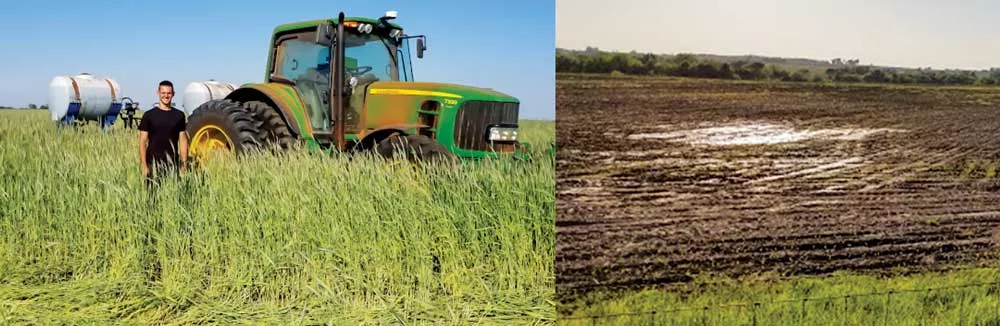
EARLY SEASON MOISTURE. What a difference a cover crop can make. On the left is Josh Payne in his field on the day of planting, and he says his ground was dry and in good shape. On the right is his neighbor’s tilled field on the same day, visibly soaked with standing water.
PLANTING GREEN — defined as planting into a living cover crop that is terminated either immediately before or sometime after planting — is becoming increasingly popular as a tool for letting cover crops benefit soils as long as possible.
Because there is a learning curve involved with the practice, some growers who haven’t tried it are a little leery over the fear of lost time and money or even crop failure.
Josh Payne, who no-tills 800 acres of corn, soybeans and wheat with his grandpa near Concordia, Mo., recently shared several lessons he learned in the 6 years he’s been implementing the practice on his own farm.
Speaking at the 2020 National No-Tillage Conference earlier this year, Payne explained that one of the most important reasons for planting green is dealing with early-season moisture, which is a common problem in Payne’s area.
To make his point, Payne refers to the two pictures above. The first one shows him on the day he was in his field planting into waist-high standing cereal rye. The ground, he says, “was solid and dry — very good conditions.”
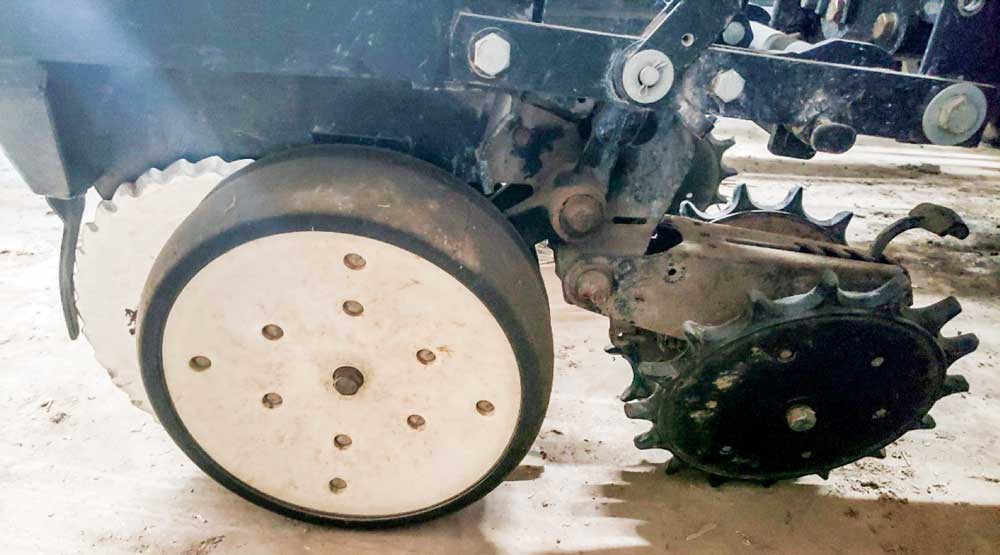
FINDING THE RIGHT SETUP. Setting up row units for planting green takes some experimentation. Here, serrated disc openers help cut through thick residue and spoked closing wheels assist in closing the seed trench.
The other photo shows his neighbor’s tilled field on the same day. The ground was muddy and saturated, with visible standing water.
The advantage of planting green…

Get full access NOW to the most comprehensive, powerful and easy-to-use online resource for no-tillage practices. Just one good idea will pay for your subscription hundreds of times over.
Download these helpful knowledge building tools

We have engineered and developed the most advanced concave system that threshes all crops, eliminates rotor loss, improves grain quality, gives you a cleaner sample – all with one set of XPR concaves.

At Titan International, our product portfolio reflects our commitment to innovation and high-quality products. Titan International offers a full line of solution-focused wheel, tire, and undercarriage products for a wide variety of off-the-road equipment in agriculture, construction, forestry, mining, power sports, high-speed trailers, and outdoor power equipment segments. As one of the largest North American manufacturers, with a network of dealers all over the world, Titan is an industry leader that original equipment manufacturers and operators can count on for durable products and quality service.

Provide expert analysis and decision support to increase productivity and profitability.