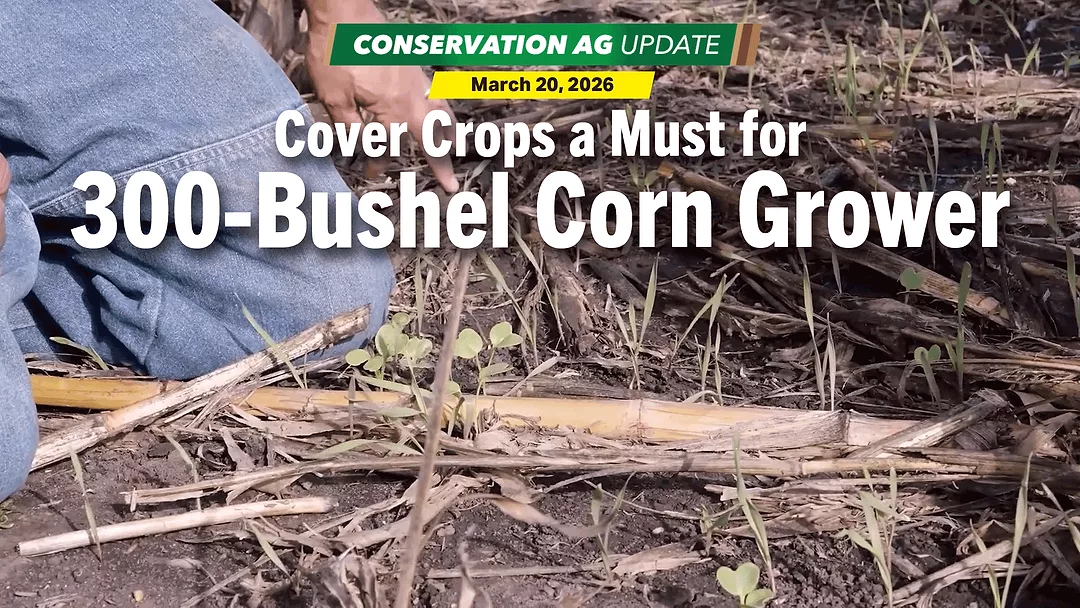
On this episode of Conservation Ag Update, brought to you by Martin-Till, Lake City, Iowa no-tiller/strip-tiller Mark Schleisman shares how cover crops helped his family sweep the NCGA corn yield contest in Iowa last year.
Wisconsin Leopold Conservation Award recipient Michael E. Berg shines light on his family’s conservation practices near the flood-prone Pecatonica River.
In the Cover Crop Connection, Mackane Vogel catches up with No-Till Farmer’s 2026 Conservation Ag Operator Fellow Tony Peirick as he prepares for planting season.
Later in the episode, we head inside AEF Plugfest, where software engineers from competing ag equipment manufacturers test out new high speed ISOBUS technology.
In the Video of the Week, Strip-Till Innovator Chris Perkins checks in from Otwell, Ind., with an update on his first experience with cover crop mixes.
This episode of Conservation Ag Update is brought to you by Martin-Till.
Since 1991, Martin Industries has designed, manufactured and sold leading agriculture equipment across North America and the world. Known for Martin-Till planter attachments, the company has expanded to include a five-step planting system including our floating, air or hydraulic and frame mounted row cleaners along with closing wheel systems, twisted drag chains, fertilizer openers, weight transfer systems and more in their lineup. Their durable and reliable planter attachments are making it possible for more and more farmers to plant into higher levels of residue & cover crops.
TRANSCRIPT
Jump to a section or scroll for the full episode...
- Cover Crops Key to Strip-Tiller’s 300-Bushel Formula
- Farmer Feature: Wisconsin No-Tiller Michael Berg
- Tony Peirick — Digging in to Cover Crops
- Equipment Compatibility Breakthroughs on Display at Plugfest
- Video of the Week: Strip-Till Innovator Experiments with Cover Crops
Cover Crops Key to Strip-Tiller’s 300-Bushel Formula
We begin in Lake City, Iowa, where Mark Schleisman and his family had not 1, not 2, but 3 300-bushel corn yield plots in 2025.
That was good enough for the top 3 spots in the NCGA’s Iowa strip-till irrigated category. But conservation, not high yields, is the name of the game for the Schleismans, who also no-till their soybeans. Mark says he uses a cover crop on 100% of his 5,000 acres.
“Cereal rye is always our base. But we always run a mix as well. We’ll have oats with it if it’s something we’re going to graze heavily in the fall. If it’s not going to get grazed heavily in the fall, we’ll just run rape, sometimes turnips or radishes, but primarily rape with our rye.”
“If it’s a field with a lot of point rows, we’ll go ahead and do it with a drone. If it’s soybean fields that are going to come off early, we have a vertical-till machine set up with an air seeder on front of it. Some of the corn acres, we’ll come in with a high-clearance machine that has an air machine on it as well.”
“Our cover crops honestly our full width tillage — it replaces that. The root system from that rye or the rape and radishes out there, that’s our tillage because you have cover crops growing everywhere. For us, that loosens the soil, opens it up, creates the channels for the water to infiltrate. We just think it does everything for us.”
A mix of cereal rye and rapeseed was grazed on Schleisman’s 317-bushel, contest-winning plot. He terminated the covers about 5 days before planting.
Farmer Feature: Wisconsin No-Tiller Michael Berg
Now to hilly southwest Wisconsin, where Michael E. Berg received the prestigious Leopold Conservation Award for his long-term commitment to soil health practices.
The Bergs do everything they can to prevent their limited topsoil from reaching the flood-prone Pecatonica River, which weaves through their 540 acres of cropland. The family’s dedication to conservation ag all started with Michael’s father, Byron Berg, who installed contour strips to prevent erosion in 1952 and always told his kids, “We don’t really own the land. We’re just taking care of it for the next generation.”
The biggest part of his life was installing good conservation knowledge and benefits for this farm and to make sure that his son and daughters knew conservation was important.
“We grow alfalfa grass; we just started growing fescue on the bottoms next to the Pecatonica River. We also grow corn and soybeans. The corn is for our steers. We’ve installed terraces along our row crop lands on parts of the farm and waterways because lots of places maybe get 6 inches of rain in a year, we might get 6 inches in a day and we can’t afford to lose a half inch, let alone any soil. That’s why we try to make sure we have no-till planting and/or grass and alfalfa on these hills, so we have near zero soil erosion.”
Berg is the founder of the Pecatonica Pride Watershed Association, bringing together outdoors enthusiasts, farmers and landowners to improve the river and inspire others to embrace conservation practices.
Tony Peirick — Digging in to Cover Crops
This year’s No-Till Farmer Conservation Ag Operator Fellow is Watertown, Wis. no-tiller Tony Peirick. Tony has been using cover crops and practicing no-till on his farm for decades. Let’s watch as Tony grabs a shovel from his truck and digs into a field of cover crops to check out the soil structure.
“Start seeing it. Yeah, that's what you want. Here's your soil texture. Yeah, there really isn't. Well, if the cover's out there, you keep it living. A few years ago, our group did a weekly check on living on cover crops and rye. And our crop consultant did it, had to break the frost every week and he checked the root depth. It's growing every day of the year in the winter. It doesn't stop growing. The roots were deeper and deeper and deeper every week you did it, but you can just see the root structure. How does this look compared to maybe ... I don't know how long you've had this field, but- Oh, it's been for over 10 years or more. So has it changed a lot? Oh yeah. All the soils is just ... We used to remember on that ... We used to not own that farm until the 80s, that 80 over there came right away.
“Then we used to plow it back in the ... Oh, that'd be early 90s already. We took it over in 84. And it could have been the late 80s, but it was so hard. We rotory hold it two to three times to get the corn out of the ground. Well, we weren't educated. I was like 10 years old, I was running a disc and disk it three times and have a real nice soft soil. And we didn't know any better. You wanted to sink in that deep. Oh, that's going to absorb all the water. And then turn to nothing concrete. And that over there was just like ... There's no color compared to what this is now that ... But that's what you want, that soil aggregation.”
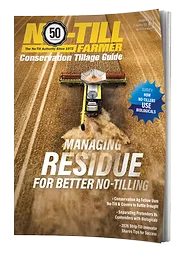
Be sure to check out the first installment of the four-part print series on Tony Peirick, which is featured in the May edition of the No-Till Farmer Conservation Tillage Guide and can also be found at no-tillfarmer.com.
Equipment Compatibility Breakthroughs on Display at Plugfest
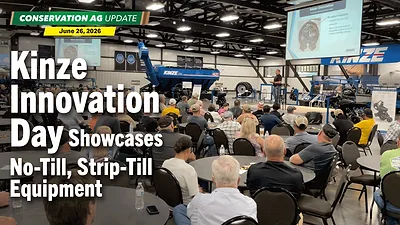
Software engineers from different ag equipment companies put competition aside and came together under one roof to test the cross-brand interoperability of their products.
It’s called Plugfest. Hosted by the Agricultural Industry Electronics Foundation, the 3-day event in downtown Milwaukee is like speed dating for tractors and implements to see if they’re compatible in mixed fleets. AEF is working on a new High Speed ISOBUS (HSI) system that’s roughly 4,000 times faster than the current ISOBUS technology. This could pave the way for real-time data, high-definition cameras, complex sensors, autonomous control and more.
“We want higher levels of automation. We want to move towards autonomous systems because we just don’t have enough operators to keep things going. This is one of the significant paths that’ll help with both of those. First, that higher performance. And today, a high-speed planter, somewhere around 10-12 mph, is a pretty rough ride, unless you have a fantastic suspension. But if the operator wasn’t there, could it go 15-18 mph and achieve equal or even better performance with HSI? We’ll see. I think we’ll find out in the coming years.”
David says the goal is to have HSI 1.0 ready by 2028.
Video of the Week: Strip-Till Innovator Experiments with Cover Crops
Time now for our Video of the Week. This one comes to us from our good friend Chris Perkins in Otwell, Ind. When I visited the Strip-Till Innovator a couple years ago, he wasn’t using cover crops. But Chris is an innovator because he’s always willing to try new things. Fast forward to 2026, he’s giving cover crops a try. And so far, Chris likes what he sees.
“Rapeseed 2 pounds, spring oats at 15 and barley at 15 last fall. We spread it with our John Deere 4045R. It did a fantastic job. We had to make a bunch of adjustments on it, go down to 50 feet for our spread pattern. We let it germinate and we strip-tilled it last fall. She is taking off now. I don’t know what I’m doing here. Me and cover crops, I don’t want to say I put them down, but I never agreed with the philosophies. I’m a fool for it because I never tried it. How can I knock something I never did?”
Chris says the fibrous root system is impressive. And he says if you have any helpful tips or pointers, send them his way. Look forward to seeing Chris at the Strip-Till Conference this August in Springfield, Ill.
That’ll do it for this week’s episode. Story idea? Shoot me an email at Nnewman@Lessiter Media.com. Thanks for watching. Until next time, for more stories visit no-tillfarmer.com, striptillfarmer.com and covercropstrategies.com.